
Jahnava Nitai Das
-
Posts
4,026 -
Joined
-
Last visited
-
Days Won
2
Content Type
Profiles
Forums
Downloads
Gallery
Events
Store
Everything posted by Jahnava Nitai Das
-
When and how long did Vyasa appear?
Jahnava Nitai Das replied to dna's topic in Spiritual Discussions
Vyasa is a post changed every chatur-yuga. Valmiki (the author of Ramayana) was himself a Vyasa for his millenium. Next chatur-yuga, Ashvathama, the childhood friend of Arjuna, will hold the post of Vyasa. Vyasa is an empowered incarnation of the Lord. Vishnu empowers a living entity to carry out the work of compiling the Vedic scriptures. -
Hinduism actually has no single founder as far as the modern history is concerned. The ancient scriptures of India claim the religion is originally established by God Himself (dharman tu sakshad bhagavat pranitam). From the scriptural viewpoint, this religion or dharma, manifests after every creation by the will of the Lord. After the present cyclical creation, the Supreme Lord Narayana instructed the first living entity within the universe, Brahma, in the matters of religion. Brahma in turn instructed this same science to his son, Narada, who in turn passed this knowledge on to his disciple Vyasa Mahamuni. In this way the ancient religion has been passed down in a chain of disciplic succession directly from God for countless millions of years. This Vedic religion is therefore known as sanatana dharma, or the "eternal religion", for it predates all man-made conceptions of time and space. We should not confuse this sanatana dharma with any sectarian religious faith, for the true sanatana dharma is the very function of the soul, as inseparable as liquidity from water. The modern word "Hinduism" is a term developed approximately 700 years ago by the Muslim invaders of India. There was a river by the name Sindhu, which was mispronounced by the invaders as Hindu. All people living beyond that river, regardless of their religious beliefs, were called as Hindus. Thus some may mistakenly conclude that it is possible to trace out the historical origins of the ancient religion of India based on the historical use of this word. We should know that in the ancient "Hindu" scriptures we will not find the word Hindu mentioned even a single time, but instead we will find the words sanatana-dharma (eternal religion), vaidika-dharma (religion of the Vedas), bhagavata-dharma (religion of God), etc. This dharma is ever fresh and eternal. It is stated in the Vedic scriptures that whenever this message of dharma is lost, God Himself will incarnate to reestablish it: yada yada hi dharmasya glanir bhavati bharata abhyutthanam adharmasya tadatmanam srijamy aham "Whenever and wherever there is a decline in religious practice, O descendant of Bharata, and a predominant rise of irreligion - at that time I descend Myself to reestablish it." (Bhagavad Gita 4.7) One such incarnation of the Supreme was that of Lord Krishna, who appeared 5,000 years ago to reestablish dharma by speaking the Bhagavad Gita on the battlefield of Kurukshetra. In the Vedic history, there are countless saints who have come and propagated the ancient teachings found in the Vedic literatures, but none can be called as the founder. Each one was a disciple of another guru, and each one was passing on the same knowledge as had been taught to him by his guru. This is the Vedic system - there is no founder, because everyone is first and foremost a disciple. Dharma cannot be man-made, for it is defined as the direct instructions of God - dharman tu sakshad bhagavat pranitam. Yours in service, Jahnava Nitai Das, Bhaktivedanta Ashram & Bhaktivedanta International Charities http://www.foodrelief.org
-
Dear Sri Kumar, Thank you for submitting your question about Gayatri mantra. Gayatri is actually a Vedic meter (chanda) and does not refer to a particular mantra. There are numerous mantras that fall into the category of Gayatri. Practically every deva has a unique Gayatri mantra. There is a Gayatri mantra for Surya, for Ganesha, for Durga, and even a Nandi gayatri for Lord Shiva's bull. The Gayatri mantras are to be recited at least three times a day, corresponding to the three sandhyas or transitions of the day. Generally when people refer to Gayatri mantra they are refering to the Surya gayatri, which begins with "om bhur bhuvah svah...", etc. This mantra is very powerful for increasing mental abilities, but there are many rules and regulations for chanting it. Among mantras, the nama-mantras (mantras made of the names of a deity) are easier to chant and bring about much quicker results. The nama-mantras do not have so many rules and restrictions for chanting, and are therefore open to all people. Examples of the nama-mantras are "sri rama jayam", "hare krishna mantra", etc. Ultimately all mantras receive their power from the names of the deities, thus many people choose to directly recite the sahasra-namas (thousand names of the deity) instead of a particular mantra. Yours in service, Jahnava Nitai Das, Bhaktivedanta Ashram & Bhaktivedanta International Charities http://www.foodrelief.org
-
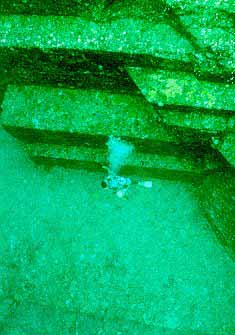
Yonaguni: the Underwater Pyramids of Japan
Jahnava Nitai Das replied to dasa's topic in Most Interesting Threads
The identical spacing between one step and the next clearly shows it is not a random occurence. Its amazing how far some scientists will go to avoid accepting evidence of ancient civilizations. [Note: some more updated photos add to this thread below.]






-
Swaminarayan- Krshna incarnation?
Jahnava Nitai Das replied to Prahlad's topic in Spiritual Discussions
Funny how the direct statements of Gita, where Krishna clearly refers to Himself with words like "Me" and "I" actually refer to a Swami Narayana whose name isn't found in any scripture and who was born a few hundred years ago. -
Lord's creation of material world...
Jahnava Nitai Das replied to vsdprasad's topic in Spiritual Discussions
Another relevant message: How did the soul deviate form the Lord? http://www.indiadivine.com/ubb/Forum11/HTML/000020.html -
Buddhist Mental Poison vs. Aim of Life
Jahnava Nitai Das replied to Tirisilex's topic in Spiritual Discussions
They are of the same category, with the difference being that one is being regulated through dharma, or religion. By association with religion, there is hope that the regulated attachement will eventually be given up. If that essence of dharma is lost, then even the regulated attachment acts to degrade one further. The four aims of life (dharma, artha, kama and moksha) are not recommended aims. The only factual aim of life is to be resituated in one's constitutional spiritual position through self-realization. Being conditioned and subject to illusion, humanity manufactures these four aims of life, thinking they will satisfy the self. Thus they have been termed as purusharthas, or "the welfare of humanity". Factually these aims are material and do not satisfy the soul, which is situated beyond all material causes and effects. Just as one may use a thorn to remove another thorn stuck in one's foot, so it is possible through regulation to utilize these external aims of life to gradually purify oneself. By keeping dharma as the center, all of one's endeavours for enjoyment (kama) and accumulation of wealth (artha) become purified, less binding and less harmful to the universe and oneself. Thus it is recommended in the scriptures, that rather than engage in unregulated activities of attachment, it is better to filter one's attachment through dharma (or religious activities). In this way there is hope of gradual future advancement through purification. [This message has been edited by jndas (edited 07-21-2002).] -
Lord's creation of material world...
Jahnava Nitai Das replied to vsdprasad's topic in Spiritual Discussions
Please see this message, near the bottom: http://www.indiadivine.com/ubb/Forum11/HTML/000053.html -
Is advaita a genuine vedic tradition?
Jahnava Nitai Das replied to karthik_v's topic in Spiritual Discussions
I can give you verses from the shruti that tell that food is the source of ultimate happiness, immortality, etc., or that prana is the absolute truth, or that the mind is supreme, etc. You should learn to read the various levels of analysis. -
http://www.geocities.com/mahaksadasa/index.html Sri Jatayu, the Vulture King, is a friendly site that does not bother to hassle devotees regardless of their particular school. The author tells stories, sings songs, and has a few articles of topical nature, and guest articles as well.
-
http://www.bvml.org/ The Bhaktivedanta Memorial Library (BVML) website is a reference library of articles and some on line books, about Gaudiya Vaisnava siddhanta and tattva,based on the teachings of predecessor acaryas and their contemporary disciples The BVML is dedicated to all the Bhaktivedantas of our guru-parampara. A compilation of articles by: Srila Sanatana Goswami, Srila Bhaktivinode Thakura, Sri Srila Bhaktisiddhanta Saraswati Thakura, Sri Gaudiya Kanthahara, Srila Bhakti Prajnan Kesava Maharaha, Srila Hrydaya Bon Maharaja, Srila Bhakti Rakshak Sridhar Maharaj, Srila Dayita Madhava Maharaja, Srila Bhakti Kumud Santa Maharja( soon to be added) Srila Bhakti Promod Puri Goswami, Srila A.C.Bhaktivedanta Swami Maharaja, Srila Bhaktivedanta Narayana Maharaja, Srila Gour Govinda Maharaja, Srila B.B. Bhodayan Maharaj (soon to be added) as well as several other Vaisnavas, and their contemporary disciples.
-
Please post each website as a separate thread, so that people can see the name of the website in the title. It will help in the future when people just want to quickly scan the subjects looking for sites to visit.
-
Use this forum for posting links to interesting websites. Websites may be about any subject provided they are non-offensive. Please post a single website per message (do not post lists of websites). This will make it easier for readers to choose websites based on the subject of the post.
-
Use this forum for advertising any products or services you may be offering.
-
We added two new categories to the forums: The Friendly Marketplace For community members to advertise their products and services. Recommended Websites For posting interesting links or advertisements for your own website. [This message has been edited by jndas (edited 07-20-2002).]
-
Is advaita a genuine vedic tradition?
Jahnava Nitai Das replied to karthik_v's topic in Spiritual Discussions
Or maybe no one replied to the points in his texts so he decided it was pointless to reply further? -
Increasing human population in kali yuga- a paradox ?
Jahnava Nitai Das replied to vsdprasad's topic in Spiritual Discussions
A general request to all: Please do not post links that some may find as offensive or repulsive. [Message with link deleted.] [This message has been edited by jndas (edited 07-18-2002).] -
The form of God according to Quran
Jahnava Nitai Das replied to Avinash's topic in Spiritual Discussions
Maybe someone can start a thread on the shaivite roots of Islam. There are some interesting articles on this topic. -
Buddhist Mental Poison vs. Aim of Life
Jahnava Nitai Das replied to Tirisilex's topic in Spiritual Discussions
Yes, there are very similar teachings found in the Gita: tri-vidham narakasyedam dvaram nashanam atmanah kamah krodhas tatha lobhas tasmad etat trayam tyajet "There are three gates leading to this hell--lust, anger and greed. Every sane man should give these up, for they lead to the destruction of the soul." And elsewhere Lord Krishna states: vita-raga-bhaya-krodha man-maya mam upasritah bahavo jnana-tapasa puta mad-bhavam agatah "Being freed from attachment, fear and anger, being fully absorbed in Me and taking refuge in Me, many, many persons in the past became purified by knowledge of Me--and thus they all attained transcendental love for Me." -
Increasing human population in kali yuga- a paradox ?
Jahnava Nitai Das replied to vsdprasad's topic in Spiritual Discussions
Thats a very interesting point. Poverty itself leads to overpopulation, which leads to further poverty. -
Is advaita a genuine vedic tradition?
Jahnava Nitai Das replied to karthik_v's topic in Spiritual Discussions
The point that seems to be missed is that Gaudiya Vaishnavas do not deny the existent of the impersonal absolute. They accept he absolute truth in three features, namely Brahman, Paramtama and Bhagavan. Thus showing an Upanishad that speaks about the divinity of the impersonal absolute is irrelevant. What is relevant is showing evidence that the personal form of God, Bhagavan, is ultimately illusory and not eternal - a key concept of advaita-vada. You may have missed krishna_s reply to this point. Madhva and Ramanuja both accept rudra to refer to Narayana. The context of the Upanishad clearly establishes that. Vishnu Purana states all names are names of Narayana because He is the empowerer behind all qualities. In the Gita Krishna establishes the same principle, that all oppulences are His vibhutis. Thus names such as Indra, Rudra, Varuna, etc., refer primarily to Vishnu, and refer to others only on a secondary level. Simply finding the name 'rudra' used in an Upanishad does not establish that Shiva is the supreme entity. This again does not establish an impersonal absolute. These same statements are made throughout the Gita, that Krishna is the maintainer and foundation of everything, that He is in everything, yet everythign is not within Him: maya tatam idam sarvam jagad avyakta-murtina mat-sthani sarva-bhutani na caham tesv avasthitah "By Me, in My unmanifested form, this entire universe is pervaded. All beings are in Me, but I am not in them." na ca mat-sthani bhutani pasya me yogam aisvaram bhuta-bhrn na ca bhuta-stho mamatma bhuta-bhavanah "And yet everything that is created does not rest in Me. Behold My mystic opulence! Although I am the maintainer of all living entities, and although I am everywhere, still My Self is the very source of creation." It can still be taken quite literally when we understand that He is everything. The (our) hands, feet and heads within the existence are His, yet they are not Him. His height of 10 iches refers to the Paramtama who is meditated on as 10 inches tall by the yogis. And He is present everywhere both as the Paramtma (who has entered every atom and the hearts of the atmas) and as the foundation of existence, brahman or brahmajyoti. Having said this, I really don't see this discussion going anywhere, as I don't believe either side is reading the posts in this thread. -
Increasing human population in kali yuga- a paradox ?
Jahnava Nitai Das replied to vsdprasad's topic in Spiritual Discussions
All of the Puranas and Itihasas revolve around the theme of cyclical ages, where different qualities manifest in different ages. There are even different methods of self-realization prescribed for the different ages based on the qualification of the inhabitants. Within these different ages, there are sub waves of the other yugas. This is a concept you will find explained nicely in the writings of Sri Aurobindo. It is based on this that Aurobindo predicts the coming of a Golden Age within the Kali Yuga. If we even look at the last five thousand years of history, or even the last 20 years, we will clearly see there has been rapid degradation in society, both morally and spiritually. Just see the types of things that are shown on Television today compared to 20 years ago. Compare the habits of the teens of today with those of teens from previous decades. Degradation of culture and society is a fact. If we extend our vision farther, then the same pattern emerges, but on a larger scale. [This message has been edited by jndas (edited 07-16-2002).] -
You can view the movies with "Windows Media Player", which is built in to Windows. But you would need to download the movie clips to your hard drive. Windows Media Player is located here: Start Button-->Programs-->Accessories-->Entertainment-->Windows Media Player Then just open the video file.
-
Is advaita a genuine vedic tradition?
Jahnava Nitai Das replied to karthik_v's topic in Spiritual Discussions
But it also speaks of dvaita, which is why Gaudiya vaishnava's accept bheda-abheda, oneness and difference. The Bhagavatam does not support pure nondualism, nor the concept that avataras are brahman covered by Sattva guna (i.e. illusion). -
In Bengal and Orissa these initiations by family priests are as common as upanayanam in South India, yet they are not only reserved for the higher casts. It is just a ritualistic ceremony with little spiritual meaning. The brahmanas in Orissa and Bengal eat fish. Their rituals are not signs of a spiritual vows or commitment. Thus I wouldn't give much importance to Bhaktivinoda Thakur's initiation ceremony, regardless of whether it occured before or after him having given up eating fish (if he did indeed eat fish!). A lot of these things are based on non-established points. For the sake of argument I am just accepting that what other people have said here is true. It would probably be better if someone posted Bhaktivinoda Thakur's own statements about him eating fish.