
Guruvani
-
Posts
5,105 -
Joined
-
Last visited
Content Type
Profiles
Forums
Downloads
Gallery
Events
Store
Posts posted by Guruvani
-
-
 <table width="100%"><tbody><tr><td align="left" valign="top" width="100%"> Geometry > Projective Geometry > General Projective Geometry
 <table border="0" cellpadding="0" cellspacing="0"> <tbody><tr><td class="title" valign="baseline">Projection</td></tr><tr><td valign="top">
 </td><td></td></tr> </tbody></table> </td></tr><tr valign="top"><td width="100%">

A projection is the transformation of points and lines in one plane onto another plane by connecting corresponding points on the two planes with parallel lines. This can be visualized as shining a (point) light source (located at infinity) through a translucent sheet of paper and making an image of whatever is drawn on it on a second sheet of paper. The branch of geometry dealing with the properties and invariants of geometric figures under projection is called projective geometry.
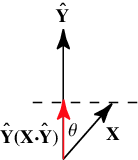
The projection of a vector
 onto a vector
  is given by
 <table style="padding-left: 50px;" align="center" cellpadding="0" cellspacing="0" width="100%"> <tbody><tr><td align="left">
 </td></tr> </tbody></table>
 where
 is the dot product, and the length of this projection is
 <table style="padding-left: 50px;" align="center" cellpadding="0" cellspacing="0" width="100%"> <tbody><tr><td align="left">
 </td></tr> </tbody></table>
 General projections are considered by Foley and VanDam (1983).
The average projected area over all orientations of any ellipsoid is 1/4 the total surface area. This theorem also holds for any convex solid.
</td></tr></tbody></table>

-
This purport by Srila Prabhupada explains nicely that the spiritual body is something that must be developed and attained. The wording in this purport clearly shows that the spiritual body has to be developed by the spiritual spark. The spirit spark must develop a spiritual body through devotional service.
Otherwise, like the Mayavadis, the spirit spark remains without a spiritual body as a spark of the brahmajyoti.
Śrīmad Bhāgavatam 2.2.17 purport,
For the impersonalist the ultimate goal or destination is the brahmajyoti of the spiritual sky, but for the devotees the ultimate goal is the Vaikuṇṭha planets. The devotees experience the above-mentioned state of affairs by attainment of spiritual forms for activity in the transcendental loving service of the Lord. But the impersonalist, because of his neglecting the association of the Lord, does not develop a spiritual body for spiritual activity, but remains a spiritual spark only, merged in the effulgent spiritual rays of the Supreme Personality of Godhead.So, this is the original situation of the living entities who are simply spirit sparks in the brahmajyoti.
They have no spiritual body.
The spiritual body is DEVELOPED through devotional service, otherwise the spirit spark has no secret, hidden, sleeping spiritual body laying around Vaikuntha like a zombie.
The Vaikuṇṭha planets are also forms of eternity, bliss and knowledge, and therefore the devotees of the Lord, who are admitted into the abode of the Lord, also get bodies of eternity, bliss and knowledge."Get bodies" is far from reviving a comatose spiritual body.
"Get bodies" means that they didn't have one so they "get bodies" for entering into Vaikuntha.
-
Whoa. What an asisine statement. Projection is an extremely well know phenomena in pyschology. One can debate the proper application of it but deny it's existence is rather foolish.
I didn't deny they that the theory exists.
I have heard it many times before.
I still think it is an asinine concept.
-
It's a psychological phenomenon known as projection...well documented.
I have never read of any such thing in the shastra.
That sounds like some rubbish theory you learned from some academic idiot whoud couldn't find his own ass if his life depended on it.
"projection"?
What an asinine concept.
-
Give us a break, Guruvani.
Big deal, so his disciples cite his pre-ISKCON accomplisments.
If I remember correctly, there is a statement somewhere in the books of Srila Prabhupada that says that no endeavor should be made to understand the pre-devotee life of a great devotee.
That is one of the things that many devotees object to about Satsvarup's biography of Srila Prabhupada.
I don't think it is proper to probe into the history of a devotee before he became a devotee.
One famous Hare Krishna guru was a drug smuggler and drug dealer.
But, I don't see him or his followers including that in his accolades.
I don't see any difference.
Whether one was an NFL star or a drug dealer they are all the same - karmi life non-devotional nonsense.
I was drawn to the website with some books of Maharaja that are currently being advertised on the dandavats web site.
As I looked around I browsed into the "about Danavir Goswami" section and was just a little put-off with his volleyball history being included in the brief biography of his life.
When a person becomes a devotee be becomes a new person, a different person.
I don't consider that the valleyball champ from Santa Cruz was Danavir Goswami.
That was Dane Holtzman, a non-devotee sense enjoyer that didn't have a spiritual master or a spiritual life.
To include that in the description of "Danavir Goswami" just seems really awkward and improper to me, a person that has always respected and admired Danavir DAS Goswami.
By the way, why did he drop the DAS from his title name?
-
I find this bit fascinating. I haven't run across the Druze very often. They are supposed to be fairly secretive about their beliefs. One of my co-workers is Druze from Lebanon; that's how I became aware of their existence.
http://en.wikipedia.org/wiki/Druze
Danavir Maharaja trained me up as a new bhakti in L.A. in 1975.
I have always admired him.
He has even been to my house here in Floria.
However, I think his followers are a bit off track when they post his accomplishments as a karmi non-devotee as the glories of Danavir Maharaja who is definitely more deserving of accolades beyond and above his glories as a non-devotee sense enjoyer in illusion.
-
About Danavir Goswami

Danavir Goswami (Dr. Dane Holtzman) was born in Los Angeles in 1949. He studied sociology and economics at the University of California, Los Angeles (UCLA). While there he excelled in athletics and was selected the Most Valuable Player of 1970 (indoor volleyball) by the National Collegiate Athletics Association (NCAA) and won the international 2-man beach volleyball tournament at Santa Cruz.
http://www.rvc.edu/about_danavir_goswami.html

-
-
Who cares?
I care.
Millions of people care.
All parents care that their children will have to live through such a disaster.
Most people care.
Only a few brainwashed cult fanatics say they don't care.
Vrindavan is not far from the Pakistan Border.
What if Vrindavan becomes a battleground?
I care.
Many people care.
Anybody with half a brain should care if the Earth becomes victimized by the war between evil powers.
Any person with a little compassion and concern for the plight or mankind should care.
War doesn't help anything.
So, why should we be so cavalier about war?
The world doesn't need war.
The world needs God consciousness.
If people are struggling just to survive they don't have any time to cultivate God consciousness.
That is why culture is useful and valuable to mankind.
It regulates human society so that there is time to cultivate God consciousness and a peaceful life of self-realization.
I care.
I have kids that I don't want to have to live through a global conflict.
If you don't care then you must be some single person involved in a cult that has you brainwashed.
Most normal thinking people care.
They care very much.
-
But, the question this topics concerns is if in Goloka there are different gradations of souls as marginal, internal etc.
Are Rupa Manjari and other ragatmika devotees of Vrindavan "marginal jivas" with the potential to fall down because of misuse of their free will?
Are the ragatmika devotees of Vrindavan fallible jivas who potentially can fall down and become worms in stool in the material world?
If they are marginal jivas then of course it means that they are potentially fallible.
If they are internal energy then of course they are infallible.
Are some devotees in Goloka marginal jivas while others are not?
Or,
Śrī Caitanya Caritāmṛta Madhya 19.154, purport:<!-- BEGIN TEMPLATE: bbcode_quote --> Quote:
<table border="0" cellpadding="6" cellspacing="0" width="100%"> <tbody><tr> <td style="border: 1px solid rgb(102, 102, 102); padding-left: 3ex; padding-right: 3ex;" bgcolor="#e0e0e0"> Everything in the Goloka Vṛndāvana planet is a spiritual expansion of sac-cid-ānanda. Everyone there is of the same potency — ānanda-cinmaya-rasa. </td> </tr> </tbody></table>
<!-- END TEMPLATE: bbcode_quote -->
-
It appears that the ragatmika role models are the original devotees of Vrindavan who are themselves the examples of the different types and styles of service that can be rendered to Krishna in different loving exchanges.
A devotee should never think that he has become the ragatmika.
The devotee should always aspire to simply follow the real ragatimika devotees who are the group leaders of all the different devotees of Vrindavan.
Devotional perfection can never be attained until one is mature and developed enough to naturally practice raganuga sadhana in the wake of one of the ragatmika parishads of Vrindavan.
The idea of just waking-up in Vrindavan to svarupa-siddhi is not possible.
One must eventually become mature and developed enough in his devotional sentiments that he naturally adopts raganuga sadhana by focusing on the ragatmika role model in Vrindavan he most appreciates.
In the Rupanuga Gaudiya camp that role model is most generally perceived to be Rupa Manjari.

-
How do you know when you are one with Krishna?
You don't.

-
pujala ragapata gaurava bhange
Friday, June 22nd by Swami BV Tripurari | No comments
I came across this explanation of the meaning and history of Bhaktisiddhanta Saraswati Thakura’s famous pujala ragapata gaurava bhange statement. It sheds some new light on it. This is an unedited informal speech of Pujyapada Sridhara Maharaja. Read it over.
“His (Bhaktisiddhanta Saraswati Thakura’s) whole life in a nutshell is expressed in this, his own expression. Pujala ragapata, the very nature of my sampradaya is this. Pujala ragapata gaurava bhange. matala harijana visaya range, pujala ragapata gaurava bhange. The whole tenor of his preaching expedition, pujala ragapata gaurava bhange. The ragapat is above, on our head. That is the goal. We are to go there. But before that you have got charm for many things, the grandeur. You should try to learn that what is at present charming to you, utilize that for the service of that great domain of love. The majesty, the awe, the wealth, the reverence, what is grand to you, what attracts you most, all these, put into the service of that Lord of love and beauty. The absolute is beauty and love, harmony, autocrat, and everything should be sacrificed for Him. Learn this! Whatever you come in connection with sacrifice into the fire to establish that Lord of love. For his little satisfaction, all this grandeur may be put into the fire.
“Composed by Guru Maharaja himself. When from the hired house in Calcutta. The deities and the matha was removed to his own construction, constructed matha . The deities were carried in a chariot and we were dancing and we were dancing and singing just in front of the deities. At that time he composed some eight lines perhaps. You should sing this and direct the chariot from the hired house to our own house, matha. Matala hari jana visaya range pujala ragapata gaurava bhange. It is currently seen that the devotees have made themselves mad in handling so many material wealth. Generally the devotees should engage themselves in the subject of the Lord, but here in Gaudiya Matha we find they are handling money, motor car, this, that, everything here, lavishly, visaya range. For what purpose, pujava ragapata gaurava bhange to show that the ragapata, giving up everything and only through the internal love we shall worship the Lord not external sources, majesty, reverance not necessary. But here they have come to do this they are handling extensively the wealth and their of the outer world, what is the meaning?
“Gaurava bhange - to show that the ragapata is above all, those that are followers of raga-pata their position is very high. Not that they can not be masters of this mundane world. So, they have left everything and are taking the path of worshiping Him, in their heart. Not that. But all these grandeur, all reverence everything should go to serve them. Pujava ragapata - everything will havgot its fulfillment with their connecting in any way with the feet of those that are engaged in their worship exclusive of these worldly things with his heart. And only the flow of devotion from their heart they are doing. And the whole thing will have its fulfillment if that can connect to worship the feet of those that are living in that plane. The fulfillment of the majesty, awe and reverence, wealth everything. His grandeur is only meant to serve them, those niskincana, those who do not have anythlng on the gopi, and mentally they are reaching or not reaching. Who do not care for that. But all these must be meant to have their fulfillment to go to touch their feet. To exemplify to show, to teach to the world the fulfillment of everything is only to touch the feet of those niskincana who have made the absolute good, the Lord of love and beauty the all in all in their right.
“The whole world must learn for its own goodness for its own welfare to teach this to the world. The Gaudiya Matha people are handling all these things, the motor car, the wealth, the money, the airplane. While in Bombay one gentleman, a Bengali, was an officer in the mint there he asked me, You have come to collect money but you are very big man, very rich man, he told me. Yes we say we are rich and we say we are beggar. Now we must come to some understanding. You say that we are very rich. Why? We spend money like water. A man who has got much money he can spend his money for such purposes. And we being beggar we use, ordinary man would agree this is superfluous money otherwise a beggar man must not spend money for such purpose. One who has got a crore, he can throw some thousand for the luxurious activities. So you think we have got much money so one day we can see. But we say we are beggar with no money. Still we spend money in such a way. Now the question will come whether what we spend will be for a good purpose or bad. Suppose a doctor, he may not be wealthy, he has got a motorcar. Because he can attend many patients thereby this is not his luxury. Generally men will think that one who has got a car, one who has got a plane, he must be a money man of higher order. Then only he can keep such things. But for the business purpose he may keep such things. A doctor may have many patients he can visit by motorcar. We also use things in that way that with these things … One thing, to decorate the deity, you may think that this is superfluous. But we think this is the fulfillment of life. Every good things must come to decorate, to serve Narayana. That is our creed. Difference in creed. Beggars we are, still we spend money like water. Only for decoration, festival, distribution of prasadam. We beg money and we spend, lavishly, but not for our but we feel the necessity of our particular nature. So the question how we spend not how much money we have got. We are poor still we are beggar, Still we spend money like a rich man. Rather the rich man would be afraid to spend money like that. Pujala ragapata gaurava bhange. All wealth has got its only fulfillment in the service of those to preach the creed of those that are above this monetary world. The greatest goal possible by worshiping the Lord and connecting him with this world. Pujala ragapata. He has understood what is real ragapata. With this idea I have gotten such attraction; with this we have got encouragement within him. They are dancing, I have seen. I have had a sort of conception of the reality that he is good and beautiful and they are dancing. . Pujala ragapata gaurava bhange. What is proper expressions they have understood, they have realized and they are dancing. Krsna nama ruci habe gucibe vandana doyale nitai caitanya bole nace amar mana.” (Srila Sridhara Maharaja)
-
Śrī Caitanya Caritāmṛta Madhya 22.152
rāgamayī-bhaktira haya 'rāgātmikā' nāma
tāhā śuni' lubdha haya kona bhāgyavān
SYNONYMS
rāga-mayī — consisting of attachment; bhaktira — of devotional service; haya — is; rāgātmikā — spontaneous love; nāma — the name; tāhā śuni' — hearing this; lubdha — covetous; haya — becomes; kona bhāgyavān — some fortunate person.
TRANSLATION
"Thus devotional service which consists of rāga [deep attachment] is called rāgātmikā, spontaneous loving service. If a devotee covets such a position, he is considered to be most fortunate.
-
Śrī Caitanya Caritāmṛta Madhya 22.150
paramāviṣṭatā bhavet
sātra rāgātmikoditā
SYNONYMS
iṣṭe — unto the desired object of life; svā-rasikī — appropriate for one's own original aptitude of love; rāgaḥ — attachment; parama-āviṣṭatā — absorption in the service of the Lord; bhavet — is; tat-mayī — consisting of that transcendental attachment; yā — which; bhavet — is; bhaktiḥ — devotional service; sā — that; atra — here; rāgātmikā-uditā — called rāgātmikā, or spontaneous devotional service.
TRANSLATION
"'When one becomes attached to the Supreme Personality of Godhead, his natural inclination to love is fully absorbed in thoughts of the Lord. That is called transcendental attachment, and devotional service according to that attachment is called rāgātmikā, or spontaneous devotional service.'
PURPORT
This verse is found in the Bhakti-rasāmṛta-sindhu (1.2.272).
-
This verse explains:
Śrī Caitanya Caritāmṛta Madhya 22.149rāgātmikā-bhakti — 'mukhyā' vraja-vāsi-jane
tāra anugata bhaktira 'rāgānugā'-nāme
SYNONYMS
rāgātmikā-bhakti — spontaneous devotional service; mukhyā — preeminent; vraja-vāsi-jane — in the inhabitants of Vraja, or Vṛndāvana; tāra — that; anugata — following; bhaktira — of devotional service; rāgānugā-nāme — named rāgānugā or following after spontaneous devotional service.
TRANSLATION
"The original inhabitants of Vṛndāvana are attached to Kṛṣṇa spontaneously in devotional service. Nothing can compare to such spontaneous devotional service, which is called rāgātmikā bhakti. When a devotee follows in the footsteps of the devotees of Vṛndāvana, his devotional service is called rāgānugā bhakti.
PURPORT
In his Bhakti-sandarbha, Jīva Gosvāmī states:
tad evaḿ tat-tad-abhimāna-lakṣaṇa-bhāva-viśeṣeṇa svābhāvika-rāgasya vaiśiṣṭye sati tat-tad-rāga-prayuktā śravaṇa-kīrtana-smaraṇa-pāda-sevana-vandanātma-nivedana-prāyā bhaktis teṣāḿ rāgātmikā bhaktir ity ucyate. . . . tatas tadīyaḿ rāgaḿ rucyānugacchantī sā rāgānugā.
When a pure devotee follows the footsteps of a devotee in Vṛndāvana, he develops rāgānugā bhakti.
-
My war theory is a little different.
It doesn't start between India and Pakistan.
It starts between Israel and Iran.
The middle-east become a battleground.
Oil production is severely interrupted in the middlde-east.
Russia gets behind Iran.
USA behind Israel.
They fight it out in the middle-east.
Then Pakistan gets in the mix.
India gets in the mix.
Russia, Pakistan and Iran bring down India.
The evil alliance spreads towards Europe.
Nato fights it out with the Russian alliance.
Europe gets hammered.
Russia brings troops off the border of China to fight in Europe.
The Chinese see the time is ripe to invade Russia and get the territory they desperately need.
It's nuclear nightmare time.
China and Russia annihilate Each other with nukes.
The western world survives to live in a radioactive nightmate and die a slow horrible death from radiation contamination of the entire planet.
A few people survive in bunkers and start to rebuild the human race after several years of struggle.
Aliens come to Earth and say "We tried to warn you".

-
God is on top of the mountain.
But he sends his messenger below
to spread the wonderful message
I'll beam you up when you're ready to go
-
Śrī Caitanya Caritāmṛta Ādi 6.104
śāstrera siddhānta ei, — vijñera anubhava
mūḍha-loka nāhi jāne bhāvera vaibhava
SYNONYMS
śāstrera — of the revealed scriptures; siddhānta — conclusion; ei — this; vijñera anubhava — realization by experienced devotees; mūḍha-loka — fools and rascals; nāhi jāne — do not know; bhāvera vaibhava — devotional opulences.
TRANSLATION
This conclusion of the revealed scriptures is also the realization of experienced devotees. Fools and rascals, however, cannot understand the opulences of devotional emotions.
PURPORT
When a person is liberated in the sārūpya form of liberation, having a spiritual form exactly like Viṣṇu, it is not possible for him to relish the relationship of Kṛṣṇa's personal associates in their exchanges of mellows. The devotees of Kṛṣṇa, however, in their loving relationships with Kṛṣṇa, sometimes forget their own identities; sometimes they think themselves one with Kṛṣṇa and yet relish still greater transcendental mellow in that way. People in general, because of their foolishness only, try to become masters of everything, forgetting the transcendental mellow of servitorship to the Lord. When a person is actually advanced in spiritual understanding, however, he can accept the transcendental servitorship of the Lord without hesitation.
-
I enjoyed the video.
Classic Goswami Maharaja katha.
I would love to have available more regular such video sanga with Goswami Maharaja.
I was disappointed when his website went off the web.
I always read all his article published on the website by Hasyapriya prabhu.
-
I enjoyed the video.
Classic Goswami Maharaja katha.
I would love to have available more regular such video sanga with Goswami Maharaja.
I was disappointed when his website went off the web.
I always read all his article published on the website by Hasyapriya prabhu.
-
Living entity refers to the sparks of the brahmajyoti, not to the liberated devotees of Vaikuntha.
This needs to be understood or so many misunderstandings arise from the sayings of Srila Prabhupada.
A devotee does not refer to another devotee as 'living entity".
It would be rude and improper.
-
In this purport, Srila Prabhupada specifically refers to the jiva-shakti - marginal potency as the spirit sparks of the brahmajyoti.
When shastra refers to marginal potency it is refering not to servitors in Vaikuntha but to the spirit sparks of the brahmajyoti who are simply on the lowest platform of shanta-rasa in an impersonal conception of reality.Śrī Caitanya Caritāmṛta Ādi 5.40 purport,
<!-- BEGIN TEMPLATE: bbcode_quote --> Quote:
<table border="0" cellpadding="6" cellspacing="0" width="100%"><tbody><tr><td style="border: 1px solid rgb(102, 102, 102); padding-left: 3ex; padding-right: 3ex;" bgcolor="#e0e0e0"> The activities in the spiritual sky are manifested by the internal potency in pure spiritual existence. They expand in six transcendental opulences, which are all manifestations of Mahā-sańkarṣaṇa, who is the ultimate reservoir and objective of all living entities. Although belonging to the marginal potency, known as jīva-śakti, the spiritual sparks known as the living entities are subjected to the conditions of material energy. It is because these sparks are related with both the internal and external potencies of the Lord that they are known as belonging to the marginal potency.</td></tr></tbody></table>
The devotee servitors of Vaikuntha are never referred to as living entities.
The jiva-shakti is the sparks of the brahmajyoti.
All the souls who are liberated servitors of Vaikuntha are manifested not by the jiva-shakti but by the svarupa shakti.
That is why Vigraha and his likes are so confused because he thinks that all the references to "living entities" refers to all the liberated souls of Vaikuntha when in fact it is simply in reference to the jiva sparks of the brahmajyoti.
“The fact is the individual living entities are eternally part and parcel of the Supreme Lord, and both of them are very intimately related as friends. But the living entity has the tendency to reject the sanctions of the Supreme Lord and act independently in an attempt to dominate the supreme nature, and BECAUSE HE HAS THIS TENDENCY; he is called the marginal energy of the Supreme Lord. " BG 13.23 pp.This above statement refers to the jivas manifested in the Viraja by Maha-Vishnu and who reject his instructions to come to the light of the spiritual world but instead become enamored by the glittter of the material energy.
This statement has nothing to do with the liberated pure devotees of Krishna in the spiritual world.
It refers only to the marginal jivas who are manifested in the marginal line between the spiritual and material energies.
-
Śrī Caitanya Caritāmṛta Ādi 5.40 purport,
The activities in the spiritual sky are manifested by the internal potency in pure spiritual existence. They expand in six transcendental opulences, which are all manifestations of Mahā-sańkarṣaṇa, who is the ultimate reservoir and objective of all living entities. Although belonging to the marginal potency, known as jīva-śakti, the spiritual sparks known as the living entities are subjected to the conditions of material energy. It is because these sparks are related with both the internal and external potencies of the Lord that they are known as belonging to the marginal potency.When the jiva is no longer related with the external potency, then how can he be called marginal?
Śrī Caitanya Caritāmṛta Madhya 19.154, purport:
<!-- BEGIN TEMPLATE: bbcode_quote --> Quote:
<table border="0" cellpadding="6" cellspacing="0" width="100%"> <tbody><tr> <td style="border: 1px solid rgb(102, 102, 102); padding-left: 3ex; padding-right: 3ex;" bgcolor="#e0e0e0"> Everything in the Goloka Vṛndāvana planet is a spiritual expansion of sac-cid-ānanda. Everyone there is of the same potency — ānanda-cinmaya-rasa. </td> </tr> </tbody></table>
<!-- END TEMPLATE: bbcode_quote -->

Questions About War
in Spiritual Discussions
Posted
It's easy to be cavalier and cold about war unless and until it is your situation that is disrupted and displaced by the war.
It is easy to talk big about "who cares", until the war comes to your house.
Then, the reality of war hits home and "who cares" becomes "I hate war".