
Jahnava Nitai Das
-
Posts
4,026 -
Joined
-
Last visited
-
Days Won
2
Content Type
Profiles
Forums
Downloads
Gallery
Events
Store
Everything posted by Jahnava Nitai Das
-
Rather than worry about hollow rituals that no one understands and have no bearing on our lives, why not spend a week and read through the Bhagavad Gita to understand what Hinduism actually is. In the Gita Krishna states, "Knowing this nothing remains to be known." It is the greatest of all knowledge and the king of all secrets (raja-vidya raja-guhyam). All rituals are for the purpose of increasing our spiritual knowledge of the self (atma). Without coming to such an understand, such rituals are useless; like dead bodies without souls.
-
Seeing as you are not following the Hindu dharma (of ahimsa and vegetarianism), there is little conflict you will face. Religion is probably not a high priority in your life anyway, but for social conventions you can learn to follow her principles. Some principles are better than nothing. Hinduism and Islam are generally not compatible for those seriously following their respective paths. For others who do not regard their religion or culture much, there is little conflict that will occur (as they are usually just ritualistic followers).
-
What is the Gauranga Dharma...
Jahnava Nitai Das replied to Starman's topic in Spiritual Discussions
Does anyone here actually believe Srila Prabhupada would be happy or wanted initiated devotees to be able to choose to chant just four rounds of Hare Krishna mahamantra if they chanted more rounds of Nityananda Gauranga? It's a great thing to chant the names of Mahaprabhu and Nityananda, but they shouldn't claim it has anything to do with Srila Prabhupada. In case anyone has not seen him before, you can see a picture of Swami Gaurangapad here: http://vyasapuja.gaurangadharma.org/ -
What is the Gauranga Dharma...
Jahnava Nitai Das replied to Starman's topic in Spiritual Discussions
There is no contradiction. Srila Prabhupadapada says even those who chant "Nitai Gaur Radhe Shyam Japa Hare Krishna Hare Rama" attain spiritual ecstasy despite the mantra being a sahajiya concoction, so what then of chanting the bonafide names of Gouranga and Nityananda. What is the guru aparadha is when someone is a follower of Srila Prabhupada, yet refuses to take the humble position of disciple and does not follow what he taught. Srila Prabhupada has given a sadhana that will be followed by all of his disciples and grand disciples. Any follower of Srila Prabhupada who wants to manufacture his own system of sadhana while neglecting Srila Prabhupada's personal example and instructions is an offender to Srila Prabhupada. Since Swami Gaurangapad is not a follower or disciple of Srila Prabhupada he is not offending Srila Prabhupada (though misusing Srila Prabhupada's name may be another case). Being a follower of Srila Prabhupada doesn't mean you say Prabhupada is a great guy, it means being humble and following his order. For those following Srila Prabhupada's teachings, it is offensive to disregard his instructions and manufacture another process of sadhana. You should ask your guru why Srila Prabhupada condemned his disciples for chanting Panchatattva mantra on japa beads. If he cannot explain the scientific reason why, then that means he is not qualified or knowledgeable enough to decide which mantras can and cannot be chanted on japa beads for sadhana. Last time I saw his answer he admited he did not know why Srila Prabhupada condemned it. -
What is the Gauranga Dharma...
Jahnava Nitai Das replied to Starman's topic in Spiritual Discussions
Yet Srila Prabhupada never had any of his disciples chant anything on japa beads except the Hare Krishna maha-mantra. In fact he chastised his disciples for manufacturing a process of sadhana different than what he taught: "Who is that rascal sannyasi who has recommended to chant Pancha Tattva mantra on the japa beads? First, send me his name. I hope this meets you in good health. Your ever well wisher, A.C. Bhaktivedanta Swami There is nothing wrong with chanting the pancatattva mantra (or the nityananda gouranga mantras) on japa beads (as They accept no offenses) except for one thing: It's a speculation and a deviation from Srila Prabhupada's personal instructions on sadhana, a guru aparadha. That in and of itself is enough reason to reject it. To propagate it as though it was Srila Prabhupada's personal instruction or desire that everyone would perform this sadhana is misleading and quite offensive to Srila Prabhupada. If it were so he would have had his disciples do it. Certainly his disciples were coming from the most fallen backgrounds, yet he gave them the Hare Krishna maha-mantra. It is a fact that this is not the sadhana that Srila Prabhupada taught, regardless if you can find several quotes in his writings glorifying the chanting of Mahaprabhu's names. To say anything else is just a sign that one has not studied Srila Prabhupada's life and teachings enough. I am happy to see people chanting the names of Mahaprabhu and have nothing bad to say about the Swamiji who teaches this path. It is a great path and will certainly bring spiritual advancement to the practitioners. But it is not the path and sadhana taught by Srila Prabhupada, whom I follow. Srila Prabhupada was always extremely angry when his disciples would try to change the simple process of Krishna consciousness that he gave us. When some sannyasi tried suggesting that we needed to chant the panchatattva mantra on japa beads (since we are all the most fallen), Prabhupada replied, "Who is this rascal." Not because the Pancatattva mantra cannot be chanted on japa beads, but because some rascal wanted to distort the pure message and instructions that Srila Prabhupada had given everyone - all in the name of Srila Prabhupada himself. -
Christ and Krishna - the Name is the Same
Jahnava Nitai Das replied to a topic in Spiritual Discussions
In Orissa in many rural villages they sing "Hare Krishta". Previously I thought it could have been a "trick" by Prabhupada, but after hearing it I realized it was factual. -
Urine Therapy treatment for cancer
Jahnava Nitai Das replied to a topic in Ayurveda, Health and Wellbeing
I am no expert on urine therapy, and I am not sure if it will work for serious cases as you have described. But this is what I know: It shouldn't be done in connection with western medicine, as the urine will contain high concentration of the medicines you take. I would not suggest anyone stop taking western medicine to try this. Even better than taking one's own urine is taking the urine of a baby calf. This will have a much greater effect on sickness. Whether or not it will work in the case you have described I cannot say, but it is certainly worth a try. -
the RAma in the Maha Mantra.
Jahnava Nitai Das replied to KrishnaBhakta's topic in Spiritual Discussions
When you use words like "silent" and "not pronounced" it means no sound is made. This isn't the case with "raama". The "ma" is clearly pronounced, though not as "maa". Both Hindi and Sanskrit are written in devanagari script, but Hindi is not read the same as Sanskrit. So though the word may be written the same, it is read as "Raam" in Hindi and as "Raama" in sanskrit. Since the name is actually sanskrit, the correct pronunciation is the second. The same is the case for nearly all sanskrit words imported into Hindi. -
the RAma in the Maha Mantra.
Jahnava Nitai Das replied to KrishnaBhakta's topic in Spiritual Discussions
"Ramo" is due to bengali pronunciation, just as "Ram" is due to Hindi pronunciation. In Orissa they chant "Hare Krushna". Thus its not just a matter of George Harrison pronouncing it in a particular way. Hundreds of millions of Indians "mispronounce" the mahamantra as well, but the Lord isn't looking for their perfect pronunciation. The Lord is looking only for their devotion. Since the original mantra is in sanskrit, we should try our best to chant the mantra as it is meant to be pronounced, but imperfect pronunciation is no fault in the chanting of the Lord's name. -
the RAma in the Maha Mantra.
Jahnava Nitai Das replied to KrishnaBhakta's topic in Spiritual Discussions
The second "a" is only silent in Hindi, not in sanskrit. In sanskrit all syllables are pronounced. North Indians generally mispronounce these sanskrit words and names due to their familiarity with Hindi. Thus they have a tendency to say "raam" instead of "raama". -
The story of Brahmaa visiting Krishna in Dwaraka
Jahnava Nitai Das replied to a topic in Spiritual Discussions
I believe it is in the Chaitanya Charitamrita. I don't have time to look up the verse numbers at present, but will try latter. -
Actually there is no such saying in the Gita. The Bhagavad Gita predates all of these religions by thousands of years. What Lord Krishna does say is that one should give up all so-called religions and simply surrender to Him: sarva-dharman parityajya mam ekam sharanam vraja aham tvam sarva-papebhyo mokshayisyami ma sucah "Abandon all varieties of religion and just surrender unto Me. I shall deliver you from all sinful reaction. Do not fear."
-
There is no answer to give, as he is simply stating what his religious books say. Just because he says souls go to heaven after people die doesn't mean he has defeated the entire concept of reincarnation. It's just his opinion. As far as logic goes, why does a just and merciful God put some people into situations where they can never have a chance to know about Jesus Christ, and thus end up in eternal hell. Take the example of children born deep in the amazon, who never get a chance to know that a Jesus Christ exists. Its no fault of their's, but God decided that they would be born in a place where there are no Christians and thus get a ticket to eternal hell. What about children who die when they are one year old due to some disease? They didn't get to accept Jesus Christ either. What about the children who die in abortions? Do they go to eternal hell as well for not accepting Jesus. They all have the burden of the "original sin" which they must repent for. They didn't accept Christ, so they must suffer forever in hell. What about children born with terrible diseases, abject poverty, in war torn countries, etc. Why is God punishing them for something they never did? Why does God put some of us in rich families, and some of us in poor families. Why does God make some of us healthy and some of us born with horrible uncurable diseases? And after God plays his cruel game of giving random suffering, He blames these small children for not accepting His religion and surrendering to his only son? If God wanted someone to become his follower, why did he make them born in the middle of Afghanistan surrounded by mullahs? And according to this God's view, that boy is supposed to magically accept Jesus Christ and repent otherwise he gets an eternal life of hell and damnation. As long as we do not accept the principles of reincarnation and karma, religion becomes an illogical joke and God becomes a tyrant.
-
test
-
Read this: Karma, Jnana and Bhakti: The Three Paths of the Vedas http://www.indiadivine.org/karma-jnana-bhakti-yoga1.htm
-
The three primary divisions of yoga in the Gita are karma-yoga, jnana-yoga and bhakti-yoga.
-
Krishna dances with the gopis as well. There are some gurus who use your logic to support the gurus performing rasa lila. Regarding the topic at hand, it should be noted that Bhaktivinoda Thakur, Bhaktisiddhanta Saraswati and Srila Prabhupada all advised against sannyasa for women. Prabhupada even condemned it thoroughly. Furthermore, the scriptures do not support it. Of course if you find some "pure devotee" who tells you its ok, good luck. There have been many such pure devotees come and go.
-
Gita 7.21 is somewhat close, as the devas are devotees of the Lord: yo yo yam yam tanum bhaktah sraddhayarcitum icchati tasya tasyacalam sraddham tam eva vidadhamy aham "I am in everyone's heart as the Supersoul. As soon as one desires to worship the demigods, I make his faith steady so that he can devote himself to some particular deity."
-
Since you have yet to post any evidence to support your view, we will not allow this discussion to continue as it is going (simply based on your word). Either post the evidence for discussion, or this thread will be closed. You imply that you were initiated by Srila Prabhupada, yet you identify yourself as Bhakta Tom. Something is certainly fishy with regards to your story and presentation. You go on to make absurd statements about ISKCON allowing meat eating according to "Vedic principles", when this is certainly not the case.
-
First you speak about how others are ignorant of the Gita because they believe Lord Krishna to be the Supreme Person. You stated that even a casual reading of the Gita would make it clear that their view point is wrong. Yet when presented with substantial evidence from the Gita itself, suddenly you are not interested in discussing the Gita, but instead want to discuss social anomalies in Madhya Pradesh? I think it is obvious you really do not have a clear understanding of the Gita and its message, yet you want to pose as though you know. You laugh at the personalists for their ignorant understanding of scripture, yet oddly enough it is you who are speaking absurdities such as "the supreme trinity of Brahma, Vishnu and Shiva" (something manufactured for 5th grade "World Religions" text books). Bhagavan Sri Krishna is Purushottama, the Supreme Person, and this is echoed on every page of the Gita. Those with a poor fund of knowledge sometimes profess that the Gita speaks of surrender to an unknown, unmanifest divine beyond Krishna. Nowhere in the Gita is such a concept ever introduced. Throughout the Gita Lord Krishna affirms that He Himself is the Supreme Absolute Truth and that surrender to Him is the ultimate goal of life. Great saints such as Ramanuja, Madhva, Vallabha, and Chaitanya have demonstrated practically the application of these divine instructions of the Gita. None of these saints and acharyas have hypothesized an unknown, unmanifest divine beyond Krishna. Krishna's own statements in the Gita are crystal clear and require no speculation as to his intent: sarva-dharman parityajya mam ekam sharanam vraja aham tvam sarva-papebhyo mokshayishyami ma shucah "Abandon all varieties of religion and just surrender unto Me. I shall deliver you from all sinful reaction. Do not fear." Krishna tells to Arjuna, "mam ekam sharanam vraja", "Take Me as your only shelter!" aham tvam sarva-papebhyo mokshayishyami, "I will liberate you from all sinful reactions!" Krishna the Supreme Person, Purushottama, is speaking to Arjuna, the person, and instructing him directly what to do: "Surrender to Me and take Me as your only shelter. I will deliver you!" And Arjuna's conclusion after hearing the Gita: karishye vacanam tava. "I will act according to Your instructions." The concept of an unmanifest impersonal divine beyond Krishna and superior to Krishna is a fairy tale never touched upon in the Gita.
-
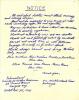
Here is Srila Prabhupada's handwritten instructions to all initiated disciples. Please note that they are required to abstain from eating meat, as well as many other things. http://www.audarya-fellowship.com/download.php?Number=66833 Srila Prabhupada's instructions on this matter are crystal clear in all of his books. We don't need an obscure off topic conversation to try to establish something he never taught.
-
In case you missed the post, I will repost it for your convenience below. Please address these points rather than bringing up completely unrelated topics in an attempt to avoid the actual discussion. You imply that those of us believing Krishna to be the Supreme Person have not read the Gita, nor are we very knowledgeable about history. Please demonstrate your higher learning by addressing these points directly. I could have followed your example and simply replied that "You are evidently no student of the Gita", but I will not resort to this cheap tactic. I will let your own words speak for themselves, and honest readers can decide what is the actual conclusion of the Gita. Regarding your latest reply, what tribals in Madhya Pradesh do, or what Zulus in Africa do is really irrelevant. Those who are sanatana-dharmis accept the authority of the Vedas and regard them as apaurusheya. Right and wrong is not based on one's whims and feelings, but rather on the statements of the Vedas: dharman tu sakshad bhagavat pranitam Dharma is not based on our choice and whim, it is defined as the direct injunctions of God given in the Vedas. As such, sanatana-dharmis accept right and wrong according to the Vedic statements, not according to cultural whims. [Repost about the form of Krishna:] Unfortunately ignorant people misunderstand the Lord's divine birth and appearance and consider him to be an ordinary man: avajananti mam mudha manusim tanum asritam param bhavam ajananto mama bhuta-mahesvaram "Fools deride Me when I descend in the human form. They do not know My transcendental nature and My supreme dominion over all that be." Some people consider Lord Krishna to be a human manifestation, but they fail to understand the Lord's divine nature, His param-bhavam. Throughout the Gita Lord Krishna is referred to as Bhagavan and Purushottama, both of which indicate His divine personality. Purushottama literally means "the Supreme Person". Lord Krishna is eternally the Supreme Personality of Godhead as confirmed throughout the Gita: yasmat ksharam atito 'ham aksarad api cottamah ato 'smi loke vede ca prathitah purusottamah "Because I am transcendental, beyond both the fallible and the infallible, and because I am the greatest, I am celebrated both in the world and in the Vedas as that Supreme Person." Please note that Lord Krishna is celebrated in the Vedas as the transcendental Supreme Person. Nowhere in the Gita does Lord Krishna state his form to be mundane, material, temporary, or ordinary. On the contrary, every verse speaks about his divine transcedental form and personality. Krishna's own words are that he is purushottama, the Supreme Person. Lord Krishna's birth and activities are not material. Lord Krishna states in the Gita that they are divine (divyam). Simply by knowing them one becomes free from the material existence: janma karma ca me divyam evam yo vetti tattvatah tyaktva deham punar janma naiti mam eti so 'rjuna "One who knows the transcendental nature of My appearance and activities does not, upon leaving the body, take his birth again in this material world, but attains My eternal abode, O Arjuna." And simply by remembering Lord Krishna at the time of death one attains the divine abode of Lord Krishna, param dhama. anta-kale ca mam eva smaran muktva kalevaram yah prayati sa mad-bhavam yati nasty atra samsayah "And whoever, at the time of death, quits his body, remembering Me alone, at once attains My nature. Of this there is no doubt." In the Upanishads Lord Krishna's spiritual form is confirmed as follows: sac-cid-ananda-rupaya krishnaya Lord Krishna's rupa (form) is eternal, full of knowledge, and full of bliss. He is not an ordinary human manifestation as the ignorant proclaim. Brahma-ji sings his glory in the Brahma-samhita as follows: isvarah paramah krsnah sac-cid-ananda-vigrahah anadir adir govindah sarva-karana-karanam "Krishna who is known as Govinda is the Supreme Godhead. He has an eternal blissful spiritual body. He is the origin of all. He has no other origin and He is the prime cause of all causes." The great sages Asita, Narada and Vyasa all consider him the Supreme Person: arjuna uvaca param brahma param dhama pavitram paramam bhavan purusam sasvatam divyam adi-devam ajam vibhum ahus tvam rsayah sarve devarsir naradas tatha asito devalo vyasah svayam caiva bravisi me "Arjuna said: You are the Supreme Brahman, the ultimate, the supreme abode and purifier, the Absolute Truth and the eternal divine person. You are the primal God, transcendental and original, and You are the unborn and all-pervading beauty. All the great sages such as Narada, Asita, Devala, and Vyasa proclaim this of You, and now You Yourself are declaring it to me." What is Arjuna's conclusion of Lord Krishna? svayam evatmanatmanam vettha tvam purusottama bhuta-bhavana bhutesa deva-deva jagat-pate "Indeed, You alone know Yourself by Your own potencies, O origin of all, Lord of all beings, God of gods, O Supreme Person, Lord of the universe!" According to Arjuna, Lord Krishna is the God of gods (devadeva), the origin of all (bhuta-bhavana), Lord of all beings (bhutesha), and the Supreme Person, purushottama. And Lord Krishna's conslusion is as follows: yo mam evam asammudho janati purushottamam sa sarva-vid bhajati mam sarva-bhavena bharata "Whoever knows Me as the Supreme Personality of Godhead, without doubting, is to be understood as the knower of everything, and He therefore engages himself in full devotional service, O son of Bharata." One who knows Lord Krishna as the Supreme Person knows everything. Other's, regardless of how educated they may think themselves to be, are in the darkness of avidya. This is the self-evident conclusion of the Gita. No, Vishnu is the supreme Absolute Truth, who is unsurpassed and equaled by none including Brahma and Shiva. Lord Krishna confirms this as follows in the Gita: mattah parataram nanyat kincid asti dhananjaya mayi sarvam idam protam sutre mani-gana iva "O conqueror of wealth [Arjuna], there is no Truth superior to Me. Everything rests upon Me, as pearls are strung on a thread." The Supreme Person (purushottama) Bhagavan Sri Krishna has stated Himself to be the supreme truth. No where does he say some unmanifested higher principle is supreme. Rather He says He Himself is Supreme. Throughout the Gita Lord Krishna uses words such as "I", "Me", "My", etc., yet foolish people conclude that these words do not actually refer to Krishna. Despite no indication anywhere in the Gita, they propose that these words actually refer to something "higher" than Krishna, some unmanifested truth not mentioned anywhere in the Gita. One who reads the Gita with an honest heart will see the self-evident message clearly, that Lord Krishna is the Supreme Truth whom we should surrender to: aham sarvasya prabhavo mattah sarvam pravartate iti matva bhajante mam budha bhava-samanvitah "I am the source of all spiritual and material worlds. Everything emanates from Me. The wise who know this perfectly engage in My devotional service and worship Me with all their hearts." This looks to be something picked up from a 5th grade text book on Hinduism written by an Englishman. The Upanishads state: narayanad brahma jayate, narayanad prajapatih prajayate, narayanad indro jayate, narayanad astau vasavo jayante, narayanad ekadasa rudra jayante, narayanad dvadasadityah. "From Narayana, Brahma is born, and from Narayana, the patriarchs are also born. From Narayana, Indra is born, from Narayana the eight Vasus are born, from Narayana the eleven Rudras are born, from Narayana the twelve Adityas are born." Thus Narayana is clearly established as the Supreme Person. eko vai narayana asin na brahma na isano napo nagni samau neme dyav-aprthivi na naksatrani na suryah sa ekaki na ramate tasya dhyanantah sthasya yatra chandogaih kriyamanastakadi-samjnaka stuti-stomah stomam ucyate. "In the beginning of the creation there was only the Supreme Personality Narayana. There was no Brahma, no Siva, no fire, no moon, no stars in the sky, no sun. There was only Narayana, who creates all and enjoys all" And from the Puranas: narayanah paro devas tasmaj jatas caturmukhah tasmad rudro 'bhavad devah sa ca sarva-jnatam gatah. "Narayana is the Supreme Personality of Godhead, and from Him Brahma was born, from whom Siva was born."
-
Please address the statements of Bhagavad Gita cited above rather than trying to bring up unrelated material.
-
Right and wrong has nothing to do with choice or belief. Those who follow sanatana dharma accept the Vedas as spiritual authority, and thus those doctrines that go against the teachings of the Vedas are rejected. Those who profess a path contrary to the Vedic teachings, while claiming to be based on sanatana dharma, should expect their erroneous views to be challenged and exposed. For example, anyone who would proclaim that there are three supreme beings (Brahma, Vishnu and Mahesh) should not be surprised if someone points out their fallacy. Basing one's belief on western views of Hinduism (from where the concept of the absolute trinity comes) is not a good foundation. And some people firmly believe and trust that by blowing up buildings with truck bombs they are pleasing God. Such belief and trust is meaningless as it is not actually in tune with the will of God. The view that all paths are equal and valid is foolish. A path that is against dharma is not equal to dharma. Any belief that espouses all paths as equal and correct is itself adharma as it encourages adharma in the name of tolerance. Shankara was not tolerant, he debated and defeated all those who objected to his conclusions. The same is the case with Ramanuja, Madhva and other acharyas. Yet the Vedas teach differently. According to the Vedas, those who engage in sinful conduct attain hellish births. Krishna states the following about such demoniac people: yah shastra-vidhim utsrjya vartate kama-karatah na sa siddhim avapnoti na sukham na param gatim "But he who discards scriptural injunctions and acts according to his own whims attains neither perfection, nor happiness, nor the supreme destination." Krishna clearly states that those who do not act according to the Vedic scriptures do not attain the supreme destination. All paths do not lead to the same goal according to the Gita. Those who kill animals are engaging in sinful activity regardless of which religion they claim to follow. Simply because someone is born in a Hindu family does not make them exempt from karmic reaction. The laws of nature will punish all of us for the violence we inflict on others, and Hindus are no exception. Those who live demonic lifestyles, engaging in sinful conduct, are treated in a special way by Lord Krishna: tan aham dvisatah kruran samsaresu naradhaman ksipamy ajasram asubhan asurisv eva yonisu "Those who are envious and mischievous, who are the lowest among men, are cast by Me into the ocean of material existence, into various demoniac species of life." asurim yonim apanna mudha janmani janmani mam aprapyaiva kaunteya tato yanty adhamam gatim "Attaining repeated birth amongst the species of demoniac life, such persons can never approach Me. Gradually they sink down to the most abominable type of existence." This displays complete ignorance of the laws of karmic reaction which are the foundation of Hindu philosophy. God does not determine who is born in a rich or poor family, who is born in a Christian or Hindu family, etc. Our own past actions have determined our present situation, thus our birth is our own choice and fault. Just as one born as an animal or tree has little chance to engage in dharma, so some humans born in other cultures also have little chance to perform true dharma. Those who are sincere in their heart will be guided by the paramatma to the right path. According to the Gita it is one out of many thousands who will perform true dharma, thus we should not be surprised if the majority of the world is engaged in adharma. As a sanatana-dharmi I follow the path of the Vedas. Dharma is not about what is convenient and easy, it is about what is right and true.
-
Unfortunately ignorant people misunderstand the Lord's divine birth and appearance and consider him to be an ordinary man: avajananti mam mudha manusim tanum asritam param bhavam ajananto mama bhuta-mahesvaram "Fools deride Me when I descend in the human form. They do not know My transcendental nature and My supreme dominion over all that be." Some people consider Lord Krishna to be a human manifestation, but they fail to understand the Lord's divine nature, His param-bhavam. Throughout the Gita Lord Krishna is referred to as Bhagavan and Purushottama, both of which indicate His divine personality. Purushottama literally means "the Supreme Person". Lord Krishna is eternally the Supreme Personality of Godhead as confirmed throughout the Gita: yasmat ksharam atito 'ham aksarad api cottamah ato 'smi loke vede ca prathitah purusottamah "Because I am transcendental, beyond both the fallible and the infallible, and because I am the greatest, I am celebrated both in the world and in the Vedas as that Supreme Person." Please note that Lord Krishna is celebrated in the Vedas as the transcendental Supreme Person. Nowhere in the Gita does Lord Krishna state his form to be mundane, material, temporary, or ordinary. On the contrary, every verse speaks about his divine transcedental form and personality. Krishna's own words are that he is purushottama, the Supreme Person. Lord Krishna's birth and activities are not material. Lord Krishna states in the Gita that they are divine (divyam). Simply by knowing them one becomes free from the material existence: janma karma ca me divyam evam yo vetti tattvatah tyaktva deham punar janma naiti mam eti so 'rjuna "One who knows the transcendental nature of My appearance and activities does not, upon leaving the body, take his birth again in this material world, but attains My eternal abode, O Arjuna." And simply by remembering Lord Krishna at the time of death one attains the divine abode of Lord Krishna, param dhama. anta-kale ca mam eva smaran muktva kalevaram yah prayati sa mad-bhavam yati nasty atra samsayah "And whoever, at the time of death, quits his body, remembering Me alone, at once attains My nature. Of this there is no doubt." In the Upanishads Lord Krishna's spiritual form is confirmed as follows: sac-cid-ananda-rupaya krishnaya Lord Krishna's rupa (form) is eternal, full of knowledge, and full of bliss. He is not an ordinary human manifestation as the ignorant proclaim. Brahma-ji sings his glory in the Brahma-samhita as follows: isvarah paramah krsnah sac-cid-ananda-vigrahah anadir adir govindah sarva-karana-karanam "Krishna who is known as Govinda is the Supreme Godhead. He has an eternal blissful spiritual body. He is the origin of all. He has no other origin and He is the prime cause of all causes." The great sages Asita, Narada and Vyasa all consider him the Supreme Person: arjuna uvaca param brahma param dhama pavitram paramam bhavan purusam sasvatam divyam adi-devam ajam vibhum ahus tvam rsayah sarve devarsir naradas tatha asito devalo vyasah svayam caiva bravisi me "Arjuna said: You are the Supreme Brahman, the ultimate, the supreme abode and purifier, the Absolute Truth and the eternal divine person. You are the primal God, transcendental and original, and You are the unborn and all-pervading beauty. All the great sages such as Narada, Asita, Devala, and Vyasa proclaim this of You, and now You Yourself are declaring it to me." What is Arjuna's conclusion of Lord Krishna? svayam evatmanatmanam vettha tvam purusottama bhuta-bhavana bhutesa deva-deva jagat-pate "Indeed, You alone know Yourself by Your own potencies, O origin of all, Lord of all beings, God of gods, O Supreme Person, Lord of the universe!" According to Arjuna, Lord Krishna is the God of gods (devadeva), the origin of all (bhuta-bhavana), Lord of all beings (bhutesha), and the Supreme Person, purushottama. And Lord Krishna's conslusion is as follows: yo mam evam asammudho janati purushottamam sa sarva-vid bhajati mam sarva-bhavena bharata "Whoever knows Me as the Supreme Personality of Godhead, without doubting, is to be understood as the knower of everything, and He therefore engages himself in full devotional service, O son of Bharata." One who knows Lord Krishna as the Supreme Person knows everything. Other's, regardless of how educated they may think themselves to be, are in the darkness of avidya. This is the self-evident conclusion of the Gita. No, Vishnu is the supreme Absolute Truth, who is unsurpassed and equaled by none including Brahma and Shiva. Lord Krishna confirms this as follows in the Gita: mattah parataram nanyat kincid asti dhananjaya mayi sarvam idam protam sutre mani-gana iva "O conqueror of wealth [Arjuna], there is no Truth superior to Me. Everything rests upon Me, as pearls are strung on a thread." The Supreme Person (purushottama) Bhagavan Sri Krishna has stated Himself to be the supreme truth. No where does he say some unmanifested higher principle is supreme. Rather He says He Himself is Supreme. Throughout the Gita Lord Krishna uses words such as "I", "Me", "My", etc., yet foolish people conclude that these words do not actually refer to Krishna. Despite no indication anywhere in the Gita, they propose that these words actually refer to something "higher" than Krishna, some unmanifested truth not mentioned anywhere in the Gita. One who reads the Gita with an honest heart will see the self-evident message clearly, that Lord Krishna is the Supreme Truth whom we should surrender to: aham sarvasya prabhavo mattah sarvam pravartate iti matva bhajante mam budha bhava-samanvitah "I am the source of all spiritual and material worlds. Everything emanates from Me. The wise who know this perfectly engage in My devotional service and worship Me with all their hearts." This looks to be something picked up from a 5th grade text book on Hinduism written by an Englishman. The Upanishads state: narayanad brahma jayate, narayanad prajapatih prajayate, narayanad indro jayate, narayanad astau vasavo jayante, narayanad ekadasa rudra jayante, narayanad dvadasadityah. "From Narayana, Brahma is born, and from Narayana, the patriarchs are also born. From Narayana, Indra is born, from Narayana the eight Vasus are born, from Narayana the eleven Rudras are born, from Narayana the twelve Adityas are born." Thus Narayana is clearly established as the Supreme Person. eko vai narayana asin na brahma na isano napo nagni samau neme dyav-aprthivi na naksatrani na suryah sa ekaki na ramate tasya dhyanantah sthasya yatra chandogaih kriyamanastakadi-samjnaka stuti-stomah stomam ucyate. "In the beginning of the creation there was only the Supreme Personality Narayana. There was no Brahma, no Siva, no fire, no moon, no stars in the sky, no sun. There was only Narayana, who creates all and enjoys all" And from the Puranas: narayanah paro devas tasmaj jatas caturmukhah tasmad rudro 'bhavad devah sa ca sarva-jnatam gatah. "Narayana is the Supreme Personality of Godhead, and from Him Brahma was born, from whom Siva was born."