
Guruvani
-
Posts
5,105 -
Joined
-
Last visited
Content Type
Profiles
Forums
Downloads
Gallery
Events
Store
Posts posted by Guruvani
-
-
Śrī Brahma-saḿhitā 5.43
goloka-nāmni nija-dhāmni tale ca tasya
devi maheśa-hari-dhāmasu teṣu teṣu
te te prabhāva-nicayā vihitāś ca yena
govindam ādi-puruṣaḿ tam ahaḿ bhajāmi
SYNONYMS
goloka-nāmni — in the planet known as Goloka Vṛndāvana; nija-dhāmni — the personal abode of the Supreme Personality of Godhead; tale — in the part underneath; ca — also; tasya — of that; devi — of the goddess Durgā; maheśa — of Lord Śiva; hari — of Nārāyaṇa; dhāmasu — in the planets; teṣu teṣu — in each of them; te te — those respective; prabhāva-nicayāḥ — opulences; vihitāḥ — established; ca — also; yena — by whom; govindam — Govinda; ādi-puruṣam — the original person; tam — Him; aham — I; bhajāmi — worship.
TRANSLATION
Lowest of all is located Devī-dhāma [mundane world], next above it is Maheśa-dhāma [abode of Maheśa]; above Maheśa-dhāma is placed Hari-dhāma [abode of Hari] and above them all is located Kṛṣṇa's own realm named Goloka. I adore the primeval Lord Govinda, who has allotted their respective authorities to the rulers of those graded realms.
PURPORT
The realm of Goloka stands highest above all others. Brahmā looking up to the higher position of Goloka is speaking of the other realms from the point of view of his own realm: the first in order is this mundane world called Devī-dhāma consisting of the fourteen worlds, viz., Satyaloka, etc.; next above Devī-dhāma is located Śiva-dhāma one portion of which, called Mahākāla-dhāma, is enveloped in darkness; interpenetrating this portion of Śiva-dhāma there shines the Sadāśivaloka, full of great light. Above the same appears Hari-dhāma or the transcendental Vaikuṇṭhaloka. The potency of Devī-dhāma, in the form of the extension of Māyā, and that of Śivaloka, consisting of time, space and matter, are the potency of the separated particles pervaded by the penumbral reflection of the subjective portion of the Divinity. But Hari-dhāma is ever resplendent with transcendental majesty and the great splendor of all-sweetness predominates over all other majesties in Goloka. The Supreme Lord Govinda by his own direct and indirect power has constituted those respective potencies of those realms.
-
-
-
Why don't you read Shiva Purana and Shiva Gita for a change?

Narayana is the Lord of Vaikuntha - the spiritual world.
-
Science is now saying that a cow produces more greenhouse gas everyday than does an SUV.
So, now science is blaming cows for global warming.
Sure, blame it on the cows.
It's not carbon based fuels that is the problem it is them darn cows.

-
if we look into the lives and theories of these scientists we will find volumes and volumes of speculation, fraud, cheating and lies.
these scientists are big time cheaters and liars.
I watch all their latest theories and programs on the science documentaries and all their theories and claims are just laughable and ridiculous.
these scientists are ignorant fools that make a fat salary dreaming-up all these false theories and false science.
really, I don't trust anything these idiots spout-off.
-
We don't accept BSST's or SP's everything as ultimate authority.

This is a compromised position on the position on Lord Shiva, hence doesn't hold much authority.
so, you are saying that Narayana is not the Lord of Vaikuntha?
Where does your book say Siva is Lord of Vaikuntha?
-
Srila Sridhara Maharaja: That will be fair for you, that you will extend it from the ritvik board. Who is already empowered, they will extend, their consideration. They can extend their scope. In this way you move, it will have spiritual characteristic. Do you follow?
Devotee: Yes.
Srila Sridhara Maharaja: These eleven, they will extend themselves. From this point, it will be-the area of the acaryaship will be extended. Then gradually twenty-four or more, but it will spread from this point, extend. Bigger, bigger, bigger. That you may do, to keep the spiritual characteristic of the extension of the Acarya Board.
-
Rtvik is gradually wining in ISKCON circles. Rtvik is a type of guru. One of a slightly lesser status who connects one to the principle acarya.
Srila Sridhar Maharaja once said that the ritvik is the vartma-pradarshaka guru.
That is the guru who shows one the proper path.
Srila Sridhara Maharaja: Everything, everything. And the ritviks are but vartma pradarsaka guru. When he was living, he appointed so many ritviks, representatives, they are really, they are vartma pradarsaka. Do you follow? -
<center> Brahma Samhita chapter 5 TEXT 45
</center>
<center>ksiram yatha dadhi vikara-visesa-yogatsanjayate na hi tatah prthag asti hetohyah sambhutam api tatha samupaiti karyadgovindam adi-purusam tam aham bhajami</center><center> SYNONYMS
</center> ksiram--milk; yatha--as; dadhi--yogurt; vikara-visesa--of a special transformation; yogat--by the application; sanjayate--is transformed into; na--not; hi--indeed; tatah--from the milk; prthak--separated; asti--is; hetoh--which is the cause; yah--who; sambhutam--the nature of Lord Siva; api--also; tatha--thus; samupaiti--accepts; karyat--for the matter of some particular business; govindam--Govinda; adi-purusam--the original person; tam--Him; aham--I; bhajami--worship. <center> TRANSLATION
</center> Just as milk is transformed into curd by the action of acids, but yet the effect curd is neither same as, nor different from, its cause, viz., milk, so I adore the primeval Lord Govinda of whom the state of Sambhu is a transformation for the performance of the work of destruction.
<center> PURPORT
</center> (The real nature of Sambhu, the presiding deity of Mahesa-dhama, is described.) Sambhu is not a second Godhead other than Krsna. Those, who entertain such discriminating sentiment, commit a great offense against the Supreme Lord. The supremacy of Sambhu is subservient to that of Govinda; hence they are not really different from each other. The nondistinction is established by the fact that just as milk treated with acid turns into curd so Godhead becomes a subservient when He Himself attains a distinct personality by the addition of a particular element of adulteration. This personality has no independent initiative. The said adulterating principle is constituted of a combination of the stupefying quality of the deluding energy, the quality of nonplenitude of the marginal potency and a slight degree of the ecstatic-cum-cognitive principle of the plenary spiritual potency. This specifically adulterated reflection of the principle of the subjective portion of the Divinity is Sadasiva, in the form of the effulgent masculine-symbol-god Sambhu from whom Rudradeva is manifested. In the work of mundane creation as the material cause, in the work of preservation by the destruction of sundry asuras and in the work of destruction to conduct the whole operation, Govinda manifests Himself as guna-avatara in the form of Sambhu who is the separated portion of Govinda imbued with the principle of His subjective plenary portion. The personality of the destructive principle in the form of time has been identified with that of Sambhu by scriptural evidences that have been adduced in the commentary. The purport of the Bhagavata slokas, viz., vaisnavanam yatha sambhuh, etc., is that Sambhu, in pursuance of the will of Govinda, works in union with his consort Durgadevi by his own time energy. He teaches pious duties (dharma) as stepping-stones to the attainment of spiritual service in the various tantra-sastras, etc., suitable for jivas in different grades of the conditional existence. In obedience to the will of Govinda, Sambhu maintains and fosters the religion of pure devotion by preaching the cult of illusionism (Mayavada) and the speculative agama-sastras. The fifty attributes of individual souls are manifest in a far vaster measure in Sambhu and five additional attributes not attainable by jivas are also partly found in him. So Sambhu cannot be called a jiva. He is the lord of jiva but yet partakes of the nature of a separated portion of Govinda. (Sri Brahma Samhita, translation by Srila Bhaktisiddhanta Saraswati Thakur Prabhupad.)
<hr width="100%">
-
Guruvani!! Do you even understand the meaning of 'Shambhu'?
Shambu means Swayambhu! One who has emanated out of his own self!
Self born, created by his own self, will and power! Shiva is Swayambhu, Shambhu and Sadashiva. You run after these demarcations, but try reaching any of them!
Sambhu (Sanskrit) [from sam auspiciously, happily + bhu being, existing]
-
Prof. C.S. Mahadev:
i. Brahma, Vishnu, Rudra, Maheswara and Sadasiva are called the Moorthi Panchakam and of these five Sadasiva is Mahavishnu Himself or Lord of the Lords. ii. Of the three Brahma, Mahavishnu and Siva, Mahavishnu alone is the embodiment of Satvika guna, what we need is this consciousness of Satva. iii. Sankara Bagavatapada has emphasized in his Puranasangraha that Lord Mahavishnu's Satya Loka is the seat of Vaikunta where the Lords of Lords dwells. v. Madhavacharya, in his Puranasara says that Vishnu, Siva, Brahma-all mean Mahavishnu. They are not separate but one. The Universality of God is brought out by Madhawacharya.non-ISKCON scholar gives his view.
-
Originally Posted by Beggar
If this is what you've been trying to say then you've been trying to setup some of the posters. What your saying here is totally true. This is why Adwaita Acharya is said to be both Maha Visnu and Sada Siva.
Mahavishnu and Sadasiva are one and the same.
When this Sadasiva deals with maya he becomes Shambhu.
-
"Aum Shanti Shanti Shanti" This, too, is found first in the Upanishads, the call for tranquility, for divine stillness, for Peace everlasting.
yes.... the OM is representing Supreme Brahman.
Peace in Supreme Brahman.........
OM Hari Om
OM Tat Sat
-
Lord Brahma prays to Lord Siva:
Śrīmad Bhāgavatam 4.6.46na vai satāḿ tvac-caraṇārpitātmanāḿ
bhūteṣu sarveṣv abhipaśyatāḿ tava
bhūtāni cātmany apṛthag-didṛkṣatāḿ
prāyeṇa roṣo 'bhibhaved yathā paśum
SYNONYMS
na — not; vai — but; satām — of the devotees; tvat-caraṇa-arpita-ātmanām — of those who are completely surrendered at your lotus feet; bhūteṣu — among living entities; sarveṣu — all varieties; abhipaśyatām — perfectly seeing; tava — your; bhūtāni — living entities; ca — and; ātmani — in the Supreme; apṛthak — nondifferent; didṛkṣatām — those who see like that; prāyeṇa — almost always; roṣaḥ — anger; abhibhavet — takes place; yathā — exactly like; paśum — the animals.
TRANSLATION
My dear Lord, devotees who have fully dedicated their lives unto your lotus feet certainly observe your presence as Paramātmā in each and every being, and as such they do not differentiate between one living being and another. Such persons treat all living entities equally. They never become overwhelmed by anger like animals, who can see nothing without differentiation.
This Siva as Paramatma is the Sadasiva.
Jivas can become Rudras (Siva) if they execute the post of Lord Brahma for 100 lifetimes.
(per Narayana Maharaja)
a Jiva can never become Sadasiva.
-
Thanks.
I found in that page:
namaste....
-
Śrīmad Bhāgavatam 4.6.42
brahmovāca
SYNONYMS
brahmā uvāca — Lord Brahmā said; jāne — I know; tvām — you (Lord Śiva); īśam — the controller; viśvasya — of the entire material manifestation; jagataḥ — of the cosmic manifestation; yoni-bījayoḥ — of both the mother and father; śakteḥ — of potency; śivasya — of Śiva; ca — and; param — the Supreme; yat — which; tat — that; brahma — without change; nirantaram — with no material qualities.
TRANSLATION
Lord Brahmā said: My dear Lord Śiva, I know that you are the controller of the entire material manifestation, the combination father and mother of the cosmic manifestation, and the Supreme Brahman beyond the cosmic manifestation as well. I know you in that way.
PURPORT
Although Lord Brahmā had received very respectful obeisances from Lord Śiva, he knew that Lord Śiva was in a more exalted position than himself. Lord Śiva's position is described in Brahma-saḿhitā: there is no difference between Lord Viṣṇu and Lord Śiva in their original positions, but still Lord Śiva is different from Lord Viṣṇu. The example is given that the milk in yogurt is not different from the original milk from which it was made.
Sambhu is an amsa of Sadashiva.
-
Srila Rupa Gosvami writes in Laghu Bhagavatamrta (43): sadasivakhya tan murtis tamoguna varjita "Unlike the ordinary Siva, Sadasiva is beyond tamo guna."
-
So, the Vaishnavas are interested in the Siva who is free from maya's influence - the Bhakta Siva.
-
-
Śrī Brahma-saḿhitā 5.16
ahańkārātmakaḿ viśvaḿ
tasmād etad vyajāyata
SYNONYMS
ahańkāra — the mundane egotistic principle; ātmakam — enshrining; viśvam — universe; tasmāt — from that (Śambhu); etat — this; vyajāyata — has originated.
TRANSLATION
The function of Śambhu in relation to jīvas is that this universe enshrining the mundane egotistic principle has originated from Śambhu.
PURPORT
The basic principle is the Supreme Lord Himself who is the embodiment of the principle of existence of all entities devoid of separating egotisms. In this mundane world the appearance of individual entities as separated egotistic symbols, is the limited perverted reflection of the unalloyed spiritual (cit) potency; and, as representing the primal masculine divine generative function Śambhu, it is united to the accommodating principle, viz., the mundane female organ which is the perverted reflection of the spiritual (cit) potency, Ramādevī. At this function Śambhu is nothing but the mere material causal principle embodying the extension in the shape of ingredient as matter. Again when in course of the progressive evolution of mundane creation each universe is manifested, then in the principle of Śambhu, born of the space between the two eyebrows of Viṣṇu, there appears the manifestation of the personality of Rudra; yet under all circumstances Śambhu fully enshrines the mundane egotistic principle. The innumerable jīvas as spiritual particles emanating from the oversoul in the form of pencils of rays of effulgence, have no relation with the mundane world when they come to know themselves to be the eternal servants of the Supreme Lord. They are then incorporated into the realm of Vaikuṇṭha. But when they desire to lord it over Māyā, forgetting their real identity. the egotistic principle Śambhu entering into their entities makes them identify themselves as separated enjoyers of mundane entities. Hence Śambhu is the primary principle of the egotistic mundane universe and of perverted egotism in jīvas that identifies itself with their limited material bodies.
-
" harer nama harer nama harer namaiva kevalam
kalau nasty eva nasti eva nasti eva gatir anyatha"
- A Sanskrit verse from Brhan-naradiya Purana which means
"In this age of Kali, there is no alternative, there is no alternative, there is no alternative for spiritual progress other than the chanting of the holy name, the chanting of the holy name, the chanting of the holy name of the Lord."
-
Srila Prabhupada said "you can't buy a ticket to Vrindavan".
Going to Vrindavan is not something you can accomplish at the ticket counter of the Airlines.
The Vrindavan that you go to on the strength of your credit card or bank account is an external mayic form of Vrindavan, not the real thing.
We hear many devotees saying "I am going to Vrindavan" and I already have my plane ticket reserved.
Well, they aren't going to the real Vrindavan. They are going to Vrindavan, India - not Gokula Vrindavan.
Nope, you can't buy a ticket to Vrindavan or Navadvip or any transcendental realm.
But, any place where devotees congregate to glorfy Krishna is Vrindavan.
Realizing that is something else.
-
Now your on to something: You get an A.
so, the check is in the mail?
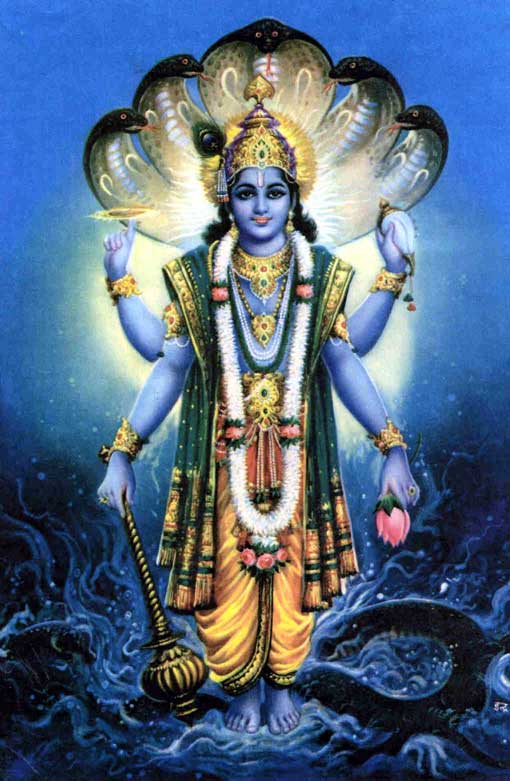
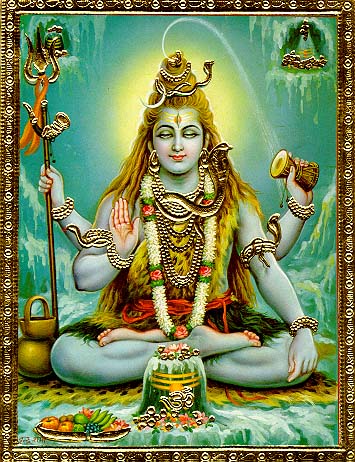
Mother Yahoda Worships Lord Shiva
in Spiritual Discussions
Posted
Did you catch this one Muralidhara?
See what Srila Guru Maharaja says about Siva..........