

krsna
-
Posts
5,715 -
Joined
-
Last visited
Content Type
Profiles
Forums
Downloads
Gallery
Events
Store
Posts posted by krsna
-
-

Where is Maya lurking in this pastime trying to ensnare the'conditioned' soul into taking birth in the Bronx ?
Come on my dear Prabhu's,let's get real and give up once and for all this pre-primary apa-siddhanta thinking ,i.e.,that we got into Maya in Krsnaloka.
Think about,pray about it deeply and you'll see that it was simply a 'white lie' to get us drugged up ex-hippies and ex-judeo christian types hooked on chanting the Holy Names.It was nothing less than Prabhupada's infinite wisdom,compassion and mercy on the fallen souls of Kali-yuga.'Conditioned souls' DO NOT fall from Krsnaloka !
<font color="red"> Out of compassion for the fallen souls, Sri Krisna Caitanya came to this world with His personal associates and divine abode to teach saranagati, surrender to the almighty Godhead, and to freely distribute ecstatic love of God, which is ordinarily very difficult to obtain. This saranagati is the very life of the true devotee
The ways of saranagati are humility, dedication of the self, acceptance of the Lord as one’s only maintainer, faith that Krishna will surely protect, execution of only those acts favorable to pure devotion, and renunciation of conduct adverse to pure devotion.
The youthful son of Nanda Maharaja, Sri Krishna, hears the prayers of anyone who takes refuge in Him by this six-fold practice.
Bhaktivinoda places a straw between his teeth, prostrates himself before the two Goswamis,Sri Rupa and Sri Sanatana, and clasps their lotus feet with his hands. “I am certainly the lowest of men.” he tells them weeping, “but please make me the best of men by teaching me the ways of saranagati” </font color>
-
Prabhupada's Coming (Part 2)
by Paratrikananda dasa
After the morning program everyone would help clean the temple and then we’d all go on sankirtan. We’d cram into one vehicle and drive to a business district or college campus, chanting rounds along the way and trying valiantly to stay awake. Within ten minutes we’d be out cold, but Krsna usually made sure there was at least one conscious person in the vehicle who could wake up the driver.
When we reached our sankirtan spot, we’d scramble out of the van and form a line facing our audience. The men would be stationed at either end of the line with the women in the middle, to insure their safety. A brief pep rally prefaced the chanting as the sankirtan leader called out, “Back to home!” with devotees responding, “Back to Godhead!” We really felt we were going home, and this call and response was repeated three times with escalating enthusiasm. Then the mrdanga came in with a couple bars of pounding rhythm, followed by the sizzle of kartals and prayers to our spiritual master. While chanting, we’d dance in time to the music and in step with one another. Every ten minutes one devotee would address the onlookers with a brief explanation of Krsna consciousness. We’d also chant and dance in procession, moving single file or double file up and down the street while remaining in step with each other. After thirty minutes we’d break into two groups. Half the devotees would continue chanting and the other half would distribute BTGs, trying to get a quarter for each magazine. Every half hour the chanters and distributors would trade places. At that time it was considered a good day for a small temple if the entire sankirtan party distributed two or three dozen BTGs and collected fifteen to twenty dollars. To sell even one hardback book was nothing short of a certified miracle. But later, when we realized Prabhupada’s precedent desire was to distribute his books, we made that our priority and amazing things happened.
In 1971, as book distribution was getting off the ground, an average distributor could easily sell four, five, even six big books a day! And we’d always stuff about twice as many books as we could sell into our canvas book bags, just in case we got lucky. Before the discovery of airports and wigs we’d spend the entire day running door to door in devotional clothing with thirty pounds of Krsna books bouncing off our hips. If we went to the store, ran errands or went out to chant japa, we brought our book bag along and made sure everyone that crossed our path had a chance to know about Krsna. And though sankirtan often meant being ridiculed by the public or harassed by the police, we were determined to please our spiritual master by this service and convinced that Krsna consciousness would take over the world within twenty years. It was exciting and blissful being in the vanguard of Prabhupada’s mission.
While preaching, one of the most frequently heard comments was, “You guys have an answer for everything.” And we did, because we had unshakable faith in Srila Prabhupada. Even if we didn’t know the answer to a challenging question, if we were preaching intrepidly and depending on Krsna, He would provide the answer on the spot. It would come to you like a lightning bolt and you could just stand back and watch in amazement as Krsna used your tongue and your mouth to silence the opposition by revealing something even you weren’t aware of.
We were a handful of youngsters. We had almost no resources. We had almost no experience in spiritual life or in the ways of the world. But we did have Prabhupada as our spiritual master. And this singular asset gave us unabashed confidence to face any adversary -- students, professors, scholars, scientists, politicians, atheists, impersonalists or yogis -- it didn’t matter. Srila Prabhupada made a similar declaration during his morning walk at Cheviot Hills in 1973:
Just like we dare to face any chemist, any scientist, any philosopher. Why? On the strength of Krsna, we believe that "There is Krsna. When I shall talk with him, Krsna will give me intelligence." This is the basics. Otherwise, from qualification, standard, they are very much qualified. We are common laymen before them. But how do we challenge them? Because we know. Just like a small child He can challenge a very big man because he knows, "My father is there." He is catching the hand of the father, and he's sure that "Nobody can do anything to me."
In the evening we’d head back to the temple for prasadam, aratik, and Bhagavad-gita class. And before taking rest we drank hot banana milk and read from Krsna book. We read from each of Srila Prabhupada’s books every day, 6 classes in all -- Bhagavatam, Nectar of Devotion, TLC, Sri Isopanisad, Bhagavad-gita and Krsna book. Reading Prabhupada’s books was paramount ecstasy. He was our absolute authority and practically everything that came out of a devotee’s mouth was prefaced with: “Srila Prabhupada said...”. Everything fell into one of two categories -- bona fide and bogus. All that came from Prabhupada was bona fide and anything else was simply bogus.
During the week, prasadam was served on sheets of wax paper to save money. We ate with our fingers and refrained from conversation while honoring Krsna’s mercy. The lunch staples were rice, capatis and spicy hot dahl. Dahl chaunces were so devastating that when the chaunce pan was flung into a boiling pot of dahl, flames would shoot up, blowing the lid off the pot and filling the kitchen with a dark, pungent cloud that sent everyone scrambling out the door, coughing and wheezing.
When Sunday came around most, if not all, the devotees would stay back to clean and decorate the temple or help prepare the Sunday Love Feast. The kitchen was considered an extension of the deity room and the jurisdiction of Sri Radha. Some devotees would offer obeisances before beginning kitchen service. Karmi clothing and prajalpa were strictly forbidden and only initiated Brahmins could work with the fire. And the word was, Krsna would not accept an offering unless the kitchen was spotless. Pots, utensils and tables were rinsed immediately before use, even if they’d been cleaned minutes prior. We even kept Krsna’s pots shiny on the outside and often spent an hour or more scouring the carbon and rust off the underside of a wok. Preparations were made with utmost care, while struggling to refrain from savoring the aroma of the un-offered food. The entire process was a meditation on pleasing Krsna. Many of these standards were described in a letter Srila Prabhupada wrote to Aniruddha in 1968:
Kitchen should be considered as good as the Lord's room, and nobody should wear shoes in the kitchen, smelling and tasting of foods being prepared for the Lord should never be done, talking within the kitchen should be only what is necessary for preparing the prasadam, or about the Lord…
Daily prasadam was irresistible but Sunday feast prasadam was simply beyond mortal conception -- sweet rice flavored with camphor, butter oozing from the halava, puris puffed like balloons, gulabs exploding in your mouth, saffron rice with fried curd balls, samosas the size of your fist, exotic lassis, fresh milk burfi, crispy golden pakoras, subjis and chutneys so hot your forehead would sweat, and everything floating in puddles of ghee. We always took to our full satisfaction, and then some! After the Sunday lecture we’d have two or three massive plates of prasadam while preaching to guests. When the guests went home we’d finish whatever was left on their plates. When that was gone we’d wipe out whatever was left in the serving containers and pots. And when the prasadam supply was finally exhausted we’d have a kirtan. We knew prasadam was spiritual because it was physically impossible to consume as much as we did. During my first year of devotional service I heard repeatedly, “Prabhupada said new devotees should take so much prasadam that they waddle like a duck.” This was one instruction I took to heart. But later on, when I tried to become more serious about Krsna consciousness, I came to dread Sundays, knowing I wouldn’t be able to control myself during the feast. I felt like a werewolf on a full moon night and once I actually asked Bhakta das, my temple president, to lock me in the office so my senses wouldn’t get the best of me. But he didn’t take me seriously and I remained a servant of my tongue for a long time. Controlling the senses was difficult but at least prasadam was non-different from Krsna. He appeared in this form to help us become attached to Him. In becoming addicted to prasadam we became addicted to Krsna.
Chanting, dancing, feasting and philosophy. This was Lord Caitanya’s movement -- Prabhupada’s gift to the world. And although Krsna Consciousness was sometimes a struggle, it was always wonderful. Perhaps the most wonderful part was how much Prabhupada cared about us despite our deficiencies. We were all lost souls who had given up on God, turned our backs on religion, and rejected the moral standards of our parents. Some of us were drug addicts, some of us were suicidal, and some of us were just crazy. Some of us were even civilized and educated, but none of us had a clue. It was not until we met Srila Prabhupada that we understood the purpose of life. He brought us hope and gave thousands of young hearts a reason to live.
In Prabhupada we realized a gentle father, a trusted friend, an exalted teacher. He guided us beyond the insanity of materialism and offered us the precious gift of devotion to Krsna. In return we were fiercely loyal. At a time when it was fashionable to sport hair below the shoulder, we shaved our heads clean to please him. When sex, drugs and rock ’n’ roll were a way of life, we gave them up because he asked us to. When love and peace were bywords, he taught us to stand and fight for Krsna. When others were preparing for their future, we gave the best years of our lives to him. And although he always directed our love toward Krsna, that made us love him even more. Whenever he would visit our temple and we had a chance to see him, it made all our sacrifices worthwhile. The week prior to his arrival would always turn into a ‘round the clock marathon -- remodeling, painting, cleaning, sewing, decorating, cooking and publicizing the arrival of, “His Divine Grace A.C. Bhaktivedanta Swami Prabhupada, Spiritual Master of the Universe”. The non-devotees had their “Miss Universe” and “Mr. Universe” contests but with Prabhupada there was no contest. He was the undisputed jagad-guru, Spiritual Master of the Universe, and we were proud to announce his arrival that way, no matter how strange or pretentious it sounded to outsiders.
For most of us, physical association with Srila Prabhupada was during guru-puja or Bhagavatam class, and occasionally we’d get a chance to offer some personal service. We were happy to be menial servants of such a great personality, though most of the time our service was in separation. That did not imply, however, that we weren’t greedy for Prabhupada’s physical association. No one could deny there was something magical about being in his presence.
When Prabhupada came to California in the summer of 1972, he spent much of his time in Los Angeles, but he also visited smaller temples in the area to enliven his disciples. I was on a traveling sankirtan party at that time and somehow our itinerary just happened to coincide exactly with Srila Prabhupada’s (hmmm…must’ve been Krsna’s arrangement). Every time Prabhupada landed at an airport or arrived at a temple on his ‘72 west coast tour, we were there to greet him. In Los Angeles, ours were faces in the crowd but with consecutive appearances in a string of smaller temples, those same faces stuck out like sore thumbs. But we had no shame -- we’d do anything to see him. From Southern California to the Pacific Northwest, we were Prabhupada’s unofficial west coast welcoming committee. And Prabhupada didn’t seem to mind. Perhaps because all along the way we were distributing his books -- we didn’t decrease our service.
For Prabhupada’s visit to Portland, the devotees had made accommodations for him in a fancy hotel suite, as the tiny temple facilities were crowded and inadequate. But Prabhupada wanted to be with the devotees and elected to stay at the temple. As no arrangement had been made for him there, he patiently waited for us to prepare a little space. With expeditious devotion, I helped scrub and clean the small room and adjacent bathroom that would serve as His Divine Grace’s quarters during his visit. Prabhupada’s humility and love for us made a deep impression on me.
While Srila Prabhupada was in Los Angeles, I was fortunate to be there also. In the morning he’d go for a japa walk then return to greet the deities and give class. The devotee that first saw Prabhupada’s car in the distance would enthusiastically cry out, “Prabhupada’s coming!,” and the message would quickly echo throughout the temple. This was our curtain call and upon hearing it we’d rush around making final arrangements for the reception of His Divine Grace and the greeting of the Lord. Someone would start a kirtan and we’d form two lines facing each other in front of the temple. When Prabhupada arrived he’d walk between us carrying a basket of flowers. He’d stop in front of each devotee, accept a flower from them, reach into his basket and offer a flower in return (to the best of my knowledge this pastime was unique to Los Angeles). Then he’d proceed to the temple room for darsana.
When greeting the deities, Prabhupada would always offer full dandavats at each altar. As he sat on his vyasasana we’d sing the Guruvastakam prayers and offer flower petals at his feet (the offering of aratik paraphernalia had not yet been introduced). Afterwards he’d lead us in an electrifying version of, “Jaya Radha Madhava” and deliver a brilliant lecture on Srimad Bhagavatam.
And then the grand finale: Kirtan began slow and purposeful like a locomotive leaving the station. Gradually picking up speed, the momentum soared until the energy of hundreds crystallized into a single mass. We were Prabhupada’s army and no force on earth could stop us. The power of serving him was almost more than we could wield. Our enthusiasm could not be contained, and it exploded like a volcano. Chanting and dancing in rampant ecstasy, we affirmed our allegiance and gratitude to our eternal spiritual master, His Divine Grace A.C. Bhaktivedanta Swami Prabhupada.
Inevitably Srila Prabhupada went on to visit other centers in other parts of the world. But even when Prabhupada wasn’t physically present, the devotees in some centers would still relay the “Prabhupada’s coming” mantra throughout the temple when it was time to greet the deities. This was our way of remembering him and making the pain of separation a bit more tolerable.
Although many years have passed, we can still foster this mood today. We can still serve Srila Prabhupada as if his arrival was just around the corner. We can meditate on him traveling and preaching throughout the world or the universe and hope that someday he’ll visit us again. And if we believe and act as if Prabhupada’s coming, he will come. For the only thing that truly separates us from him is our own consciousness.
(To be continued)
-
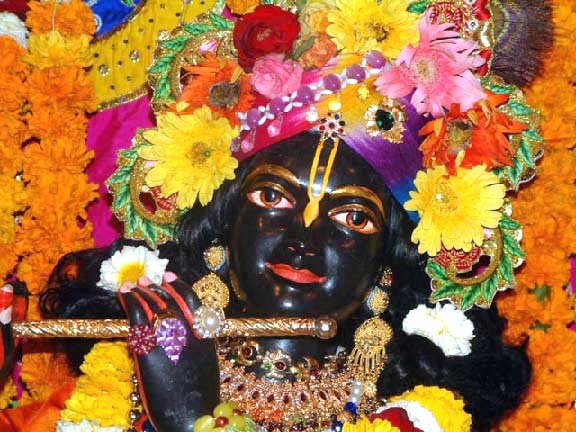
"Dear Lord, when You appear in Your different incarnations, You take different names and forms according to different situations. Lord Krsna is Your name because You are all attractive; You are called Syamasundara because of Your transcendental beauty. Syama means blackish, yet they say that You are more beautiful than thousands of Cupids. Kandarpa-koti-kamaniya. Although You appear in a color which is compared to the blackish cloud, because You are transcendental Absolute, Your beauty is many many times more attractive than the delicate body of Cupid."
(Krsna, The Supreme Personality of Godhead, Chapter 2)
/images/graemlins/cool.gif
-
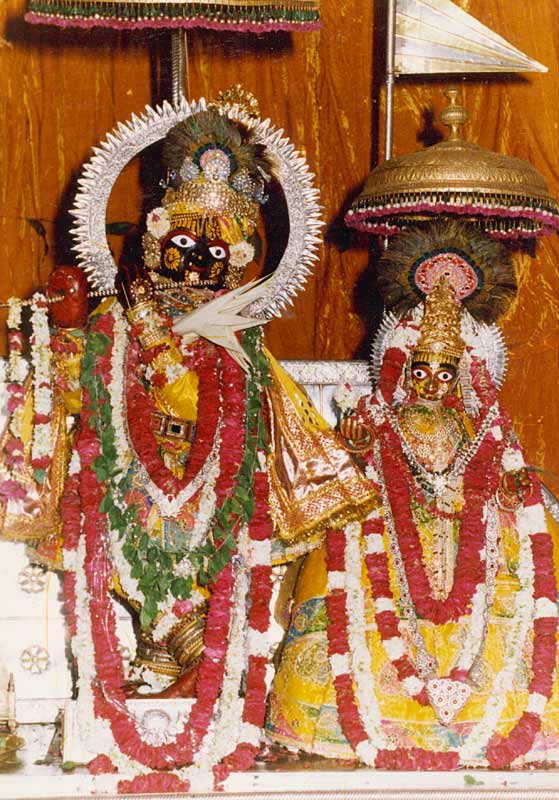
When I think of Sri Radha Govinda my heart melts in devotional ecstasy and I forget this material world !
/images/graemlins/smile.gif
-

Hear No Faults ,See No Faults , Speak no faults .
/images/graemlins/confused.gif
-

Devotee: Can you give some practical advice as far as chanting kirtan and japa?
Vishnujana Swami: Kirtan is to be executed constantly. Lord Chaitanya went through the streets and He invited everyone to join in the sankirtan movement, constantly chanting the holy names of the Lord. So arrangements should be made for the chanting of the holy names of the Lord to go on in every town and village, constantly. In every media -- radio, television, etc. -- chanting should be going on, along with nice dancing and feasting. That's the program.
Then, as far as japa is concerned, one has to chant personally for his advancement in Krishna Consciousness, 16 rounds daily on his beads. There are helps in chanting attentively. One of these helps obviously is simply the beads. The beads are given to you by the Spiritual Master, and you chant Hare Krishna, paying attention to each bead. And this vow of chanting attentively, on each bead, this vow impresses the Supreme Lord. He sees that you are serious, and He gives you realization. It's that simple. You chant in regulation and vow; the Supreme Lord sees, "Oh, he is serious. He's keeping his vow," and then He gives you realization. If you don't chant attentively, if you don't, you're thinking of making the 10 kinds of offenses while chanting, then the Lord will see that you're desiring something else. After all, you can't fool Him -- He's livin g right there within your heart. He knows your desire before you even speak or think. So, if while you're chanting you're committing offenses, thinking of sense gratification, being attached to material objects, then the Lord will know what you really want, and therefore you won't feel the bliss of chanting offenselessly. The Lord won't allow you to feel that, because you are desiring other things. See, the main thing is to realize that "I'm dealing with Krishna." That's the main thing.
That this chanting -- "I'm being with Krishna; therefore I have to be very careful." Krishna can't be fooled like you can fool me. You can easily fool me, that you are chanting attentively, you see. That's easy to fool me because my senses are imperfect... [break] ...Actually, if you see me come in the room and you are thinking something nonsense and doing something nonsense, and immediately you feel ashamed, actually you should feel that way twenty-four hours a day, because Krishna is always there, witnessing. You know how it is that you'll be doing some nonsense and you're thinking that no one is watching. "No one knows what I am thinking." But as soon as your godbrother comes in and suspects you, then immediately you feel ashamed, "Oh, I'm doing something which is not good." Now, the difficulty here is that you don't realize that it's not good for you. It's not that you're offending me; you're hurting yourself -- this is what they don't understand, you see. This means that he doesn't understand that he's hurting himself. So herein lies a great difficulty: there's a blind spot in our consciousness, that we don't know that our actions are directly harming our development in Krishna Consciousness, if we're not humble in dealing with Krishna at every moment. We don't understand that. We don't give that value, you see, we think we're simply socially existing. That if I do some offense, then my godbrother will criticize me and I have to bear his criticism.
No. You're hurting yourself for not realizing that you're dealing with Krishna. That is the worse suffering. That's the worst illusion, you see. Therefore japa is meant as an individual practice of Krishna Consciousness. So that for some time, at least two hours during the day, you stop socially dealing. You understand? You stop socially dealing and you realize that "I am dealing with Krishna." If I make offense in thought, well here's the holy name right on my lips; the Lord is right there, and He is witnessing. You can easily fool me as we're going through the day's activities, if you're looking lustfully on a girl or this or that. That's easy, you see, and if I catch you, you can feel that "Oh, Vishnujana has caught me," or this or that. But the difficulty is that you don't realize that you're dealing with Krishna. Therefore one of the beautiful aspects of japa is it forces you to realize that "When no one else is around, and I'm chanting Hare Krishna, I'm dealing with Krishna." And, "Unless I do it properly, then I'm being offensive to the Lord." There's no one else to hurt but me. I can't hurt Vishnujana, I can't hurt this one, I can't hurt that one, you see. I can't offend them, all I can do is offend God and myself. Therefore, this solitary chanting of japa is also recommended. Japa is done individually. Sometimes I see devotees, they have a collective japa class. No, japa means individually, we are chanting, for two hours. So try to utilize that time, scrutinizingly...
VSN: Bhagavad-gita Class 4.36 - St. Louis, Missouri -- March 27, 1973 >>> Ref. VedaBase => VSN: Bhagavad-gita
-
There are two kinds of instructing spiritual masters. One is the liberated person fully absorbed in meditation in devotional service, and the other is he who invokes the disciple's spiritual consciousness by means of relevant instructions. (Adi 1.47)
Generally a spiritual master who constantly instructs a disciple in spiritual science becomes his initiating spiritual master later on." (Adi 1.35)
"A devotee must have only one initiating spiritual master because in the scriptures acceptance of more than one is always forbidden. There is no limit, however, to the number of instructing spiritual masters one may accept.
"The guru must be situated on the topmost platform of devotional service. There are three classes of devotees, and the guru must be accepted from the topmost class..." (Madhya 24.330) "When one has attained the topmost position of maha-bhagavata (perfected devotee), he is to be accepted as a guru and worshiped exactky like Hari, the Personality of Godhead. Only such a person is eligible to occupy the post of guru." (Madhya 24.330)
"Srila Rupa Goswami advises the devotee to be intelligent to distinguish between the kanistha-adhikari (neophyte), madhyama-adhikari (intermediate), and uttama-adhikari (fully self-realized)...Srila Bhaktivinoda Thakura has given some hints to the effect that an uttama-adhikari vaishnava can be recognized by his ability to convert many fallen souls to Vaishnavism.One should not become a spiritual master unless he has attained the platform of uttama adhikari. A neophyte vaishnava or a vaishnava situated on the intermediate platform can also accept disciples, but such disciples must be on the same platform, and it should be understood that they cannot advance very well toward the ultimate goal of life under his insufficient guidance. Therefore a disciple should be careful to accept an uttama adhikari as a spiritual master." (Nectar of Instruction txt 5)
Unless one is a resident of Krishna Loka, one cannot be a Spiritual Master. That is the first proposition. A layman cannot be a Spiritual Master, and if he becomes so then he will simply create disturbance. (Letter Mukunda 6/10/69)
...sometimes, if a spiritual master is not properly authorized and only on his own initiative becomes a spiritual master, he may be carried away by an accumulation of wealth and large numbers of disciples." (NOD 14 p.116)
As soon as a foolish disciple tries to overtake his spiritual master and becomes ambitious to occupy his post he immediately falls down. (S.B. 5/12/14 P)
The so called spiritual master without sense control is certainly the cheater, and the disciple of such a so called spiritual master is the cheated." (S.B. 2.9.43)
Such cheating gurus should not be accepted. Anyone can see how the bona fide spiritual master accepts disciples from all over the world. The guru is a qualified brahmana; therefore he knows Brahman and Parabrahman. He thus devotes his life ... teaches his disciples to follow in his footsteps. Thus he is an acarya or jagad-guru. (Madhya 24.330)
Srila Rupa Gosvami, however, has explained that jagad-guru properly refers to one who is the controller of his tongue, mind, words, belly, genitals and anger. Prthivim sa sisyat: such a jagad-guru is completely fit to make disciples all over the world. (Adi. 7.64)
-
Grhasta Transformation Workshop
Posted September 19, 2004
A weekend grhasata workshop and seminar by Krsnanandini Devi Dasi and Tariq Ziyad in Detroit. 9/25–26.
Please join us in the historic and inspiring setting of the Fisher Mansion (Detroit ISKCON) for an enriching weekend, with a couple that is leading ISKCON through a monumental enhancement of Krsna-conscious household life.
This seminar is for those who want to
Get practical, hands-on skills and techniques to live a Krsna-conscious married life;
Be better parents, understand the needs of children and how to fulfill parenting responsibilities with grace, affection, and skill;
Understand the duties of grhasthas according to guru, sadhu, and sastra, taking into account time, place, and circumstances;
Set spiritual family and personal goals;
Be better prepared for marriage and have realistic expectations about finance, intimacy, and family life in general.
Resolve conflicts and solve problems so that both spouses are satisfied;
Explore resources for grhasthas before and during marriage.
Improve communication and connectedness with your spouse or learn to do so in other relationships.
Thanks and appreciation from dipika.org to our sponsor and host,
Fee: 85.00 per person or 145.00 per couple, or for those staying in temple accommodations, 100 per person and 160 per couple.
Please join us.
Contact Purusa-sukta das to make a reservation or for any questions: Psukta@aol.com
Hare Krsna
© dipika.org September 19, 2004
-
-
Interesting article taken from ,http://siddhanta.com/weblogs/culture/ bringing up salient points about 'devotees' who choose to go back to school for 'preaching':
**************************
Going Back to School for What?
by krishna kirti das
The last three weeks have been hectic for me--moving my home, attending a wedding in my family out of state, and having Bhakti Vikas Maharaja at my home for the past week (nectar!). So things are finally settling down. As such, I have a little time to post something relevant to many of us in ISKCON--particularly those who are going back to school to get a University education.
Getting trained in the University is ostensibly for two things: to get better money-making opportunities or to teach. Teaching is considered the higher of these two objectives; Lord Chaitanya as the baby Nimai was offered coins or the Bhagavatam to see which path in life He would take. He chose the Bhagavatam over the coins.
However, teaching also means learning. Nowadays, one has to acquire certain recognized credentials in order to be recognized by society as a teacher. The Universities confer these credentials on persons who have satisfied their teachers that their students have sufficiently learned from them. The danger associated with learning in the University is that a set of presumptions also come with the techniques for study. These presumptions are many times incompatible with a Krishna Conscious world view. This reference (recently posted here on ISKCON Cultural Journal) is posted here again because it nicely makes the point:
What these [historical] methods meant for the Bible was that it would be treated, as was often said, just "like any other book." Once this initial move was made, of course, one was on a scholarly track that would yield conclusions consistent with the premise, namely, that the Bible was a cultural product just like any other book.
(George M. Marsden. The Soul of the American University, From Protestant Establishment to Established Nonbelief. Oxford University Press, New York, 1994. Page 207)
The techniques of academia can be dovetailed with preaching, of course. That is yukta-vairagya. However, a persistent danger with dovetailing something (especially something dependent on a non-Krishna Conscious world view) in Krishna's service is that which is being dovetailed may imperceptibly be co-opted by dark, ulterior motives hidden within our hearts. How many excesses were formerly perpetrated by us devotees in the name of preaching? Within ISKCON in the 80's and 90's was found on the lips of devotees the parody "Preaching is the Excuse," which of course was derived from Srila Prabhupada's "Preaching is the Essence." Similarly, the subtle danger with academic technique is that when we come to rely on it as a source of knowledge, then the temptation to rely on it to tell us things about Krishna Conscious topics may be too great to resist.
For many in academic research, "preaching" may in fact be the "old excuse" in a new bottle. An alternative reason for devotees going back to school may be they have doubts about the shastras and Prabhupada's teachings they have failed to come to terms with. Hence, the primary motive for education may not be preaching so much as it is to somehow learn Krishna Consciousness in such a way as to keep our own prejudices intact.
If ISKCON wishes to avoid the label of naive realism, a number of strategies suggest themselves. One is to also acknowledge the strength of pramanas other than shabda in order to make conditional allowances for historically contingent, "relative" knowledge. Prabhupada himself shows that this may be done. While certainly favoring revelation over reason and perception, for audiences unfamiliar with the text tradition he makes ample use of logic and everyday examples. Further, following the lead of nineteenth-century theologian Bhaktivinoda Thakura (1838--1914),9 ISKCON can reexamine its traditional texts and reappropriate them in ways consistent with modernity, discerning the symbolic through critical scholarship.
(Tamal Krishna Goswami, Krishna Kshetra Das, "Re-Visioning ISKCON", as printed in The Hare Krishna Movement, The Postcharismatic Fate of a Religious Transplant, Columbia University Press, New York, 2004. Page 418 - 419)
Here we have an example of an attempt to understand shabda, or shastra through the lens of mundane scholarship. The justification for doing so was that Bhaktivinoda Thakura himself had done so. However, it has been shown that the unspoken assumption that Bhaktivinoda Thakura himself actaully held scholarly views of scripture that treated the Bhagavatam as an ordinary book are unfounded. Just because a great devotee uses mundane knowledge to help others understand shastra does not mean he relies on such knowledge. Some other notable features of this attempt by devotees to see shastra from the mundane platform are that sense perception and inference are given undue weight vis-a-vis shabda. If shastra and our acharyas say the Bhagavatam was written 5000 years ago and mundane scholars claim it was written 1000 years ago, then why should we try to "make conditional allowances for historically contingent, 'relative knowledge"? The different conclusions arrived at by our acharyas and by historical critical methods are not compatible--even paradoxically. Accommodation with presumptions (such as the idea that the Bhagavatam evolved) that are inherently antithetical to Krishna Conscious presumptions (that the Bhagavatam is revealed scripture) has to eventually lead to the establishment of one set of presumptions over the other. In this case, we are seeing the establishment of mundane precepts over transcendental precepts. (Bolding and color added.)
If ISKCON is to be rid of residual sexism, a theology is needed that interprets his comments in the spirit of bhagavat dharma, taking into account the hard realities of present life, even if in doing so the principles of varnashram dharma are set aside.
(Tamal Krishna Goswami, Krishna Kshetra Das, "Re-Visioning ISKCON", as printed in The Hare Krishna Movement, The Postcharismatic Fate of a Religious Transplant, Columbia University Press, New York, 2004. Page 421)
"Hard realities of present life" means that (Western) karmi society is now the standard by which Vedic culture is to be evaluated. Setting aside "the principles of varnashram dharma" means guru-avajna, or disobeying the order of the guru. Srila Prabhupada stated consistently, emphatically and frequently that varnashram dharma must be introduced in ISKCON and in society in general. Although the above reference claims that they are following bhagavat dharma, their conclusion is actually a transgression of the order of the spiritual master. Following the order of the spiritual master is also bhagavat dharma, so transgressing his order cannot be bhagavat dharma. The above has to be understood as mano-dharma.
Can our agenda be pushed further? A radical discontinuity with Chaitnaya Vaishnava theology within the realm of sambandha might mean, for example, blurring the divide that separates personalists from impersonalists. . . . Still, only faint praise is given brahmavadins, while mayavadins are censured with the harshest rhetoric.13 Indeed, Prabhupada defines his mission in terms of their defeat.14 To be fair, the reverse is equally true: those adhering to the advaita viewpoint often depreciate the Vaishnavas. Impersonalists and Vaishnavas rarely perceive each other as fellow travelers, despite having much in common. For ISKCON, at times this has meant alienating many in its diasporic Indian congregation who feel confused, if not deeply offended, by what they perceive to be sectarian conflict in ISKCON's condemnation of revered people, past and present, because of impersonal beliefs.
(Tamal Krishna Goswami, Krishna Kshetra Das, "Re-Visioning ISKCON", as printed in The Hare Krishna Movement, The Postcharismatic Fate of a Religious Transplant, Columbia University Press, New York, 2004. page 420 - 421)
The above reference leads with the question, "Can we push our agenda further?" Essentially, they recommend accommodation with impersonalism in order to pander to the impersonalist misconceptions of some Indian guests at ISKCON temples. Condemnation of "revered people, past and present" is code for Mayavadis like Vivekananda, Rama Krishna and Sai Baba-all of whom Srila Prabhupada certified as rascals. In other words, they want ISKCON's devotees to accommodate both with Mayavada as a philosophy ("blurring the divide that separates personalists from impersonalists") and offer lip service to Mayavadis like Rama Krishna and Sai Baba. So this is the agenda, and accommodation with Mayavada is its superlative objective. If we get there, then there can be no further pushing since everything will be totally ruined. The fact that some ISKCON leaders wrote what is quoted above means that unless we do something quickly to stop this, ISKCON is on target for becoming yet another Mayavada institution.
Perhaps I'm just being a reactionary fundamentalist, but the results we seem to be getting from academic studies (all on the pretext of preaching of course) are curiously similar to those obtained by Protestant Christian institutions in America around the 1960s (bolding added):
David Riesman in 1956 described American academia as a "snakelike" procession, in which parts that were behind the leader, especially those in the middle, constantly try to follow the changing direction of the head.23 Keeping up meant hiring faculty with loyalti4es to national academic standards more than to church concerns. It also meant dropping anything that might be interpreted as religious indoctrination. Measures of academic success emphasized evidence that students were being taught to think for themselves, as opposed to "conformism" or submission to "authoritarianism." 24 All these factors added to the impulse for mainline church-related colleges to define themselves in terms less and less distinct from their secular counterparts.
During the 1960s a number of well-funded studies examined what church-relatedness meant for a college.25 As David Riesman and Christopher Jencks commented in 1968, "Organizations like the National Council of Churches as well as individual denominations are constantly commissioning investigations aimed at defining a unique mission for those colleges which remain Protestant, but the very idea that such questions require research is a tribute to the triumph of academic over clerical values." The concluded "Very few Protestant colleges admit that the substance of what they teach is influenced by ideological considerations."26 By the end of the 1960s, mainline Protestantism's own studies were saying little more than that their colleges should learn from the universities.27
(George M. Marsden. The Soul of the American University, From Protestant Establishment to Established Nonbelief. Oxford University Press, New York, 1994. Page 415 - 416)
It looks like going back to school is resulting in something similar for ISKCON. "Re-visioning ISKCON" is euphemistic code for reshaping Prabhupada's movement as something more secular, more accommodating of Mayavada.
krishna_kirti das
-
Jaya Radhe Jaya Radhe Radhe
by Hari Vyasa Devacarya
(refrain)
jaya rAdhe jaya rAdhe rAdhe jaya rAdhe jaya zrI-rAdhe
jaya kRSNa jaya kRSNa kRSNa jaya kRSNa jaya zrI-kRSNa
(1)
syAmA gorI nitya-kisorI prItama-jorI zrI-rAdhe
rasika rasIlo chaila-chabIlo guNa-garabIlo zrI-kRSNa
(2)
rAsa-vihArini rasa-bisatArini piya-ura-dhArini zrI-rAdhe
nava-nava-raGgI navala-tribhaGgI syAma-su-aGgI zrI-kRSNa
(3)
prAna-piyArI rUpa-ujyArI ati-sukuGvArI zrI-rAdhe
maina-manohara mahA-moda-kara suGdara-bara-tara zrI-kRSNa
(4)
sobhA-sainI mobhA-mainI kokila-bainI zrI-rAdhe
kIrati-vantA kAmini-kaGtA zrI-bhagavaGtA zrI-kRSNa
(5)
caGdA-badanI kuGdA-raDanI sobhA-sadanI zrI-rAdhe
parama-udArA prabhA-apArA ati-sukuGvArA zrI-kRSNa
(6)
haMsA-gavanI rAjati-ravanI krIDA-kavanI zrI-rAdhe
rUpa-rasAlA naina-bisAlA parama-kRpAlA zrI-kRSNa
(7)
kaGcana-belI rati-rasa-relI ati-alabelI zrI-rAdhe
saba-sukha-sAgara saba-guNa-Agara rUpa-ujAgara zrI-kRSNa
(8)
ravanI-ramyA tara-tara-tamyA guNa-agamyA zrI-rAdhe
dhAma-nivAsI prabhA-prakAsI sahaja-suhAsI zrI-kRSNa
(9)
zaktyAhlAdini ati-priya-vAdini ura-unmAdini zrI-rAdhe
aGga-aGga-tauna sarasa-salauna subhaga-suthauna zrI-kRSNa
(10)
rAdhA-nAmini guNa-abhirAmini hari-priya-svAminI zrI-rAdhe
hare-hare-hari hare-hare-hari hare-hare-hari zrI-kRSNa
(1) O zrI RAdhe! You are a fresh young maiden with slender waist, endowed with the luster of new adolescence; You possess the fairest golden complexion; You are eternally situated in the sweet blossoming of divine youth; You are the only perfect match for Your most Beloved. O zrI KRSNa! You are the true relisher of transcendental mellows; You are sweet and relishable in every aspect; You are so effulgent that You represent the topmost superexcellence of pure enchantment; You are situated in great pride due to full awareness of Your own transcendental qualities.
(2) O zrI RAdhe! You are the sportive Princess of the ecstatic rAsa-dance festival, which You organize every night. You are the distributor of pure ecstatic rasa-mellows to all other living entities; You love to embrace the chest of Your Lover. O zrI KRSNa! You are the connoisseur of newer and newer playful sports. You like to stand in a three-fold bending posture that
always appears ever-fresh; Your body is perfectly exquisite in both proportion and deep dark complexion.
(3) O zrI RAdhe! You are the most dear loving friend of everyone’s life; You manifest a brilliant splendor of sheer beauty; You are extremely soft and delicate due to Your fresh youth. O zrI KRSNa! You are the enchanter of the mind of Cupid; You are the giver of great transcendental bliss to all living entities; Your beauty surpasses the best by far.
(4) O zrI RAdhe! You are the manifestor of wonderful beauty while You are gracefully reclining on a flower bed; You radiate the luster of the transcendental Cupid, Lord KAmadeva; Your speech sounds just like the soft, gentle cooing of the cuckoo bird. O zrI KRSNa! You are honored by Your own glorious fame; You are the lover of lusty young gopIs; Your position is the highest amongst all the different forms of Godhead.
(5) O zrI RAdhe! You are the possessor of a spotless moon-face; Your teeth look just like small round jasmine flowers; You are the very abode of majestic beauty and splendor. O zrI KRSNa! You are the most supremely magnanimous personality; Your bodily aura radiates out into unlimited eternity; You are naturally endowed with the softness of extremely youthful charms.
(6) O zrI RAdhe! You are fond of walking like a majestic swan; You are the most radiant lover; You are the instigator of many fun sports and contests. O zrI KRSNa! You are the embodiment of the most relishable type of beauty; Your lotus eyes are large and wide; You are the topmost merciful personality.
(7) O zrI RAdhe! You are just like a golden creeper wound around the zyAma tamAla-tree; You are completely full to the brim with the ecstatic mellows of purely divine love; Your unique activities are conducted in complete privacy. O zrI KRSNa! You are the ocean of all types of happiness; You are the mine of all good qualities; You radiate a famous aura of glorious beauty.
(8) O zrI RAdhe! You are the most charming mistress of Your beloved; You are naturally situated at the topmost level of successive greatness; Your divine qualities are imperceptible to ordinary senses or minds. O zrI KRSNa! You area permanent resident of the holy abode of zrI Vraja; You radiate a most influential aura; You naturally wear a pleasant smile.
(9) O zrI RAdhe! You are the very potency of divine pleasure; Your speech is such that whoever hears it becomes lovingly attached to it; Your breasts are crazed with the wildest desire to be satisfied by Your Beloved. O zrI KRSNa! You are endowed with such bodily limbs that each and every aspect of them is very captivating; Your beauty is indeed saturated with an all-pervading, overflowing rasa-current; Your chest is beautifully endowed with majestic divine opulences.
(10) O zrI RAdhe! You arecelebrated with the most blessed name of “RAdhA”; You please everyone with your good qualities; You are the only worshipable Queen for Haripriya [the author, Hari VyAsadeva]. Hare Hare Hari, Hare Hare Hari, Hare Hare Hari, zrI KRSNa.
-
GItAvalI
Eight Prayers in Glorification of zrImatI RAdhArANI
By Srila Bhaktivinod Thakura
Song 1
rAdhikA-caraNa-padma, sakala zreyera sadma,
jatane je nAhi ArAdhilo
rAdhA-padmAGkita dhAma, bRndAbana jAr nAma,
tAhA je nA Azroy korilo
He who has failed to carefully worship the lotus feet of zrImatI RAdhikA,
which are the abode of all auspiciousness; he who has not taken shelter in the
transcendental abode known as VRndAvana, which is decorated with the
beautiful lotus flower named RAdhA...
rAdhikA-bhAva-gambhIr, citta jebA mahAdhIr,
gaNa-saGga nA koilo jIvane
kemone se zyAmAnanda, rasa-sindhu-snAnAnanda,
labhibe bujhoha eka-mane
...he who in this life has not associated with the devotees of RAdhikA, who
are very wise and whose devotion for RAdhA is very deep-how will such a
person ever experience the bliss of bathing in the ocean of Lord zyAma's
sublime mellows? Please understand this most attentively.
rAdhikA ujjvala-raser AcArya
rAdhA-mAdhava-zuddha-prem vicArya
zrImatI RAdhikA is the exemplary teacher of the brilliant mellows of conjugal
love. This pure love between RAdhA and MAdhava is worthy of discussion and
contemplation.
je dharilo rAdhA-. parama jatane
se pailo kRSNa-. amUlya-ratane
He who has grasped hold of the lotus feet of RAdhA with great care obtains
the lotus feet of KRSNa, which are like priceless jewels.
rAdhA-. vinA kabhu kRSNa nAhi mile
rAdhAr dAsIr kRSNa sarva-vede bole
Without taking shelter of the lotus feet of RAdhA, one can never personally
meet Lord KRSNa. The Vedic scriptures declare that KRSNa is the property of
the maidservants of zrI RAdhA.
choData dhana-jan, kalatra-suta-mita,
choData karama geyAn
rAdhA-.-paGkaja, madhurata sevan,
bhakativinoda paramAn
Abandoning wealth, followers, wife, sons, and friends, and giving up
materialistic activities and intellectual knowledge, being absorbed in the
sweetness of service to the lotus feet of zrImatI RAdhArANI-this is
Bhaktivinoda's conviction.
-
Radharani Ki Jai! Maharani Ki Jai!
(1)
rAdhAraNI kI jai, mahAraNI kI jai.
bolo barSANe vArI kI jai jai jai
(2)
ThAkuraNI kI jai, harI pyArI kI jai
vRSabhAnu-dulArI kI jai jai jai
(3)
gaurAGgI kI jai, hemAGgI kI jai
vrajarAja-kumArI kI jai jai jai
(4)
vrajA-ranI kI jai, vraja devI kI jai
gahvara vana vArI kI jai jai jai
(1) All glories to RAdhArANI! All glories to the greatest of all Queens. Sing the glories of RAdhArANI, who lives in BarSANA.
(2) All glories to RAdhA ThAkuraNI [Queen RAdhA], who is the beloved of zri Hari. All glories to the beloved daughter of King VRSabhAnu.
(3) All glories to RAdhArANI who has a fair complexion and golden limbs.
(4) All glories to the Queen of Vraja. All glories to the goddess of Vraja. All glories to RAdhA who wanders in the Gahvara forest.
-
_____
27th November, 1973
Lynne Ludwig
California
My dear Lynne Ludwig,
Please accept my blessings. I beg to acknowledge receipt of your letter from California dated November 27, 1972, and I have noted the contents carefully, although due to extensively travelling and preaching tour in India, I have not yet got the opportunity to reply you at length until now. Your complaint is that you have met two of my young disciples in California and they appeared to you as having "a very negative outlook towards the people they meet." Of course, I do not know the case, what are the circumstances, but kindly forgive my beloved disciples any unkindness or indiscretions on their part. After all, to give up one's life completely for serving the Lord is not so easy thing. And Maya, or the illusory material energy, she tries especially hard to try to get back and entrap those who have left her service to become Devotees. So sometimes in the neophyte stage of devotional service, in order to withstand the attack of Maya and remain strong under all conditions of temptation, young or inexperienced devotees will adopt an attitude against those things or persons possibly harmful, threatening to their tender devotional creeper. They may even over-indulge in such feelings just to protect themselves, and thus they will appear to some non-devotees, who are perhaps themselves still very enamoured by the material energy of Maya, as being negative or pessimistic.
But actual fact is that this material world is a miserable, negative place, full of danger at every step, duhkhalayam asasvatam, temporary abode of death, birth, disease and old-age, home of suffering and pain only. To come to that platform of understanding of things as they are, that is not a very common thing, and therefore such persons who attain to it, they are described as "great souls":
mam upetya punar janma
duhkhalayam asasvatam
napnuvanti mahatmanah
samsiddhim paramam gatah
This verse is spoken by Krishna, or God, Himself in Bhagavad-gita (8,15) so who can be more final authority? That means that anyone who has understood that the material worlds are places of misery and temporaryness, duhkhalayam asasvatam, they never return here again, and because they are mahatmanah, the great souls, Krishna keeps them with Him, having qualified themselves to escape this nasty place by becoming His pure devotees. So the point is that to make advancement in spiritual life, everything material, unless it is utilized to serve and please Krishna, must be viewed with a pessimistic eye. We are not very much hopeful for any lasting pleasure or satisfaction for our deepest cravings within this realm of gross matter.
You refer to the word "love" several times in your letter, but actual fact is there is no love in this material world. That is false propaganda. What they call "love" here is lust only, desire for personal sense-gratification;
kama esa krodha esa
rajoguna samudbhavah
maha-sano maha-papma
viddhy enam iha vairinam
Krishna tells Arjuna, His disciple, that "It is lust only . . . which is the all-devouring, sinful enemy of this world." In the Vedic language, their word for materialistic "love" as we call it at present day; "kama" lust for material desire, not love. The word for love, actually love we find in Vedas is "prema", meaning one's love of God, only. Outside God, there is no possibility of loving. Rather it is lusty desire the whole range of human activities, whatever and whenever, so long with this atmosphere of matter, the every activity of the human being--or any living entity-- is based upon or given impetus, and thus polluted, by the attraction between male and female, sex-desire. For that sex-life, the whole universe is spinning round--and suffering! That is the harsh truth. So-called love, here, means "you gratify my senses, I'll gratify your senses," and as soon as that gratification stops: immediately there is divorce, separation, quarrel, hatred. So many things there are, going on under this false conception of love. Actual love means love of God, Krishna.
Everyone wants to repose his loving tendency in some object which is in his opinion worthy. So it is a question of ignorance only, poor fund of knowledge, where to find that Supreme Lovable Object actually worthy to accept and reciprocate their love. People simply do not know, there is no proper information. Anything material, as soon as there is some attachment, it will kick you upon the face, deteriorate, disappoint you--it's bound to dissatisfy and frustrate you, that's a fact. So these young boys in your country, and all over the world, they are accepting. "Yes, that is fact," and they are getting the right information from Krishna:
bahunam janmanam ante
jnanavan mam prapadyate
vasudevah sarvam iti
sa mahatma sudurlabhah. (B.G. 7.19)
"After many births and deaths, he who is actually wise surrenders unto Me, knowing Me to be the cause of all causes and all that is. Such a great soul is very rare." Again Krishna uses the word mahatma, great soul. So these are not ordinary boys and girls, our devotees, that you have met, no. They are to be considered as actually wise, great souls, because they have experienced in so many births the miserable disease of material life and they have become disgusted. Therefore they are seeking higher knowledge, something better, and when they find Krishna and surrender unto Him, they become mahatma, actually in knowledge. This material world is just like a prison-house, a punishing place just to bring us to that point of becoming disgusted and surrendering at last to Krishna, going back to my original nature of eternal life of bliss and complete knowledge. So these devotees, that is their credit, they have done what is "very rare" amongst all men in the human society, sudurlabhah, very rare.
So after surrendering to Krishna, that will be the final receptable for investing his love: in God. If somehow or other anyone develops their dormant love of God--love of god is present there in everyone, just like fire is there in the unlit match, covered-over--if Krishna becomes the Supreme Adorable Objectality, the Supreme Friend, the Supreme Master, the Supreme Lover--then, oh, he shall never again become disappointed or unhappy. Rather, because his loving propensity is rightfully placed,
mac-citta mad-gata-prana
bodhayantah parasparam
kathayantas ca mam nityam
tusyanti ca ramanti ca
the devotee, one whose life is surrendered to Krishna, is always enjoying "great satisfaction and bliss" and he is constantly "enlightened", always positive, not negative as you say. The advanced devotee is the friend of everyone: yoga-yukto visuddhatma, purified soul engaged in loving devotional service to Krishna, sarvabhutatmabhutatma, he is dear to everyone and everyone is dear to him; and in another place Krishna claims that: yo mad bhakta sa me priya, that His devotee who is very dear to Him, advesta sarva-bhutanam, maitah karuna eva ca, is not envious but is the kind friend to all living entities. The devotee is supposed to be, furthermore, equal to everyone, panditah sama-darsinah, never discriminating; this one good, this one bad, no.
So these are the descriptions of the more advanced stages of Krishna Consciousness devotees, when has got mature knowledge by development, and at present many of our students are young boys, they are learning gradually and the process is so effective, certain, and authorized that if they stick to it they will come to the right point, as you say, of loving. But that love is not material, that is our point, so it may not be judged on the false sentimental platform of ordinary mundane dealings. So to say they are not loving, that maybe true from the materialists point of view--they have given up affection for family, friends, wife, country, race, like that, all based upon the bodily concept of life or flickering sense-gratification--they have become little detached from Maya's love, or lust, and they want Krishna's love, or endless, full, rewarding love, but they have not yet developed to that point, that's all and we cannot expect that all of a sudden, being addicted to so many bad habits, your countrymen, will give up eating flesh, taking intoxication, sex-life, and so many other nasty things, and become overnight great self-realized souls. That is not possible. That is utopian. Just becoming initiated as Krishna's devotee puts him in the topmost category of human society: sa buddhiman manusyesu, sa yuktah krtsna-karma-krt: "he is intelligent among human society, he is in the transcendental position, although engaged in sorts of activities". And such devotee, no matter he has not advanced yet to the highest level of spiritual understanding, still he is to be considered the most exalted personality never mind he has got any temporary frailties:
api cet suduracaro
bhajate mam ananya-bhak
sadhur eva sa mantavyah
samyag vyavasito hi sah
"Even if a devotee commits the most abominable actions, he is to be considered saintly because he is properly situated," (B.G. 9,30).
As you will say, "To err is human", so in the neophyte stage we may always expect some discrepancies are there. Kindly see the things in this light and forgive their small mistakes. The big thing is they have given their life, everything to Krishna--that is never a mistake.
Your ever well-wisher,
A. C. Bhaktivedanta Swami
-
-

Kali won't go away
it's in the air I breathe
the water I drink and the GM foods I eat. /images/graemlins/blush.gif
Up is down
Down is up /images/graemlins/tongue.gif
Peace is War /images/graemlins/mad.gif
Love is Hate /images/graemlins/frown.gif
Can't think straight anymore. /images/graemlins/confused.gif
Who's gonna save me now ? /images/graemlins/shocked.gif
I'm outta here ! /images/graemlins/ooo.gif
'nitya-bandha' - krsna haite nitya-bahirmukha
'nitya-samsara', bhunje narakadi duhkha
"Apart from the ever-liberated devotees,
there are the conditioned souls,
who always turn away from the service of the Lord.
They are perpetually conditioned in this material world and are subjected to the material tribulations brought about by different bodily forms in hellish conditions."
(Cc Madhya 22.12)
-
Muslim Writer Examines Gujarat Riots
http://www.organiser.org/dynamic/modules.php?
name=Content&pa=showpage&pid=39&page=20
MUMBAI, INDIA, September 4, 2004:
In February of this
year in Godhra in Gujarat, a Muslim mob set railway carriages on fire
and some 57 men, women and children, reportedly Karsevaks returning
from Ayodhya, were charred to death. The reaction was swift and equally
brutal. Hindu mobs in Ahmedabad and elsewhere torched Muslim shops and
slaughtered Muslim men, women and children. Intellectual opinion was
sharply divided over what happened. Charge and counter-charge flew
thick and fast and it became impossible to separate truth from fiction.
How and why did this terrible thing happen? Some called it genocide, a
pogrom aimed at eliminating Muslims from Gujarat, forgetting that
genocide is one-sided. Events in Gujarat were vengeful riots during
which both Hindus and many Muslims were killed. Dr. Rafiq Zakaria, a
distinguished Muslim with impeccable liberal credentials, was so deeply
moved he could not help writing his book, "Communal Rage in Secular
India." He attributes the Gujarat killings and other riots to sectarian
politics which are a "hangover of the British rule and the consequence
of Partition." He asserts that the miseries the Muslims are undergoing
in South Asia today are of their own making, for they had asked for
Partition, ironically becoming its worst victims. He adds, "Had it not
been for the secular temper of a large number of Hindus and the broad
humanism which is the kernel of Hinduism, the extermination of Indian
Muslims would have been easily carried out."
Dr. Zakaria did not write the book to denounce Hindus, but to convince
them that their rage against Muslims is misplaced. He has used his
considerable scholarship to prove his case by, for example, going back
a thousand years to the case of the Babri Masjid in Ayodha, which he
says was built by Mir Baqi (a Shia) who was one of the generals of
Babur (a Sunni). Mir Baqi built it for the exclusive use of Shias.
(Sunnis and Shias don't, as a rule, pray in each others' mosques.)
During the controversy in 1988, the General Secretary of the All-India
Shia Conference and the Shaikul Imam of Najaf, the highest religious
authority of the Shias, affirmed that it was a Shia mosque, and Shias
had no objection to its re-location in a nearby village, the birthplace
of Mr. Baqi. But as the Sunnis had meanwhile taken over the mosque and
named it Babri Masjid, the matter assumed a different connotation. The
rest is tragic history.
Dr. Zakaria argues that that Muslim rulers were not as anti-Hindu as is
generally believed, and that there have been harmful religious
misconceptions about Islam and Islamic rulers encouraged for centuries
- not only by the West and Christianity, but by Muslims themselves. Dr.
Zakaria tries to clarify jihad, zakat and fatwa. This latter, he
asserts, is an innovation which has no religious sanctity, and has been
misused by clerics. He explains Islam's opposition to idol-worship and
also reminds readers Hinduism's "central plank remains monotheistic."
He praises the work of Shivaji, Swami Vivekananda and Sardar Patel, but
says that Muslims are despondent, depressed and receive no sympathy
from Hindus who regard them as "troublesome creatures." He advises
Muslims to look within, relinquish their emphasis on differences,
discard worn-out prejudices and outmoded habits, equip themselves to
become an integral part of the modern mainstream and introduce certain
changes to their Personal Law "without compromising the Quranic
injunctions." Although Muslims have to carry historical baggage, they
should not be victimized for whatever some Muslim rulers did in the
past. He recalls the words of Allama Iqbal, "Let the temple bells
mingle with the muezzin's call, let us erase every trace of alienation
and break the barriers of separation, let us build a new temple of
unity."
-
-

/images/graemlins/wink.gif
-
How can we become gurus?
Quotations on the Guru by Bhaktisiddhanta Saraswati Thakura Prabhupada
20. Can we make disciples? (page 9)
We should not make disciples until we have become liberated or a pure devotee. You must first take shelter of a bona fide guru, become a disciple and listen to the topics of Krishna from his mouth. Then you have to put everything you have heard into practice and repeat it to others with humility. After doing this for some time, you must become guru yourself. You should not intentionally remain a "lightweight" for the rest of your days. This is a kind of self-deception. To become guru means to become a genuine devotee, engaging all of your senses in the service of Krishna, at every moment.
This does not mean that you absolutely have to make disciples. Even so, if it is God's will, some pure devotees teach Krishna consciousness for the benefit of others. They have no ulterior motive in doing so. Their one and only purpose is to make the light heavy, i.e., to turn those with no interest in Krishna towards him and make everyone into Krishna's devotees.
--o)0(o--
125. Do we have to make disciples? (page 85)
We don't have to make disciples, we have to become disciples. In other words, we have to remain constantly engaged in the service of Krishna and the spiritual master. The devotees of Vishnu, the Vaishnavas, see the guru in all things. If one becomes proud of being a Vaishnava, then one's service to Vishnu and the Vaishnavas evaporates. One who is free from the sense that he is the doer, who thinks, "I actually do nothing myself, it is Krishna alone who engages me in all activities," and who is constantly engaged in the service of the Lord can actually do something beneficial for the ordinary souls by turning them towards Krishna. But it is not enough to make phoney speeches about how you are not the doer. You have to genuinely feel that you are being made to act by the Lord.
299. Will I be able to make disciples? (page 235)
Give up your enviousness and show mercy to every living being by turning those who are currently indifferent to Krishna back toward him. Don't take up the role of spiritual master in order to do harm to others. Don't play at spiritual master with the intention of immersing yourself in the sense objects. Don't just dress up as spiritual master. Should you manage to become a sincere servant of the guru and Krishna and acquire their blessings, then there will be nothing to fear. If not, however, you are doomed.
--o)0(o--
378. Who can carry out the guru's mission? (page 299)
The work of spiritual master is done by those who have been sent here by the Lord from the transcendental world to take on the appearance of ordinary human beings for the sake of unfortunate conditioned souls like ourselves, to deliver them from the three miseries and send them back to the divine realm. The Lord's messengers, the carriers of His divine message are the intimate associates of the Lord.
The true holy person carries a sharpened sword with which he beheads the goat-like tendencies to enjoy and renounce, sacrificing them on the altar of devotion. Such a person is the true spiritual master.
The spiritual master is one who has no other duty other than service to Krishna; whose intelligence is fixed on Krishna and who sees nothing but Krishna. He has no desire to hear flattery and so is beholden to no one. He can thus fearlessly preach the truth.
One is eligible to become guru if he speaks nothing but Hari katha, if he never instructs anyone in anything other than devotional service, and if he does not waste even a second of the day in activities other than pleasing Krishna.
An insincere hypocrite cannot be a guru. One whose aspiration is for mundane activity cannot be a guru. Pseudo-gurus should be turned out and exposed. If one selfishly uses the gifts his disciples have surrendered to the Lord, taking them as a means to accumulate wealth, women and worldly fame, then he should be renounced immediately as a cheater. One should not listen to the words of such a rascal. One who purloins the materials meant for God's service in his own selfish interest is not worthy of the name "guru."
The NAradIya-purANa says-
IhA yasya harer dAsye
karmaNA manasA girA
nikhilAsv apy avasthAsu
jIvan-muktaH sa ucyate
One is called a living liberated soul who in all circumstances performs every action, whether of the body, mind or speech, in the service of Krishna. (Brs 1.2.187)
The atheist who is engaged in social service instead of devotional service to the Lord should be avoided, for such a person can benefit neither himself nor anyone else. In the name of such so-called social service, one simply falls deeper and deeper into the pit of illusion while dragging others down with him.
We refuse to keep the company of those who try to deceive the Supreme Lord by chanting on their beads or by crying and making a great show of emotion, but who do not see Krishna in every syllable, or see the beautiful Gauranga in every sound. The ultimate goal of scholarship is to understand one's relation with Krishna. Our lives can truly become auspicious only when we understand, through the association of sadhus and obedience to the spiritual master's order, that everything in the universe is somehow meant for the service of the Lord.
The path to auspiciousness is revealed when we associate with devotees who see the Lord everywhere, or who see everything in relation to the Lord, who see the spiritual master everywhere, who are more humble than the straw in the street, who are as tolerant as the tree, who are free of pride but full of respect for others, and who are constantly engaged in chanting the Holy Names attentively. It is only with the greatest good fortune that we encounter a saintly person of such qualifications. A servant of illusion may disguise himself as a spiritual master, but he will never be able to approach Mahaprabhu Gaurasundar through the enjoying mentality. Even if Gauranga's pastimes in this world, his prakata lila, are not going on at the present moment, if I am able to stay in the company of the guru and holy persons, then my consciousness will be dovetailed with theirs; my desires and aspirations will mix with theirs. If we are able to take shelter of the spiritual master in this way, surrendering ourselves fully to his lotus feet, then we will achieve the greatest good through good association, service and obedience.
--o)0(o--
438. Is it proper for us to make disciples? (p. 349)
The genuine guru does not make anyone his disciple. Rather, he makes everyone his guru by turning those who have no interest in Krishna into devotees. He tries to give Krishna pleasure by engaging everyone in his service. The guru's vision is that everything has importance; thus his every action is an act of devotion. The spiritual master sees the guru everywhere and everything related to Krishna. For him nothing is insignificant; nothing is seen as an object of the senses. He does not see this world as a mundane creation. The guru's work is a lot like that of a medical professor in the university: he is not making students, but doctors. Similarly, the guru is making other gurus.
If the Vaishnavas do not play the role of spiritual master, then the transcendental family of Vaishnavas will dwindle and disappear. The problem is that as soon as one becomes guru, he ceases to be a Vaishnava. Therefore it is not proper to act as guru if one is not qualified. This means only inauspicious results for the disciple and falldown for the guru. The spiritual master does not identify himself as a guru, for his inner identification as a servant of God is too powerful. If the spiritual master thinks of himself as guru, then the first vowel of his name changes and he becomes goru-a cow.
The genuine guru is engaged twenty-four hours a day in Lord Krishna's service. He acknowledges no duty other than serving Krishna. Thus the only person who is qualified to do the work of a guru is the devotee who is completely committed to his own spiritual master and has made service to him his life.
--o)0(o--
420. Who can take on the role of spiritual master? (p.336)
A devotee of Krishna who knows the philosophy of Krishna consciousness can act as spiritual master. Those who are ritualists, impersonalists and yogis can never be accepted as guru because they are not devotees. Only one who worships the Personality of Godhead can be guru.
On the other hand, someone who proudly thinks that he has become the servant of Krishna cannot be guru either. As long as one considers himself to be a Vaishnava, he cannot be guru. For this reason, anyone who functions as a guru does not go around calling himself a guru or a Vaishnava. This is why my spiritual master never claimed to be a Vaishnava. Anyone who calls himself a Vaishnava is immediately branded a "non-Vaishnava."
Ami to vaiSNava, e buddhi hoile
amAnI nA ho'bo Ami
pratiSthAzA Asi', hRdoya dUSibe,
hoibo niraya-gAmI
If I think "I am a Vaishnava," then I will never become humble. My heart will become contaminated with the hope of receiving honor from others, and I will surely go to hell.
tomAra kiGkora, Apane jAnibo,
'guru'-abhimAna tyaji'
tomAra ucchiSTha, .-jala-reNu,
sadA niSkapaTe bhaji
Give me the mercy that I can renounce the false conception of my being guru and can be your servant. Let me accept without duplicity your remnants, the dust of your feet and the water that has washed them.
nije zreSTha jAni, ucchiSThAdi dAne,
ho'be abhimAna bhAr
tAi ziSya tava, thAkiyA sarvadA,
nA loibo pUjA kAr
By thinking that I am superior and giving my remnants to others, I will become increasingly egotistical. Let me always remain in the mood of a disciple and never accept any worship or praise from others.
The Maha Bhagavata is the true guru. Only someone who has achieved the status of Maha Bhagavata can take the role of spiritual master. One can act as guru when he himself sees the guru everywhere, for such a person can transform another insignificant individual (or laghu) into a one capable of imparting spiritual instruction himself (guru). He can turn a non-devotee into a devotee. Evidently if one is not himself a devotee he cannot make anyone else into a devotee. Thus the meaning of being guru is being a devotee. All of one's senses must be engaged in the service of the Lord. If one cannot become fixed in the service of the guru, he has no right to act as guru.
The Maha Bhagavata is more humble than the grass in the street. He thinks he is the most insignificant person in the world. He does not think, "I have played the role of servant long enough; it's no fun any more. I need to be guru now."
The guru serves as spiritual master, but does not identify himself with that role.
--o)0(o--
160. Who should live in the math?
We don't need people who are seeking a kind of military discipline to come and live in our maths, nor those who are looking for gentile society. Only devotees of Krishna should live in the math.
If we can one by one get rid of all those people who have taken residence in the math, but are still attached to the belly and the genitals, the debauches and gluttons, then not only will our costs go down, but the whole world will be better off.
Those who live in the math but do not accept the philosophical principles or follow the monastic rule are neither submissive to the spiritual master nor do they possess humility. We should send all such independent and arrogant people home. If this means our numbers will decrease, so be it. If someone has not come here to honestly serve the Supreme Lord, but harbors desires for profit, adoration and prestige, or secretly hopes to win female admirers or make a living for himself, they should not be kept in the math. This is because ultimately they are the enemies of the math. If someone thinks, "I have lived in the math for a long time and performed so much service, so I deserve to eat nicely and dress in good clothes. I should get to play the boss. I want respect and I want to be given an important position in the temple management," these are all attitudes that are inimical to devotion and should not be tolerated. These attitudes arise out of spiritual doubt, criticism of others and gossip.
We should not becoming intoxicated with the idea that we are the greatest experts, that we are very intelligent, that we are great speakers or great singers. The real devotional attitude is one of absolute humility. If someone attacks me or criticizes me, I should chant the Holy Name and try to bear the test on my patience. One should think that Mahaprabhu has mercifully given me the chance to act according to his teachings and think of myself as lower than the straw in the street. Thus if anyone personally insults me or calls me names, I should recongnize that they have been sent by Krishna to help me advance spiritually.
161. Who has no connection to the math?
The math can have no connection with anyone who has deceptively become a resident with the intention of misusing the transcendental knowledge; as such there is no real connection.
Many people have become my disciples because they think, "In order to cross a river, one needs to engage both a ferry and a ferryman. In the same way, I need to engage a spiritual master." This is the mentaliry in which they have taken me as their guru. They have never met me and I have never spoken with them. Nor will we meet in the few days that still remain in my life. Even though these phonies may not yet have begun to practise their deceptions, they are already offensive to the spiritual master and the Vaishnavas, as a result of which their material desires will one day surface and they will give up the life of devotion.
As soon as we start to argue with the guru, or when we measure him according to the ruler of our empiric understanding, when we stop following the guru and start to imitate him, then our spiritual life is headed for disaster. Benedictions come when we put all these durbuddhi aside and sincerely surrender to thespiritual master's lotus feet, we will be truly benefited.
Wealth, learning, worthiness, scholarship, and mundane heroism are all unnecessary for the intense devotee of the Lord, because he knows that if he gives priority to such things, he will end up committing offenses to the guru and the Vaishnavas. The consequences of such offenses are deprivation from the service of the guru and the Lord.
422. How does a genuine disciple think? (p.338)
For the genuine devotee of a spiritual master, the genuine disciple, the spiritual master is his entire life, his ideal. His vow is to serve the spiritual master, and though he adores both Krishna and the spiritual master equally, he gives special preference to his spiritual master. A genuine disciple is not weak, but is empowered by the power of the guru's mercy. The spiritual master's blessings and the spiritual master's service are his hope and his strength.
A genuine disciple does not disobey the order of the spiritual master even at the risk of his life. Whatever responsibilities the spiritual master mercifully gives him, he does with all his heart. Thus he receives the guru's full blessings.
424. What is the true nature of initiation? (p.339)
Knowledge of relations, sambandha jnana, comes first. Sambandha jnana is also known as transcendental knowledge or initiation. Initiation is not simply instruction in the mantra. Initiation is the transmission of transcendental knowledge. One may read hundreds of books or make a pretense of worship according to his own fancy, but will never achieve true blessings. Only the spiritual master can bestow transcendental knowledge on a sincere disciple. One who gives up his own independence to follow the directions of the spiritual master is qualified to receive the mercy of the spiritual master. By receiving this transcendental knowledge, he becomes truly fortunate and completely fulfilled.
--o)0(o--
432. Are personal conversations more beneficial to the hearer? (p. 343)
Certainly. Someone who gives personal instructions to each individual will have a greater effect on that person than a platform speaker. The platform speaker may touch on a large number of different subjects and thus is often unable to remove all the doubts of many members of his audience, thus these people are not always benefitted. It is the same as in a college, where a student is probably more benefitted by coaching or personal tutoring than by the professor's lectures. When being coached by a tutor, the student's personal defects are more easily detected and corrected. So you should take the trouble to instruct people individually, for in this way they will receive more permanent benefit.
441. Who are the Kartabhajas? (p. 351)
The Kartabhajas are a heterodox sect. They cannot be considered Vaishnavas or devotees. They think that the spiritual master is Krishna himself, the Lord in his form as the supreme enjoyer. In other words, they do not have to worship Krishna separately. This is a blasphemous doctrine.
The spiritual master is indeed Krishna, but he is not Krishna as the enjoyer (bhoktA bhagavAn); he is the Lord in his form as servant; he is the sevA-vigraha or Azraya-vigraha. The spiritual master is the Lord, but he is also the Lord's dear servant. Krishna himself takes the form of the guru in this world in order to teach service to himself. The guru is not the viSaya-vigraha, he is not the all powerful Supreme Godhead. He is Krishna's full potency, he is of the Brahma substance, but of the nature of the ashraya, the reservoir of devotion and not the supreme object of devotion. He is absolutely free of the enjoyer mentality. Therefore Vaishnavas who have committed themselves to the guru serve Krishna under the tutelage of their spiritual master. They make service to Krishna life, but as tools of their spiritual master. They never think of the spiritual master as the enjoyer of the Rasa dance, as the lover of the gopis or the beloved of Srimati Radharani.
126. But you have made many disciples, haven't you? (page 86)
I have made no one my disciple. Those whom other people call my disciples are in fact my spiritual masters. Associating with someone else means to take something from them. I never take anything from anyone other than what I received from my spiritual master. I take no action without the direction of my spiritual master; I follow no one else's orders. One should take nothing from anyone for one's own benefit. If anyone gives something out of faith and affection for Krishna and the spiritual master, then if one uses that in their service, it will have auspicious results. The secret to entering the kingdom of God is to engage everything in His service without looking on it as an object of personal enjoyment.
-
-
When Balarama and Krsna were thus petitioned by Their smiling, intimate friends, They were inclined to please them, and They began to proceed towards the forest, surrounded by all Their friends. Immediately upon entering the Talavana, Balarama began to yank the trees with His arms, exhibiting the strength of an elephant. Because of this jerking, all the ripe fruits fell down on the ground. Upon hearing the sound of the falling fruits, the demon Dhenukasura, who was living there in the form of an ass, began to approach with great force, shaking the whole field so that all the trees began to move as if there were an earthquake. The demon appeared first before Balarama and began to kick His chest with his hind legs. At first, Balarama did not say anything, but the demon with great anger began to kicked Him again more vehemently. This time Balarama immediately caught hold of the legs of the ass with one hand and, wheeling him around, threw him into the treetops. While he was being wheeled around by Balarama, the demon lost his life. Balarama threw the demon into the biggest palm tree about, and the demon's body was so heavy that the palm tree fell upon other trees, and several fell down. It appeared as if a great hurricane had passed through the forest, and all the trees were falling down, one after another. This exhibition of extraordinary strength is not astonishing because Balarama is the Personality of Godhead known as Ananta Sesa Naga, who is holding all the planets on the hoods of His millions of heads. The whole cosmic manifestation is maintained by Him exactly as two threads hold the weaving of a cloth.
After the demon was thrown into the trees, all the friends and associates of Dhenukasura immediately assembled and attacked Balarama and Krsna with great force. They were determined to retaliate and avenge the death of their friend. But Krsna and Balarama began to catch each of the asses by the hind legs and, exactly in the same way, wheeled them around. Thus They killed all of them by throwing them into the palm trees. Because of the dead bodies of the asses, there was a panoramic scene. It appeared as if clouds of various colors were assembled in the trees. Hearing of this great incident, the demigods from the higher planets began to shower flowers on Krsna and Balarama and began to beat their drums and offer devotional prayers.
A few days after the killing of Dhenukasura, people began to come into the Talavana forest to collect the fruits, and animals began to return without fear to feed on the nice grasses grown there. Just by chanting or hearing these transcendental activities and pastimes of the brothers Krsna and Balarama, one can amass pious activities.
-
Prabhupada: Yes. If you read Krsna book and if you believe, then you see Krsna. He's not different from the book. (N98:760427CC.AUC)
Prabhupada: Krsna book is written in such a way that everyone can read. But the scheme is like that. To understand Krsna, one has to go through this... The idea is that Krsna book should be read. (721104SB.VRN Lectures)
Read Krsna book regularly. Why these books are written? Only for selling? Taking statistics, "How many books you have sold?" You learn, read. Always read, twenty-four hours. As soon as you get time, read. I do that. I do that. Reading, writing, or chanting. But when there is no other way, you sleep little. Not to enjoy sleep, but because it is not possible to continue, all right, sleep one hour, two hours, three hours, four hours, five hours. Not more than that. Not that I am sleeping, enjoying life, up to eight o'clock, twelve o'clock. (720423SB.TOK Lectures)
Even if you hear yourself, you read books, you will save your life. If you simply read Krsna book or Bhagavad-gita or Teachings of Lord Caitanya, then you know the... As long as you are reading, the sun is unable to take your life. It is not possible for the sun to take your life. (720612SB.LA Lectures)
Another process is, save time, if you chant Hare Krsna mantra, then the time is not lost. Time is not lost. Hare Krsna mantra, read book, Krsna book. Any moment, any time you spend for thinking of Krsna, working for Krsna, chanting for Krsna, eating for Krsna, dancing for Krsna, that time is saved. That time is saved. Therefore it is recommended, harer nama harer nama harer namaiva kevalam, kalau nasty eva nasty eva... Otherwise, by yoga process, it is not... How many men can actually practice yoga? It is all farce. This is possible. Even a child can take part, Hare Krsna mantra. (740120SB.HAW Lectures)
If you actually want to become free from the contamination of this material world, then you should always be engaged in chanting, sankirtanam. Not only the holy name, but reading the Krsna book, The Nectar of Devotion, Teachings of Lord Caitanya. If you feel tired chanting, you read these books. Sometimes there is psychology, transfer. You are reading some book, you want to read another book. So we have got so many books. If you feel tired this book, then transfer your attention to another book, or another book, or chant. Find out. Simply, not to waste a single moment. Kirtaniyah sada harih. Caitanya Mahaprabhu says sada. Sada means always. So we have got materials for engaging ourself always in Krsna consciousness. Not that we have got only this one item. No. We have got so many items. That is also accepted. (710214SB.GOR Lectures)
It is so nice. Because you will understand Krsna, what is Krsna, and here it is said, janma karma ca me divyam ye janati tattvatah. It is explained. The people who are reading Krsna book very seriously, and tries to understand Krsna, he will understand. Krsna is very kind. As soon as he begins reading Krsna book with a little faith and adherence, Krsna will be very much pleased. Srnvatam sva-kathah krsnah punya-sravana-kirtanah. As soon as Krsna is within your heart so when you read Bhagavad-gita or Krsna book with little seriousness, then Krsna understands, "Now he is serious to understand me." He's with the.... You haven't got to search out Krsna, He's already within you. Simply you have to become little serious. "Krsna, kindly give me knowledge so that I can understand." Buddhi-yogam dadami tam. If you are serious devotee, if you are in love with Krsna, tesam satata-yuktanam bhajatam priti-purvakam. If you are engaged in His worshiping, in chanting, man-mana bhava mad-bhakto mad-yaji mam namaskuru. If you simply follow these four principles, simply thinking of Krsna, simply, always, sa vai manah krsna-padaravindayoh. Simply meditate. This is meditation. (740329BG.BOM Lectures)
Our Krsna consciousness movement is the same: it is simply questioning about Krsna and hearing the answer. It is loka-mangalam. Anywhere this vibration will go on, there will be all auspicity. Loka-mangalam. Krsna-samprasno yenatma suprasidati. Another feature is Krsna is all-attractive; therefore, talks about Him is also attractive. In our Krsna book there are so many topics about Krsna, janma karma me divyam, about His birth, about His transference from real father's house to another foster father, then the attack by the demons upon Krsna, Kamsa. All these activities, if we simply study and hear the krsna-samprasnah, then we are liberated. Without any doubt, our liberation is guaranteed. Simply by hearing about Krsna. (720717SB.EDI Lectures)
Krsna is killing so many demons, Krsna is dancing with gopis, Krsna is playing with His cowherd boys, Krsna is going there, this is lila, smaranam. The Krsna book reading means remembering all these activities of Krsna. Simply go on reading Krsna book, repeat it, you are in the perfect stage of transcendental position. Simply read our Nectar of Devotion. Lila, atulyan. Nisamya karmani gunan atulyan, viryani lila-tanubhih krtani, yadatiharsotpulakasru-gadgadam. Pulakasru, in ecstasy. Pulaka is trembling and faltering voice and tears coming down, perspiring, these are (called) asta-sattvika-vikara. Protkantha udgayati rauti nrtyati. (710911sb.mom Lectures)
Even a respectable person, ordinary person, a big man or a rich man or a king comes, we become so much respectful. And what about Krsna when He's present as arca-murti or as the holy name? These are the realization point of view: Krsna, His name, His form, His quality, His pastimes. When you hear about Krsna, that is also Krsna. Actually, when you are reading Krsna book, Krsna is fighting with demons, that is also His pastime. So Krsna is present. So you should be very attentive and worship this hearing. Unless we come to this point, there is lack of realization what is Krsna. (710216LE.GOR Lectures)
-
Religion is a bloody disgrace
The Abrahamic family of faiths is now frighteningly dysfunctional
Tony Bayfield -- Saturday September 11, 2004 -- The Guardian
In 1982, I was down at an interfaith centre in the West Country. A friend, an Anglican priest, suggested we went to meet his bishop. Since this particular bishop lived in a proper palace, I was really up for the visit and spent a lot of time gawping at the moat, crenellated walls and power-portraits.
The bishop was charming but suggested, en passant, that the massacres at the Sabra and Shatilla refugee camps did not represent Judaism's finest hour. Being a small but bolshy Jew, I pointed out that the massacres had been perpetrated by Lebanese Christian militia and what did he have to say about that? He looked at me with genuine bemusement and said: "Obviously they weren't Christians because Christians don't do things like that. So I suppose we say, 'the blighters'."
I didn't think it was a terribly adequate response but it was only a couple of sentences in a long exchange about the common problems faced by Christianity and Judaism in Britain.
Even in the 1980s, Matthew Arnold's 150-year-old Dover Beach poem about the tide of faith receding still deafened us all. We worried about the death of God, being honest to God, and religion evaporating into the secular air. Perhaps that's why it didn't seem to us to play a significant part in most of the troubles of the world - with Belfast and Jerusalem as only partial exceptions. I remember giving sermons about the derivation of the Hebrew word for war - milchamah - which is from the word lechem, bread. The Marxists, I said, had a point when they saw economics as the basis for all struggle. It's poverty, not religion, that is the problem "out there". But the real problem, here where it matters, is the receding tide of faith.
With hindsight, I can see what a staggeringly insular perspective it was. Because faith is not on the retreat from most of the beaches of the world, only in northern Europe; because religion continues to be a hugely significant factor in global conflict. What is happening today isn't new, it's just that we faith leaders in this country didn't see it, didn't see what was coming and didn't have a clue as to our part in it all.
Nineteen years later, Tony Blair consulted 25 faith leaders at Downing Street shortly after September 11, but before we went into Afghanistan. It was a touch harder to be blind to global realities. Indeed, I did wonder out loud why he was wasting his time on religion, which seems to me to have come far too close to discrediting itself for anyone's comfort, let alone God's.
We have singularly failed to face up to the inescapable truth that faiths only exist relationally. That is that they simply cannot continue posturing as monopolistic corporations, smugly proclaiming themselves as the finished article, the last word and the ultimate truth. They surely should have discovered by now their own provisionality, fragmentary nature and deep flaws.
It is bizarre that we should still affirm a God who would bestow the totality of Her truth on any one group of human beings, and still more bizarre that we should believe in groups of human beings as being capable of grasping the totality of God's truth. Yet when my great friend Rabbi Jonathan Sacks tried to say this in a very, very mild and cautious form the outcry within a section of his own constituency almost overwhelmed him.
We have made desperately poor progress on the practical agenda of pooling what is best in our respective traditions for the good of humanity and the globe because we cannot bring ourselves to face up to the theological disclosure implicit in our diversity.
In fact, though most religious traditions are big on humility in theory, we do not seem to have a clue what it means. I half-expect to be invited to an international conference on humility and religion in which there are endless papers seeking to demonstrate in which faith the concept of humility originated and who should be awarded the gold medal for being the most humble.
But clinging to old imperialistic and triumphal notions in the face of glaring reality is not the only charge against us. We have utterly failed to stand up against the fearful, exploitative and reactionary forces - to be labelled for shorthand and convenience purposes only as "fundamentalist" - and allowed them to dominate each of us and the world stage perhaps as never before. I hope it is sufficient to say "settlers", "far-right churches in America", and "Islamic extremists" for us to be clear about whom I am talking.
The alibis and excuses - they are not really Christians or Muslims because proper Christians or Muslims do not believe/do those things; you mustn't tar everyone with the same brush, some of them are nice, sincere, peace-loving people; people are entitled to their beliefs, you should listen to them; or, worst of all, "What can we do?" - simply underline our moral and spiritual bankruptcy. Wimps, the lot of us.
In fact, the situation is getting worse and worse. Except in northern Europe, both Christianity and Islam are growing at a rate so staggering that Matthew Arnold must be spinning. What is emerging is a phenomenon that the Anglican theologian John Bowden has described as "terrifying", forms of faith that are "very hostile to other faiths and driven by a sense of malevolent activity by hostile powers that have to be combated". Religion which is aggressive, triumphalist and thrives on conflict.
Even in Judaism, which is far too small to consider converting Africa or the Far East, it is the "born again" proponents of inerrancy who read the texts as divine licence to advance and impose their views by whatever means are necessary.
I look at Indonesia, Chechnya, Afghanistan, Pakistan, Israel/Palestine, Northern Ireland, the Balkans and Sudan, and each instance of bloody conflict has a strong religious dimension. The people involved are Muslims, Christians and Jews, however much they may be behaving in a way that the best or main thrust of their respective traditions contradicts.
Lest you jump to the conclusion that I am a naive pacifist, I am not. My Jewish experience tells me that oppression and subjugation don't go away if you acquiesce. Nor am I a self-hating anti-Zionist. I am a Zionist who believes that unless two, viable states are established in Israel/Palestine, the very future of Judaism is threatened and time is rapidly running out.
What I do argue is that all faiths, particularly the embarrassingly dysfunctional Abrahamic family, have to acknowledge that no faith tradition is supreme, that no one has a monopoly on God or truth, and that the reality of pluralism discloses a theological obligation to be humble and self-critical, to pool resources, to work together for the good of humanity and the globe rather than fuel its blight and destruction.
If only we were able to assert a shared platform that transcended the platitudinous, to stand up to those who pervert our traditions, and to work together for a justice that involves compromise and humility, we might even end up stemming the decline of faith in northern Europe. By demonstrating that religion still offers meaning, purpose and human values, rather than being at best an irrelevance or at worst a bloody disgrace.
· Rabbi Tony Bayfield is the head of the Movement for Reform Judaism

108 108 108 108 108 108 108 108 108 108 108 108 108 108 108 108 108 108 108 108 108 !
in Spiritual Discussions
Posted
Srila Prabhupada Appearance
BY MADHAVANANDA DAS (ACBSP)
EDITORIAL, Sep 14 (VNN) — He Completely Fulfilled The Mission Of Srila Bhaktisiddhanta Saraswati Thakur
By
Madhavananda dasa, disciple of A.C. Bhaktivedanta Swami Prabhupada
One day after the year's most Auspicious day, Sri Krishna Janmastami, the Appearance Day of the Supreme Transcendental Person Lord Sri Krishna, Srila Prabhupada's Appearance day was celebrated worldwide.
Sincere followers were energized and blessed by Srila A.C. Bhaktivedanta Swami's transcendental memory and transcendental presence within their hearts.. He was born 108 years ago to pure devotee parents, Srimate Radharani and Sriman Gour Mohan De, who lived on Mahatma Gandhi road in Calcutta, India on that blessed day in the late summer of 1896.
Endowed with wonderful pure devotional qualities and blessed with excellent association from birth, Abhaya Charan and his pure devotee sister 'Pishima', learned primarily about Sri Sri Radha Govinda worship and 'tattva'; (scientific, transcendental truths of the absolute divine couple). Predicted at birth by astrologers to be a great teacher and reformer of pure devotion to God, educated in Sanskrit, English and other subjects at Scottish Rite Churches College in Calcutta, Sriman Abhay Charan De graduated at the very top of his class and was the class leader. Abhay refused his diploma at the ceremony due to his strong stance of solidarity with Mahatma Gandhi's Independence Movement.
Later in 1933 Abhaya's friends requested him to give them his valued opinion of the powerful preacher of Lord Chaitanya's Movement, who had come from Jaganath Puri; namely Srila Bhaktisiddhanta Saraswati Goswami Prabhupada. 'Abhay Babu' was a center of influence among his peers and his counsel was sought after by many.
Sri Saraswati Thakur was the Ray of Vishnu prayed for by his father; Srila Bhaktivinode Thakur. Sri Sarasvati Goswami was also the dedicated disciple of the great mahabhagavata 'vipralambha' renunciate Srila Gaura Kishore das Babaji Maharaja.
At that historic meeting, Abhaya Babu, who was to become Abhaya Charanaravinda by diksa (initiation) from the great Acharya, argued for Ghandian liberation from the illegal occupation by the British Empire. India must be free before any preaching and dedication to Lord Gauranga's mission can be effective, the young man asserted. The Acharya defeated Abhay's strong arguments with logic, erudition, and love. In awe of the perfect points the Thakur had made, our 26 year old hero was then amazed to hear him say: You should spread Lord Chaitanya's message and his gift of spiritual love to the English speaking countries, because you are very qualified to do just that.
It will be very auspicious for you and also for all who will hear you.
Thirty- two years later, carrying many volumes of Sri Veda-Vyasa's Srimad Bhagawatam translated from Sanskrit, Sri Bhaktivedanta Swami arrived in Boston. It was 20 years after the atom bomb had been dropped on the civilian population of Japan and it was at the height of the cold war nuclear threats of mutual assured destruction between Russia and the USA. America was at war in Vietnam, Cambodia and Laos. The ancient site of one of the largest Vaishnava temples in the world (Angor Wat in Cambodia) was being desicrated. Scores of searching souls were crying for the Lord and His representative. It was 1965. Sixty nine years earlier, during Prabhupada's birth year, Srila Thakur Bhaktivinode had sent his English treatise; The Life and Precepts of Sri Krishna Chaitanya Mahaprabhu to the McGill University in Montreal, Canada.
Our Prabhupada struggled in New York for years. He was alone, he had no money and he had never even seen snowfall. One of the worst blizzards of the century hit New York state at that time with snow drifts reaching up to 14 feet high.
Some of Prabhupada's god-brothers in India helped him, and of some of them did not. He never compromised his principles or let slip his determination. He never left us and gave up on his duty to God and Teacher. He waited steadfastly and patiently. It has been said that if you hold a meeting and tell everyone You are God, they will all come and offer praise. If you hold it and tell them; You are the servants of God they will leave . His mission was not an easy one. But his pure devotion was to prevail.
His students and his admirers began to come to the all- attractive Sri Krishna Hari-Nam Sankirtan Movement. He cared for them with fatherly affection and taught them everything about the non-dual absolute truth. . With the kingly leadership of the Sun in the 9th house of religion, along with the priestly, beneficent and wise power of Jupiter in the same sign, and the Moon's south node indicating complete victory over his material senses, he completely won the love, the hearts and the minds of hundreds of thousands of seekers. With the beneficent planet of communication and authorship; Mercury, exaltedly situated in his 10th house of career, Srila Prabhupada became the uncontested prolific translator of the Vedic scriptures into English. A plethora of English books of Srila Vyasadeva's works now was available to non- Hindus. He gave the whole world the vast wealth of the planet's oldest and original authentic scriptures, along with the commentaries of history's greatest sages. He knew only of his Guru Maharaj Bhaktisiddhanta and of his Lord Sri Gaura-Hari. He once told his disciples; You've all been sent to me by my Guru Maharaj to help me'.
He surrendered all of us, and all that he had to his Sri Guru and Sri Gauranga.
He was the real spiritual emissary of the authentic Vedic India. He was the great deliverer of Divine Love to the world. He told America's NASA, the Russian space agency and everyone else in the west how Easy Journeys to Other Planets actually do take place.
He boldly and sweetly declared to reporters including Time-Life; who had recently published the God is Dead cover; Why have I come here? Why of course to teach you that God is not dead, that everything belongs to Him only, and that everything should be used in His service.
Prabhupada was the beginning of Lord Chaitanya's Movement in the west and the savior of all. We owe him a great debt of gratitude. He told us he wanted us to repay that debt by humbly co-operating with each other to spread Lord Chaitanya's movement all over the world.
When he left us in 1977, instead of thinking of himself, he thought of each of his students when he spoke with confidential humor requesting his God brother Sri Bhaktivedanta Narayana help us (in Bengali); I've caught some monkeys in a net. They like to fight with each other. Please promise me you will help them continue their advancement Back to Home, Back to Godhead. He also generously considered our welfare when he said; For spiritual instruction go to Sridhar Maharaj in Nabadwip and Narayana Maharaj in Mathura.
The son of the Krishna Conscious and Aristocratic De family, the disciple of Srila Bhaktisiddhanta Saraswati Thakur, the sannyas disciple of Sri Bhaktisiddhanta's key disciple-assistant Srila Bhakti Prajnana Kesava Maharaj, the fast friend of the leader of Bhaktisiddhanta's disciples Srila Bhakti Rakshak Sridhar-Dev Goswami, friend of Srila Bhakti-Vaibhava Puri Goswami, Srila Bhaktivedanta Narayana Maharaj and others; Our Srila Prabhupada was remembered on September 7th with love and gratitude by thousands and thousands of fortunate souls; family, god-brothers, disciples, friends, and 2nd & 3rd generation disciples.