

krsna
-
Posts
5,715 -
Joined
-
Last visited
Content Type
Profiles
Forums
Downloads
Gallery
Events
Store
Posts posted by krsna
-
-
-
Grieving and Healing:
The entire Vedic system of samskaras is so set up so that we can become fixed in our devotion to the Lord irrespective of what developments or challenges come in our way.
It is important to remember that we are eternal spirit souls, temporarily in these material bodies, we have an original home in the spiritual realm, and a direct relationship with Krishna the Supreme Personality of Godhead.
Those souls who we have, or are associating with have been given to us by the Lord, that we can mutually benefit each other in our sojourn in this place.
At the present we may be the son, husband or father of a particular soul, but in the real or permanent scale of things, we have all had so many fathers, been so many husbands or wives, and been son to so many mothers and fathers, from time immemorial, in various species, under various circumstances, in different lives. This is nicely explained in the story of Chitraketu (Srimad Bhagavatam 6th canto 14-16th chapters), who after being revived after passing away by his grieving parents of that life, asks “Which parents of mine are you?”
Our love that we feel for the departed is genuine and should not be denied artificially out of fanaticism. Rather we need to grieve for the soul, but at the same time understand that for one who has taken birth as a devotee, always hearing the Holy name, taking prasadam, rendering service to the Deity, serving the spiritual master and the Vaishnavas, he or she has gained so much benefit, that will never be lost.
For those of us who have by the grace and mercy of the Lord come to Krishna consciousness at a later stage of our lives, similarly there is no loss for any and all devotional service that we have performed, and that such service will not forgotten by Krishna when we are relocating into a new body.
There are numerous places in Bhagavad Gita where Lord Krishna states to Arjuna that one who performs devotional service he is very dear to me, that there is never any loss or dwindling/diminition of the results of that service.
In the shastras there are numerous incidents where devotees have been saved by even performing a small amount of devotional service, what to speak of great devotees like Sri Prahlad or Dhruva, who benefit many generations. Actually, even those of us who have performed a meagre amount of service, those who are associated with us, our parents, relatives, friends all gain benefit from that service, such is the wonders of devotional service.
And as for who is to blame for our loss is described in the Srimad Bhagavatam 1:17:22 purport.
In Bhagavad-gitä it is said: svalpam apy asya dharmasya (Bg. 2.40). It is certainly a great fall to go from human life to animal life, but in the case of Bharata Mahäräja or any devotee, devotional service to the Lord never goes in vain. As stated in Bhagavad-gétä (8.6): yam yam väpi smaran bhävam tyajaty ante kalevaram. At the time of death, by nature’s law the mind is absorbed in a certain type of thinking. This may lead one to animal life, yet for a devotee there is no loss. Even though Bharata Mahäräja received the body of a deer, he didn’t forget his position. Consequently, in the body of a deer he was very careful to remember the cause of his downfall. As a result, he was given a chance to be born in a family of very pure brähmanas. Thus his service to the Lord never went in vain. (A.C. Bhaktivedanta Swami Prabhupada. Srimad Bhagavatam 5:12:15. Purport.)
Närada Muni says, “Oh, there is no loss for him.”Yatra kva väbhadram abhüd amushya kim ko vä artha äptah abhajatäm sva-dharmatah. Närada Muni says that even if he falls down he does not lose anything. But what does he gain if one is engaged in his occupational duty as a brähmana, kshatriya, vaishya, or this or that? If he sticks to his occupational duty and does not understand Krishna consciousness, what does he gain? He does not gain anything. Suppose if one follows the rules and regulations of a brähmana. His next life he may get a brähmana birth or a very, I mean to say, learned family. Like that he can get. But that is not a very good gain. But Närada Muni says if one has begun the occupational duty of Krishna consciousness, giving up all other occupational duties, even if he falls down, that one percent, two percent, remains as his asset so that he will be able to begin from next life again Krishna consciousness. So it is so nice that even one falls down, it will not Whatever he has done, whatever you have done, that is your permanent asset. Permanent because it is spiritual. This Krishna consciousness movement is spiritual. As spirit soul is eternal, permanent, similarly, any activity on the spiritual platform is eternal. It will never be lost. So there are many instructions like this.
So Prahläda Mahäräja is also stressing on that point, that durlabham mänusham janma tad apy adhruvam arthadam. Although this human form of life is not very long, but you can get the very nice result out of it.(Srila A.C. Bhaktivedanta Swami Prabhupada. 8th May 1968. Srimad Bhagavatam class 7:6:1. Boston, USA)
“It is said in the Srimad-Bhagavatam that this devotional service is so powerful that even if a devotee occasionally falls down from the standard there is no loss for him. If he is sincere, he will automatically rectify his error and Lord Krsna immediately purifies him from within. This is stated in the Bhagavad-gita also, that for the devotee Krsna gives all protection, and there is never any loss for him. But if one is not engaged in Krsna Consciousness, there is no gain for him in any position of material life.
So we must stick firmly to the chanting of the Holy Name and following the rules. This will keep us from being tricked by Maya. But there is no question of disappointment for some temporary bewilderment. We are all new and weak in this Krsna Consciousness. Just as everyone in the hospital is diseased, and although they are trying to become well there is a chance that anyone of them may relapse, but that does not mean that the hospital should be closed. It is now our business to struggle with Maya, and when we win out by Krsna's grace that is to regain our natural healthy life of Krsna Consciousness. So there is no case of disappointment.” (A.C. Bhaktivedanta Swami Prabhupada. 19th February 1970. Letter to Sucandra dasa. LA.)
Simply engage yourself in such things which will continue, ...will exist forever.
Just like we are learning here Krishna’s service. So Krishna’s service is here, and if you are perfect, then Krishna’s service is there after death also, the same thing. Therefore it is said, mära vä jiva vä. One saintly person said to a royal prince, räja-putra ciran jiva, ciran jiva: “Oh, you are the son of a king. You will live forever.” Muni-putra muni-putra mä jiva mä jiva: “Oh, you are the disciple of a saintly person, brahmacäri, you please die immediately.” Just see. Räja-putra ciran jiva, blessing räja-putra, “You live forever.” And muni-putra, the son of a muni, or the disciple of a muni, he says, mä jiva, mä jiva: “You don’t live, you’ll die. You die.” And that thing... That, what is called? This butcher. Butcher, he is advising the butcher, jiva vä mära vä: “Either you...” No. He is advising butcher, mä jiva mä mära: “Don’t die, don’t live.” And to a sädhu, saintly person, he is advising, jiva vä mära vä, two things. So what is the purport? The purport is that this prince, he is enjoying material enjoyment, but next life he will have to become a dog. “So better you live with your enjoyment. Ciran jiva. Because as soon as you die, you are going to be a dog. So better you live. So long you will live it is good for you.” And muni-putra, a brahmacäri, his business is fasting and go to collect for Guru Mahäräja, and then whatever he takes, he offers to the guru. Then the guru says that “You can eat,” he can eat. It is hardship, but by this hardship he is now prepared to go back to home, Godhead. So he says, “You immediately die so you can go to Vaikuntha immediately.” And the cruel butcher, he is advised, mä jiva mä mära: “You don’t live and don’t die. Because your living condition is so horrible that every day, morning, you have to kill so many animals and see bloodshed and this. It is a horrible life. Your occupation is very, very horrible. Therefore you should not live. But at the same time, if you die, then you are going to suffer all this suffering yourself. Then you don’t die also.” So this is the position. And sädhu, those who are saintly person, devotees, he is advised, jéva vä mära vä: “Either you live or either you die, your business is to serve Krishna. You are serving Krishna now, and after death, you will serve Krishna. So there is no question of your death, neither there is no question of your birth.” So these are some moral instructions.(Srila A.C. Bhaktivedanta Swami Prabhupada. 3rd January 1974. Srimad Bhagavatam class 1:16:6. Los Angeles.)
So having grieved naturally utilise the Asaucham period to reflect on the situation. Reflect on the nature of the soul, the nature of consciousness, and our relationship with the Lord. Having thus resolved our understanding of who we are in relation to those around us, and their eternal relationship with the Lord, and our temporal position in this world, we can be thankful for the moments of association that we had with departed loved ones, but now understanding the situation work towards healing, through spiritual knowledge and realisation.
It is required that the functional pujas of the samskaras aide us to get over the loss, and with confidence and faith fix our God given intelligence back to the job at hand, our preparation to overcome the impending threats of death and to return to the spiritual abode.
To be successful in this venture we need to have addressed all aspects of our being through the development of Krishna consciousness, as stated in Bhagavad Gita 2:59. If we have genuinely gained a higher taste and understanding, then we will no longer lament for the things of this world, having understood their nature. Where this is lacking, we need to understand that it is us who is lacking, and through positive association seek aide of fixed up devotees.
The qualification to enter into Krishna’s realm and pastimes is that we have attained at least to asakti (100% attachment to Krishna, and 100% detachment from the maya of the temporal world) (Madhurya Kadambini).
Those of us who have stepped even one foot on this path will never be the loser. We will take up from where we left off each time in each life until we have dealt with all the issues that presently convince us to seek temporal pleasure in this material realm separately from Krishna consciousness. Until this is resolved in our hearts we remain here.
In this regard, if you see me lost on the path, please kindly stop and redirect me. Some things I have understood, some I still to work on. Like persons who are attending a bath-room for the purpose of becoming cleansed – those who are preparing to bathe tolerate, while those in the shower properly equipped act as their preparation – those now drying off are supportive.
Let us then be like that in all stages of our development – where we can reach down and lend a hand, while ourselves holding on to those devotees who themselves reach down to us. Thus reaching upward in appreciation, and downward out of compassion simply following the process of devotional service we will reach the required goal, in due course of time. Of that there is no doubt.
As Srila A.C. Bhaktivedanta Swami Prabhupada so nicely, and kindly writes to his dear disciple Brahmananda:
Krsna Consciousness means
We should always be satisfied and happy,
Not that we must work something impossible,
Become overburdened and then,
Because we are unhappy by so much trouble,
We lose enthusiasm and give up all hope.
By all means we must preserve our spiritual status, that is the point.
Not that we are mad after big buildings,
Many devotees, life members, this, that______
No. These are only the ways to engage the devotees,
So that they may apply the principles
Of devotional service to some kind of work.
It is not the result of the work that we want.
If we sincerely preach
To only one person a day,
That is sufficient,
Never mind big, big programs.
So do not be bothered by these things.
Krsna does not like to see His sincere devotee
Suffer or become frustrated or depressed.
He will not stand idly by, in such a case,
So do not fear on that account.
Krsna has a plan for you,
Always think in that way
And very soon He will provide
Everthing to your heart's desire.
Letter from Srila A.C. Bhaktivedanta Swami Prabhupada to Brahmananda Swami (9th December 1972)
Put in the form of a poem.
-
The Standard for Higher Lila
Part 1
by Swami B. B. Visnu & Swami B. V. Giri
In the recent controversies amongst some of the Gaudiya Vaisnavas, those who present isolated and unusual examples of preaching as the rule, rather than as the exception to the proper Gaudiya conception, have simply increased the level of confusion. In particular the subject of the necessity of proper adhikara (qualifications) for hearing higher confidential topics regarding the Lord's lila has been greatly minimized by trying to establish the exception as the rule.
The so-called followers of rasika-gurus have written, "The highest good can be obtained by anyone who faithfully hears krsna-katha from a bona-fide rasikacarya." They then cite Srila Narottama Dasa Thakura in an attempt to justify the hearing of confidential lilas by the unqualified: "A person averse to hearing these lilas will never attain perfection. I refuse to hear his name." What they fail to state, however, is that Srila Narottama Dasa Thakura, does not say that one who is unqualified to hear such pastimes must hear, or should hear such pastimes. Being averse to hearing the Lord's lilas and being properly qualified to hear the Lord's pastimes are two completely different things. One rejects hearing the lila of Krsna due to the preference of being engaged in maya, illusion, while the latter is concerned with proper qualifications before hearing the Lord's confidential pastimes so as not to make any offense.
In this regard, Srila Bhaktivinoda Thakura has stated:
paramatma-tattva-jnanai prema-rupa prayojana, taha krsna-caritre dui prakare askita haiyacche / saksat rasasvada anvayarupe dainandina nitya-lilaya paibe / tahai asta-kaliya lila / asura-maranadi-lilaya vyatireka rupe krsna-tattva jana yaya / putana-vadha ihate arasbha haiya kamsa-vadha paryanta asura-vadha-lila / sei sab lila vyatireka rupa vraje u nirguna goloka-lilaya abhimana matra-svarupe achhe / vastutah tahara tathaya nai evam thakiteu pare na / vyatireka lila pathe rasika suddha-bhava haiya anvayalila-rasa asvadana karite karite goloka darsana paiben / esthale sanksepatah ei paryanta balilam / visesa yatna-purvaka sadhaka u prema-ruruksu purusa iha anusilana kariya bujhiya laiben /
"The highest knowledge is prema. This is revealed in two ways in the activities of Krsna. Directly it is obtained through the daily eight-fold pastimes (asta-kaliya lila). Indirectly it is obtained through the pastimes of killing the demons, from the killing of Putana to the killing of Kamsa. These pastimes exist symbolically in Vraja and only as impressions in Goloka. Actually they are not found there, and cannot exist there. Reading the indirect pastimes, the devotee can purify himself; being purified, he can taste the direct pastimes and perceive Goloka. If the aspirant for prema very carefully cultivates in this way he will understand all these matters." (Sri Caitanya Siksamrta, Chapter 7, Part 7)
It is a fact that one should hear hari-katha from a bona-fide spiritual master, but the nature of that hari-katha depends on one's qualification. The necessity to hear does not imply that everyone, (specifically the unqualified) must hear rasa-katha. We find no examples of Srila A. C. Bhaktivedanta Swami Prabhupada, Srila B. P. Puri Maharaja, Srila B. R. Sridhara Maharaja, Srila B. P. Kesava Maharaja, Srila B. D. Madhava Maharaja, Srila B. S. Goswami Maharaja and other stalwart disciples of Srila Bhaktisiddhanta Sarasvati Thakura speaking on confidential topics to open assemblies of unqualified persons.
A handful of examples have been presented by the rasika camp mentioning some non-confidential pastimes of Radha and Krsna, that have been discussed in private conversations by our acaryas. However, there are no examples found that support the thesis advocating the hearing of rasa-katha by any and all audiences, irregardless of one's qualification or disqualification. The examples sited by the rasika camp are actually isolated examples and do not represent the standard rule.
For a correct understanding of the standard rule for hearing rasa-katha one should examine the preaching of Srila Sarasvati Thakura and that of his prominent disciples. A few note worthy examples are sited here as follows:
"Pujala raga-patha gaurava bhange— Always keep the path of raga above one's head, at a respectful distance. Don't be bold enough to approach directly. My Guru Maharaja's whole life in a nutshell is expressed in this, his own expression. Pujala raga-patha, the very nature of our sampradaya is this." (Srila Sridhara Maharaja, Aug. 14, 1981)
"Pujala raga-patha gaurava bhange. This is Bhaktisiddhanta-vani, the real existence of Bhaktisiddhanta is there." (Srila Sridhara Maharaja, video-recording 1982 — Sridhara Mj Audio quote Real Audio Quicktime)
As members of the Caitanya Sarasvata-parampara, we are all followers of Srila Bhaktisiddhanta. As such, we cannot neglect his teachings and we must view the teachings of the previous acaryas in light of his teachings and example. This differentiates us from the sahajiyas, who only use quotes of Srila Visvanatha Cakravarti Thakura and the Goswamis to advocate their unauthorized path.
"We must understand the commentary of Srila Bhaktivinoda Thakura through the medium of Srila Prabhupada and we must give prominence to Srila Prabhupada's commentary.' (Acarya Kesari Sri Srimad Bhakti Prajnana Kesava Goswami, His Life and Teachings, chapter 4).
"Srila Gurudeva especially manifested guru-nistha during a discussion of tattva-siddhanta with Parama Pujaniya Yatiraja Srila Sridhara Goswami Maharaja. On that occasion, he said, "I don't recognize the path of the previous Goswamis. I simply accept Jagadguru Srila Prabhupada's line of thought as unerring truth, and I will try to know and understand the previous Goswamis through Srila Prabhupada's vision. I will first accept the excellence of his explanations and commentaries. Acaryera jei mata sei mata sara. 'The order of the guru is the active principle in spiritual life.' (Caitanya-caritamrta, Adi 12.10) and anya ara jatat mata jauka charakhara. This is my conception."
(Acarya Kesari Sri Srimad Bhakti Prajnana Kesava Goswami, His Life and Teachings, chapter 4. p 336)
In his lecture, Suddha o Viddha Bhakti, Srila Bhaktisiddhanta Sarasvati Thakura has commented:
atyanta guhyadapi guhya rai-kanura rasa-ganera padavali yadi amadera mata lampata-vyakti hate-bajare ghate-vate-mathe ya'ra-ta'ra kace gana va varnana kare, tabe ki uha-dvara jagaj-janjala upasthita haya na? bahya-jagatera pratiti prabala thakite amara ye yajana karitece baliya abhimana kari, taha nirathaka / amara ki lesa-matra-o bhagavanera janya anuraga haiyacche? ekbara niskapate antaratmake jijnasa karile bujha yaya / iha dvara bala haitecche na ye, bhajanera kriya chadiya dite haibe/ bala haitecche ye, adhikaranu-yayi krama-pathanusare agrasara haite haibe /
"The songs of Rai-Kanu's dealings with Each Other (rasa) is the greatest secret of all secrets. If those who are lascivious as ourselves go to sing or describe them in markets and bazaars, ghatas, roads and fields to each and everybody, won't it bring nothing to the world but unwanted rubbish? Whatever worship we boast of while our perception of external world is still strong as anything, is useless. 'Have I acquired a drop of at least anuraga for Bhagavan, genuine desire to give pleasure to His senses?' — this question we should ask our inner self at least once and without deceit, then everything will become clear. By that it is not intended to say that we are to give up bhajana-kriya for good. It is intended to say that one should follow the gradual path of progress according to one's adhikara (qualification)" (Srila Bhaktisiddhanta Sarasvati Thakura, Suddha o Viddha Bhakti, April 20, 1926)
"All these days we have not spoken about lila. Why? Because this is our most confidential asset. This is our only sadhya (perfection). But, one should not make the mistake of thinking that anartha-nivrtti (overcoming impediments such as lust and greed) is the prayojana (goal of life). One thinking like this will never enter into artha-pravrtti (acquiring one's actual need). For this reason, I will begin speaking about asta-kaliya-lila. I know that you are not ready to hear it. But we should know such a transcendental ideal exists within the realm of devotion. This is why anartha-nivrtti is essential. After the realm of anartha-nivrtti is artha-pravrtti, pure conjugal service to Radha and Krsna. This is transcendental reality. If we do not know of this transcendental realm, then all of our efforts may end in nirvisesa-vada (impersonalism). Do not let your day pass in trying for anartha-nivrtti. Artha-pravrtti is also necessary. Anartha-nivrtti is necessary until artha-pravrtti has started. When artha-pravrtti is present then anartha-nivrtti becomes unimportant — artha-pravrtti becomes prominent."
"Those who have chanted hari-nama for fifteen or twenty years should know such things. The beginners need not hear these topics or they will misunderstand. These topics are for certain audiences, not for all. Also, it is said, apana bhajana-katha, na kahibe jatha-jatha, 'One should not reveal one's bhajana to others.' If we disregard this instruction of our previous acaryas then there may be a permanent fall from the realm of devotional service."(Srila Bhaktisiddhanta Sarasvati Thakura, from an article in The Gaudiya, 1934)
It is clear from this statement of Sarasvati Thakura that one should hear high topics; indeed, one must hear such topics. But one must be qualified first, as stated clearly by Srila Sarasvati Thakura, by "fifteen or twenty years of (purely) chanting the Holy Name" — and his disciples were required to chant 64 rounds every day. Furthermore, Srila Sarasvati Thakura explains, "The beginners need not hear these topics or they will misunderstand." How can this be interpreted in any other way?
Devotees should know such a transcendental ideal exists within the realm of devotion and as emphasized by Sarasvati Thakura, anartha-nivrtti is essential to enter that plane.
The followers of the rasika camp claim that the only qualification necessary is lobha (greed). This is true, but it must be actual lobha, which is not a cheap thing. One must be cautious to not mistake mere enthusiasm to hear the confidential lilas as actual lobha. Immitation of lobha does not mean that one actually has lobha. Srila B.P. Puri Goswami has commented thus:
"The awakening of greed (lobha) which qualifies one for raganuga bhakti is not to be taken cheaply, as if easy to attain." (Art of Sadhana. Chapter 14.)
Srila Bhaktivinoda Thakura also makes a similar statement:
"On the path of raga, however, it is necessary to avoid imitation or deception. If that occurs, it produces disturbance and obstacles, though the person may think that his corrupted raga is real raga. Finally, material association turns that raga into material attraction and causes falldown of the jiva." (Dasa-mula Tattva)
One who actually has real greed for hearing hari-katha will reject all mundane activities and engage solely in bhajana. It has been observed, however, that a vast majority of the modern day practitioners of raganuga-sadhana are not inclined to give up their many mundane attachments and enjoying mentality. Rather than dedicating themselves to a surrendered life of seva (service), we find that their hearing of hari-katha is done in a mood of enjoyment, for their own pleasure, and is irregularly performed. When there is the occasional arranged program they come, otherwise material life goes on.
Srila Bhaktivinoda Thakura further explains real lobha as follows:
"On attaining greed for the mood of the Vraja-vasis, no other attraction remains. When that greed arises, the practitioner immediately becomes completely disinterested in sinful action, piety, social duty, neglect of duty, forbidden actions, speculation, and dry renunciation." (Dasa-mula Tattva)
"In the vaidhi-bhakti process, following this gradual method, attainment of bhava takes a long time. However, if greed for the mood of the Vraja-vasis develops, the material desires are quickly destroyed, since no other desires have a place. Along with greed for Krsna simultaneously arises bhava." (Dasa-mula Tattva)
Srila B.P. Puri Goswami quotes Srila Bhaktisiddhanta Sarasvati Thakura in this regard:
"Srila Bhaktisiddhanta Sarasvati Thakura Prabhupada explains that only after one's mind and intelligence are purified by the chanting of the Holy Names can one hear about Krsna's form, qualities, associates, and finally, pastimes. One who has not yet reached the stage of ruci, or taste for devotional service, may prematurely go to a pretender guru to take initiation and instruction in raganuga-bhakti, without first making an effort to chant the Holy Name offenselessly. Such a person may make a pretense of relishing Krsna's lila while still affected by materialistic contamination, but such an attempt will not succeed in bringing him love for the divine couple and service for Them in the spiritual abode." (Art of Sadhana, Chapter 14.)
We have seen on numerous occasions where, in the attempt to cultivate raganuga bhakti the proper measure of discretion has been neglected. Sadly, in the rasika assemblies the unqualified persons are being encouraged to unhesitatingly ask questions about highly confidential subject matters. Unfortunately, in some of these so-called rasika assemblies the love pastimes of Radha-Krsna are sometimes being discussed even up to the point of nudity in the lila. This is indeed a gross violation of the confidentiality of the Supreme Lord's pastimes.
The confidentiality of Radha Krsna-lila is never to be breached. If it is, as is done by the pseudo-rasikas, then a great offense is committed. Qualified devotees never discuss the Lord's confidential lilas in a public forum. That is the Gaudiya-sampradaya standard.
Although in many of his works, Srila Bhaktivinoda Thakura has written in great detail on the necessity of engaging in raganuga-sadhana, he has also stipulated what are the qualifications to do that as follows:
ei rupa sabhaa ami taha vyakti karile anadhikarir pakse visesa amangala haite pare / ucchisthita satya-samuha ucchapadasta na haile labhya hay na / yemata samasta vijnanasa stre kramasah ucchajnaner udaya haya, tadrupa bhakti-sastrer u ucchadhikara-krame gudha-tattve prapti haiya thake /
"If I explain this topic in the assembly, it could be harmful for the unqualified devotees. Higher truths cannot be attained unless one is situated on a higher platform. Just as higher knowledge gradually arises in all scientific literature, likewise, confidential truths are attained in devotional literatures by proper qualification." (Srila Bhaktivinoda Thakura, Prema Pradipa — Tenth Ray)
sajatiyasaya-snigdha sad-gosthi vyatita rasa-vilapa kariben na / vaisnava jagat-samrddhi sambandha bhakta-sanga vyatita janya sanga kariben na /
"One should not discuss topics of rasa with anyone except highly qualified persons on the same level of spiritual advancement." (Srila Bhaktivinoda Thakura, Sri Caitanya Siksamrta —Chapter 3. Part 2)
itara visaye vairagya prapta jata-prema lokerai rasadhikari / yahara ekhana paryanta suddha-rati u jada-vairagya labha kare nai, tahara rasadhikara janya — viphala cesta karite gele rasake sadhana baliya kadacare pravrtta haibe / jataprema puruser ye bhava sahajei haiyacche, tahai rasa / rasa-vicara kevala ei rase ki ki bhava kiprakare samyojita acche, tahara vivrtti matra / rasa sadhananga naya, ataeva yadi keha balen, aisa tomake rasa-sadhana siksa dei, se kevala tahara durttata va murkhyata matra /
"Those who have attained the level of prema and are completely detached from worldly pleasure are qualified for rasa. Those who have not attained pure rati and sense control make futile attempts to become qualified for rasa by practicing rasa. That taste which arises naturally in a person on the level of prema is called rasa. The discussion of rasa is only a description of how the various elements combine in the different rasas; it is not a part of sadhana. Therefore, if anyone says that he will teach you the sadhana of rasa, he is an impostor or a fool." (Srila Bhaktivinoda Thakura, Sri Caitanya Siksamrta, Chapter 7, Part 1)
ei raser anadhikari ke? anadhikarike hari-nama dana kara yerupa aparadha ei rasa-visaya tahar nikata vyakhya karau tadrupa aparadha /
"Who is not qualified to thus taste the nectar of the transcendental rasa? As it is an offense to give the Holy Name to an unqualified person, so it must also be an offense to explain the rasas to an unqualified person." (Bhaktivinoda Thakura, Jaiva Dharma, Chapter 28)
ei dainandini aprakrta radha-krsna-nitya-lila patha karibar sakaler adhikara nai / iha paramad-bhuta rahasya — visedha gopane rakha kartavya / yini ihar adhikari nana, tahake ei lila sravana karana ihabe na / jada-bandha-jiva ye paryanta cinta-tattve raga-marge lobha prapta na hana, se paryanta tahara nikata ihate ei lila-varnana gupta rakha kartavya / nama-rupa-guna lilar aprakrta-tattva arthat suddha-cinmaya-svarupa ye paryanta hrdaye udita na haya, se paryanta ei lila sravaner adhikara haya na / anadhikari-gana ei lila patha kariya kevala mayika-bhave jadiya stri-purusa-sangamadi dhyana karatah apagati labha kariben / pathaka mahasaya-gana savadhana ihaya narader nyaya aprakrta srnga-rasamskara-labha kariya ei lilaya pravesa kariben /
"Not everyone is qualified to read the daily pastimes of Radha and Krsna. It is esoteric knowledge of great wonder which must be kept secret. One should not let those who are not qualified hear these topics. As long as the soul has not attained greed for the spiritual world on the path of raga, the description of these pastimes must be kept hidden from him. As long as the person has no realization of the pure spiritual nature of the transcendental Name, form, qualities and pastimes of Krsna, he has no qualification for hearing these pastimes. Hearing these pastimes, the unqualified person will simply meditate on material relationships of male and female, under the influence of maya, and by this he will become degraded. The reader, with great care should attain initiation into the srngara-rasa like Narada, and then he can enter the pastimes." (Bhaktivinoda Thakura, Sri Caitanya Siksamrta, Chapter 6, Part 5)
ei madhura rasa vicare ami adhika pramana samgraha kari nai/ kenana yahara ihate pravesa karibar adhikara paiben, tahara ei raser sakala katha sri ujjvala-nilamani granthe evam jaiva-dharme dekhiya laiben /
"These topics are more elaborately described in Ujjvala- nilamani and Jaiva Dharma. By consulting those books the qualified person can realize their nature. For fear of offense by unqualified persons nothing more will be said here." (Bhaktivinoda Thakura, Sri Caitanya Siksamrta, Chapter 7, Part 7)
ye sakala vyakti sthuladehagata ye sakala vyakti sthula-dehagata sukhake bahumanana karatah cinmaya dehagata ei sakala ananda-vaicitrya avagata hana nai, tahara e saba kathar prati drstipata, manana u alocana kariben na / kenana, taha karile ei sakala varnanake mamsacarasmagata kriya mane kariya haya aslila baliya ninda kariben, naya adara kariya sahajiya-bhave adhah patana labha kariben /
"People who have strong attraction for gross material pleasure and cannot understand these topics should not read, think of, or discuss these topics of rasa, because they will think that these are all material activities and criticize them. If they do appreciate them at all, they will become degraded as sahajiyas.' (Bhaktivinoda Thakura, Sri Caitanya Siksamrta, Chapter 7, Part 7)
madhur bhakti-raske mukhya bhakti-rasa balen / jada-rasa-asrita buddhi isvara-parayana haile nivrtti —dharma labha kare, avara ye paryanta cidraser adhikari na haya, se paryanta tahader pravrtti santave na / sei sakala loker ei rase upayogita nai / madhura-rasa svabhavatah duruha / adhikari sahaje paoya yaya na baliya e rasa gudha rahasya-rupe gupta rakha ucita / etanibandhana ei sthale madhur rasa svabhavatah vistrtanga haile u sanksepe varnana karibe/
"A person who is not renounced in this way is not qualified to understand the spiritual rasas. Therefore the people in general are not qualified to understand the madhura-rasa. Madhura-rasa is very difficult to understand. It is not easy to find a person qualified to understand it. This rasa is very confidential. Therefore it is appropriate to keep it hidden from general view." (Bhaktivinoda Thakura, Jaiva Dharma, Chapter 30)
adhikara-hina-jana-mangala cintiya
kirtana korinu sesa kala vicariya
'Considering for the benefit of those who have no qualification for hearing about such things, I have thus ended my kirtana here.' (Bhaktivinoda Thakura, Kalyana Kalpa-taru 4.5-8)
In the biography of Srila Gaura Kisora Dasa Babaji Maharaja the following is written:
"Whoever's heart is free from the modes of material nature, such that no type of material lust can come, is the only person who is always engaged in determined devotional service unto the Vaisnavas. This type of person, free from all impediments in devotional service — in their hearts the sprout of love of Godhead can actually take place, by hearing about the pastimes of the Lord. But those who have some materialistic desires within their hearts, if they hear pastimes of Radha and Krsna, then as a result of that, within their hearts, the seed of material lust will manifest. Acting as if they are hearing the pastimes of Radha and Krsna, their material lust simply only grows and grows." (Sri Sri Gaura-kisora Lilamrta-lahari)
"When there is rain, weeds grow very quickly. Carefully planted seeds can also grow, but some are destroyed prematurely by a heavy downpour. By hearing a discourse about Krsna and His pastimes, the seeds of love for Krsna bud forth in the heart of those persons who are pure, devoid of material desires and sincerely dedicated to the service of the spiritual master and the Vaisnavas. Those in whom the seed of lust is found, however, will immediately become lustful upon hearing of the sportive pastimes of Sri Sri Radha-Krsna. By pretentiously hearing the pastimes of Radha-Krsna, their lust becomes inflamed. The consciousness of the conditioned living being is covered by lust, and thus they take the transcendental pastimes of Radha-Govinda to be the libidinous exploits of a mundane hero and heroine. Those who assume that, because they have faith in the pastimes of Radha and Krsna, they are able to experience the transcendental nature of those pastimes, are unaware of their own carnal desires, being overwhelmed by the illusory energy. You cannot understand from their utterances whether the pastimes are transcendental or whether they have proper regard for the pastimes." (Sri Sri Gaura-kisora Lilamrta-lahari)
Also Srila Sridhara Maharaja explains in Follow the Angels:
"Our Guru Maharaja wrote several poems, one of which is Prakrta-rasa Sata-dusani - 'A Hundred Defects in the Sahajiya Conception.' The defects are innumerable, but our Guru Maharaja put forward a hundred points of the defects in their process of 'advancement.' Mainly they are very easy purchasers. They are not prepared to pay the real price."
A few important excerpts from Prakrta-rasa Sata-dusani are presented here:
anartha thakara kale rasa-gana kore na
anartha thakara kale siddhi-labdha bole na
"While still contaminated with anarthas, one should never sing songs glorifying transcendental mellows. As long as these impediments remain, one should never state that siddhi has been attained."
anartha thakara kale lila-gana kore na
anartha-nivrtti-kale nama jada bole na
"While still contaminated with anarthas, one should never sing songs about the Lord's confidential pastimes. After these impediments are purified (anartha-nivrtti), one never speaks of the Holy Name of Krsna as if it were a mundane sound vibration."
adhikara avicara rupanuga kore na
anartha-anvita dase rasa-siksa deya na
"The followers of Srila Rupa Goswami are never neglectful in assessing anyone's spiritual qualifications. The followers of Srila Rupa Goswami never instruct a servant who is engrossed in material impediments about the science of intimate devotional mellows."
asakta komala-sraddhe rasa-katha bole na
anadhikarire rase adhikara deya na
"A devotee should never speak on the topics of devotional mellows to one who has weak, pliable faith. A devotee should never attempt to bestow the qualification for rasa upon one who is unqualified to receive it."
vaidha-bhakta-jane kabhu raganuga jane na
komala-sraddhake kabhu rasika to' jane na
"Devotees who are still on the platform of following regulated scriptural injunctions (vaidha-bhaktas) cannot yet understand anything about the exalted stage of the raganugas, practitioners of spontaneous devotional service. Those who possess weak faith cannot yet understand the realm of the rasikas, relishers of pure transcendental mellows."
svalpa-sraddha-jane kabhu jata-rati mane na
svalpa-sraddha-jane rasa upadesa kore na
"Those who possess little faith are never recognized as being highly developed in loving devotional attachment. Those who possess little faith are never to be instructed in topics concerning transcendental mellows."
anartha-visista sisye rasa-tattva bole na
"The disciple who is still contaminated with these impediments (anarthas) is never taught the science of intimate devotional mellows (rasa-tattva)."
jata-rati prauda-sraddha-sanga tyaga kore na
komala-sraddhere kabhu rasa diya seve na
"When spiritual attachment (rati) is manifest, one never leaves the company of those endowed with advanced faith. If immature devotees with pliable faith are presented with a devotional mellow, they will never be able to properly serve it."
nama krpa na korile lila suna jaya na
"Without first receiving the mercy of the Holy Name, one should never listen to recitations of Krsna's confidential pastimes."
vyavahita lila-gane kama dura haya na
aparadha-vyavadhane siddha-deha paya na
"One who is covered by offenses may sing the pastimes of the Lord, but this will never do away with the lust burning in his heart. By the blockage of offenses, one's eternal spiritual body (siddha-deha) will never be attained."
In the following letters, appearing in the book Prabhupader Patravali, Srila Bhaktisiddhanta Sarasvati Thakura clearly defines the path to attain raga-marga:
apnara patre sastra-sara-sangraha darsana kariya badi ananda labha karilam. ei sakala katha cinte bala kariya alocana karilai janite pariben ye, alaya haite jata trancade paka-buddhi prakrta prastabe phala-pradane asamartha haya / amara ksudra jiva, vidhi-pather pathik; tabe rager virodhi nahi / rager katha bada, tabe amader mukhe uha sobha paya na / chota mukhe bada katha sunile bhajananuragi-gana hasya kariya udaiya diben /
krsna ki vastu, taha yahara upalabdhi haya nai, tahara anuraga-pathe unnatadhikara praptir cesta — alasya jnapak; ihai mahajana-gana pade pade boliyacen /
sri bhagavan-nama u bhagavan eki vastu / yahader nijer bandavicare nama-namite bheda buddhi acche, tahader anartha-nivrttir janya bhajana-kusala janer seva kara nitasta avasyka; iha dekhaibar janya sri gaurasundarer parsad-bhakta-gana taha varnana karen / totapathir nyaya amara yadi uha audayite yai, taha haile loke amadigke 'prakrta-sahajiya' baliya nirdesa purvaka amader atmastarita kamaiya dibe / prakrta sahajiya-gana ei rupa durgatipakse duriya giyacche baliya sei sakala 'panke gauriva sidati' dalke raganuga bhaktir mahima pradarsana karite haile svayam bhajanacatura haiya apararer mangala vidhana karite haya / sutaram likhita kathaguli apani bhalo kariya bujhibar yatna kariben / 'bhajana' bahirer va loka dekhaibar vastu nahe / ucchaihsvare hari-nama kariben, taha haile alasyarupa bhoga amadigke grasa karite paribe na /
"I was extremely glad to see in your letter the very gist of all the sayings of sastra! After deliberating over the matter nicely in your heart you will find out that precocious thinking born of laziness can bear no real fruit. We are tiny jivas, traversing the path of vidhi, yet we are not inimical to raga. Raga-katha is high, but in our small mouth it doesn't look nice. Hearing such high words from our little mouth, devotees whose life and soul is bhajana will laughingly push us away.
Having no idea of Who is Krsna, one's trying to raise oneself up onto the path of raga exposes his laziness; Mahajanas proclaim this on every step.
Sri Bhagavan and the Name of Bhagavan are one entity. One who has conditioned perception of difference between nama and nami is utterly required to serve devotees accomplished in bhajana for rectification of one's anarthas; to demonstrate this, the eternal associates of Sri Gaurasundara have described the kind of bhajana such devotees engage in. If we go to repeat it like parrots, people will designate us as 'prakrta-sahajiyas' and thus bear down our self-assurance. But if we want to show all these prakrta-sahajiyas mired in their misconceptions the real glory of raganuga-bhakti, we have to learn the art of bhajana ourselves and only then try for others' eternal benefit.
So try to carefully understand what is written. 'Bhajana' is nothing external nor any means for showing off. Loudly call out nama, then the spirit of enjoyment in the form of laziness won't be able to swallow us."
apnara 24se tarikher patra paiya samacara jnata hailam / apni vrndavane giya vaisnava-ganer nikata ye asta-kaliya-lila-smaranadir visaya jnaniyachen, uha adaraniya, sandeha nai / kintu yebhave e sakala visaya anarthamayi avastaya dharana kara haya, visayati serupa nahe / sri hari-nama grhana karite karite se-sakala visaya vyaktivisesa jnanite paren, uhai svaruper paricaya / anartha-nivrtti haile svarupa uddhudh haya / svaruper udbodhane nityapratiti apnate asiya upasthita haya / uha keha kahakeu kapatata kariya siksa deya na va nirnaya kariya deya na / tabe niskapatacite pracur hari-nama karite karite ye upalabhdir visaya haya, taha sadhu-gurur .-padma nivedana kariya sei visayer dharana suddha u samartana kariya lite haya / uhai eka-dasa prakara svaruper paricaya / nana sthaner avivecaka guru-gana ye-sakala katha ayogaya sadhaker upara krtrimabhaver capaiya dena, uhake siddhir paricaya bala jaya na / jini svarupa-siddhi labha karen, tini e sakala paricaye svatah siddhi paricita hana evam sri-gurudeva sei sakala visaye bhajanaonntir sahaya kariya thaken matra / amara ei visaye adhika vaktavya nai / sadhaker siddhir unnatikrame ei sakala katha svabhaviki bhave akapata sevonmukha hrdaye prakasita haya /
"I have noted your letter dated the 24th. The asta-kaliya-lila about which you have heard from the Vaisnavas in Vrndavana should be highly regarded no doubt. But the way in which these pastimes are conceived of in the contaminated state is totally corrupt. Some fortunate individuals are capable of knowing these things after chanting for a long time, for that is the identity of the true self. But it can only be known after one is freed of mental contaminations. With the awakening of this spiritual identity, one automatically has constant cognition of his spiritual form. Those who say that they can teach or reveal this identity are practicing a kind of deception; it cannot be done. On the other hand, if a devotee receives some inspiration after sincerely chanting for a long time, he should go to the sad-guru or advanced devotees and ask for it to be confirmed and purified by them. The spiritual identity has eleven aspects (eka-dasa-bhava). There are many cases of unscrupulous gurus who artificially force-feed these designations on unqualified practitioners, but we cannot call this the mark of spiritual perfection. Those who have achieved the perfection of being fixed in their spiritual identity (svarupa-siddhi) have attained such a realization through internal revelation and the spiritual master's only involvement in these matters is to help the further advancement of a disciple. As a practitioner progresses toward spiritual perfection, all these things are revealed naturally within the heart that sincerely seeks service."
jahate sri-namer krpa haya, sarvatobhave sri-namer nikata bahai prathana kariben / asta-kala-lila smarana prabhrti anartha-bukta avasthar krtya nahe / kirtana-mukhai sravana haya evam smaraner suyoga upasthita haya / sei kalai asta-kala-lila-sevar anubhuti sambhava / krtrim-vicare asta-kala smarana karite nai /
"We should constantly pray to the Holy Name for His mercy. One who is still in a contaminated state should not engage in smarana of the daily cycle of the Lord's pastimes (asta-kaliya-lila). When we engage in chanting the Holy Names, we are simultaneously engaged in hearing and the opportunity for remembering is included in that. One should not engage in asta-kaliya-lila-smarana on false premises."
sri nama grahana karite karite anartha apasarita haila sri namai rupa, gua, u lila apna haite sphurti haibe /
cesta kariya krtrim bhave rupa, guna, u lila smarana karite haibe na /
"There is no point in making a separate effort to artificially remember the Lord's form, qualities and pastimes. The Lord and His Name are one and the same. This will be understood clearly when the coverings in our hearts are removed. By chanting without offenses you will personally realize that all perfections come from the Holy Name."
It is also interesting to note that in an old copy of Jaiva-dharma published by the Gaudiya Vedanta Samiti, in 1953 Srila Kesava Maharaja writes in the Introduction:
" srila prabhupader vicara-dhara anusare, bhajane kincit unnat-adhikara labh na kara parjanta 'rasa-vicare' kahara-o pravesa kara ucit nahe / srila prabhupada 'bhai sahajiya', 'prakrta-rasa-sata-dusani' o anyanya bahu prabandhadir madhye iha suspastabhave vyakta kariyachen/ athaca etadin javat anadhikari byaktir nikate-o rasa-vicara-sambalita ei 'jaiva-dharma'-grantha-khani samarpana karite haiyache/ iha srila prabhupader vicara-dharar anukul nahe/ daivat tahar aikantika prerana-krame tahara-i mano'bhista purana-kalpe, srila thakura bhaktivinoder krpa-kataksa-labhasay, tahar nija-janer preranay iha tin-bhage vibhakta
haiyache/ 'rasa-vicara-mulak' trtiya khanda amra anadhikari sadharaner nikata arpan karite iccha kari na/ tajjanya, atyanta durmmulyer batsare samanya pac-ti mudra grahana kariya-i 1-m,o 2-ya khanda ekatre pradatta haibe/..."
"According to Srila Prabhupada's line of thought, even if one engages in bhajana but is not highly qualified, it is improper to enter into discussions on rasa. Srila Prabhupada has expressed this very clearly in such works as Bhai Sahajiya, Prakrta-rasa Sata-dusani and many other essays. Nevertheless, even today there are many unqualified persons who are given to studying the portions of Jaiva Dharma containing the analysis of rasa. According to Srila Prabhupada's understanding, this is detrimental. Being the worthy recipient of Srila Bhaktivinoda Thakura's merciful glance, and being destined with an increasingly intense desire to fulfill his innermost wishes, he has divided the book into three sections for his followers. According to his desire we will not be selling the third volume, viz. rasa-vicara to the unqualified public. The first two volumes will be available for a symbolic price."
In his introduction to Professor N. K. Sanyal's book, Sree Krishna Chaitanya, Srila Sarasvati Thakura writes as follows:
"One who presumes to instruct others without himself realizing the nature of the course of loving devotion, or who, although himself cognizant of the nature of the path of devotion, instructs the disciple regarding the same without due consideration of the aptitude of the latter, is the pseudo-guru. It is necessary by all means to renounce the guidance of such a guru."
"Those who, falling into the clutches of the pseudo-guru by neglect of the proper exercise of their judgment, deceive themselves by consenting to adopt the higher grade of worship to which they are not entitled, fall under the category of the third class of offenders described above. But those who, even after becoming aware of their unfitness, persist in practicing the higher method of worship, hoping thereby to gain honour and wealth for themselves, commit the offense of religious hypocrisy. Until this defect is discarded, there can be no appearance of the principle of spontaneous liking for Krsna. These hypocrites only deceive the world by the display of the external insignia of sectarianism and pseudo-renunciation. Those persons who choose to show their regard for these arrogant persons in consideration of the external marks exhibited by them, failing to attain the favour of Krsna, only prove to be thorns in the sides of the people of this world."
-
This is the perfect alternative to the devil's excrement.
-
It rings true. Krsna says please my devotee Bhakta first,Sri Guru. Yes.
-
Is it when Krsna comes to shake your hand like he did with Sri Brahmaji ?
Or when Krsna dances on your tongue by chanting the Pure Name ?
Or you hear the fifth note of Krsna's flute playing?
I'm looking for the most perfect answer.
/images/graemlins/confused.gif
-
It's all His
Nothing is mine anymore
All I do is Krsna's doing through me
Yes,a very tight compact of love between Him and me
No kidding !
It's an internal state of reciprocal give and take:
He give me everything
And He takes away everything.
Krsna is doer,seer, maker ,etc...
I've done nothing at all ...
But desire that Krsna take over my heart and soul
and give me His very Self.
Hare Krishna
Krsna das
-
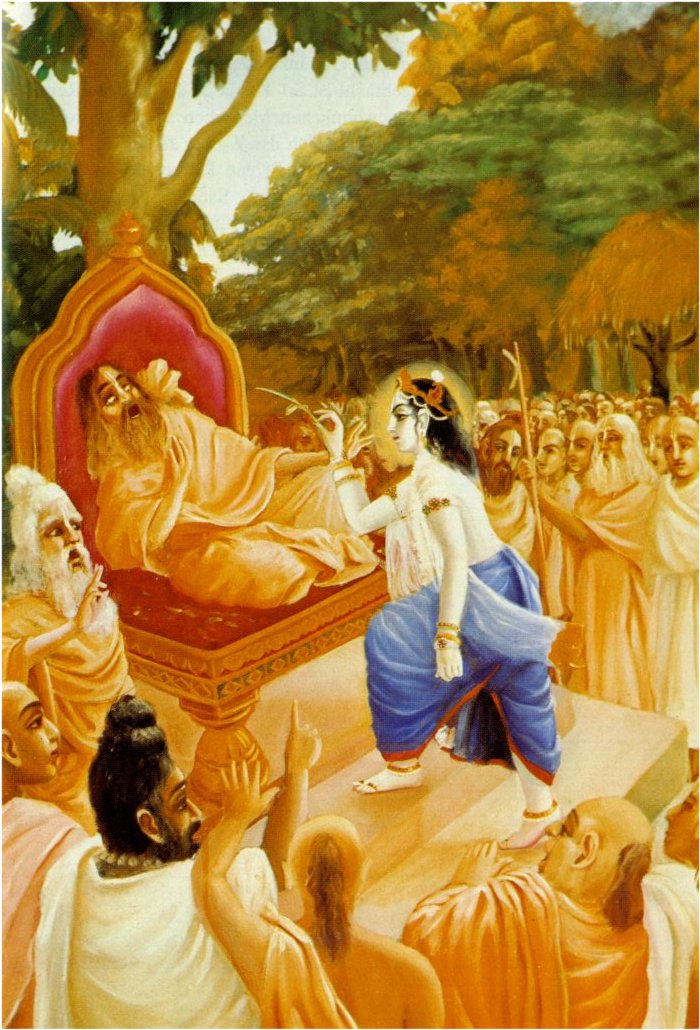
Lord Balarama shows who's boss !
/images/graemlins/cool.gif
-
Finding A Qualified Guru: The Search Within
BY SWAMI B.V. TRIPURARI
EDITORIAL, Jan 16, 1999 (VNN)
Should we look for anything less than the most qualified person when we look for our spiritual guide? Certainly not. The difficulty, however, arises when we look at our own self. It is said that "it takes one to know one." What is the aspiring disciple's capacity to recognize a qualified devotee? This must be considered.
The scripture gives us general observable criterion, that of 'brahma-bhuta' or 'brahma-nishtham', which consists of joyfulness (prasannatma), absence of hankering and lamentation (na socati na kanksati), and equal vision (samah sarvesu bhutesu). This speaks not of the highest qualifications, but of those that amount to a transcendental passport, while the visa is yet to come (visate tad anantaram.) Yet even these symptoms are not always observable.
One of Srila Prabhupada's disciples once asked if she could paint a picture of Srila Prabhupada. He agreed and gave her a photo of himself, one in which he appeared very grave. After some time, Srila Prabhupada asked her about the painting and she replied that she had not proceeded because in the photo Prabhupada looked sad. "Sad?" he replied, "That was a moment of ecstasy."
Surely he was joyful (prasannatma, more rasananda), but this kind of joy requires philosophical, if not spiritual, eyes to see. What then to speak of observable evidence of any higher attainment? 'Atah srikrsna-namadi na bhaved grahyam indriyaih', as one cannot see Krishna with material senses, so one cannot understand a 'mahabhagavata' in the highest sense of the term without having considerable spiritual attainment oneself. Again, it takes one to know one. A person who has conclusive evidence as to the spiritual attainment of his guru, is indeed qualified himself to do the work of guru. We bow down to him.
Once Srila Sridhara Maharaja spoke of three types of guru. The first type has two feet in the spiritual world. The second has one foot here and one foot there. The third has two feet here but both eyes always there. A scriptural reference in support of this notion appears in Sri Jiva Goswami's Bhakti-sandarbha. Jiva Goswami describes three types of mahabhagavatas.
The first, 'bhagavat-parsada-deha-prapt', is situated in the spiritual world in his spiritual form while appearing in the material world. Narada Muni after he received his siddha deha is an example of this kind of mahabhagavata. Such souls are very rare, 'sudurlabha bhagavata hi loke'. The second, 'nirdhuta-kasaya', does not have material conditioning but has not yet realized his siddha-deha. Sukadeva Goswami is an example of this kind of mahabhagavata. The third, 'murcchita-kasaya', is still under the dim influence of the sattva-guna, yet has the Lord as his only goal in life. Such devotees still have desire and samskaras (material impressions) in their hearts, yet due to the force of their devotion, these impurities are supressed. Narada Muni, before receiving his siddha deha, is an example of this kind of mahabhagavata. He had a mystic darsana of Sri Krishna, only to have the Lord disappear and tell him that he would not have his darsana again until he was completely pure.
Jiva Goswami's explanation is supported in a general sense by the Bhagavad Gita. In 2.59, Arjuna asks about the charateristics of a realized soul (sthita prajna). Krishna proceeds to answer Arjuna, describing a gradation of sthita prajna. This explanation applies to both those in the jnana marg and those of the bhakti marg.
>From Jiva Goswmai's explanation we can also understand Srila Prabhupada's apparently contradictory statements about the qualities of a mahabhagavata found throughout his books. At one time he speaks of the first type, at another of the second, or third. Which shall we choose? Which will we be able to recognize, when furthermore, if they are preaching, they will be functioning as madhyama-adhikaris?
Over lifetimes we have acquired sukrti, 'bhakty-unmukhi sukrti'. Proportionate to our sukrti, we are qualified to connect with the transcendental realm and its ambassadors. Qualification of guru is an important consideration, yet no less important is the qualification of the disciple. The absolute truth is not in shortage of qualified representatives. It is we who must qualify ourselves to recognize them, and this requires all of the sincerity we can gather. And this, our sincerity, truthfulness, is all we have.
As like attracts like, our sincerity in connection with our sukrti will attract a representative of Godhead. Our sincerity may be great, and our sukrti small. This also must be considered. One may drive a Cadillac, another a Volkswagen. The driver of the Volkswagen may press the accelerator to the floor, giving all his sincerity, while the driver of the Cadillac may be stepping on the brake. One may have more sukrti than another; the other may be exercising greater sincerity. In this way there is much to consider. It is not black and white. Yet surely our sincerity will not fail us, for it will bring us closer to the Lord, albeit sometimes in a roundabout way. And we are not to argue with that. It is his will about which we are inquiring.
Sometimes in the name of generating faith, we affect the opposite. Comprehensive knowledge of scripture is necessary. Anyone can quote scripture to support his point of view, but few approach the scripture to have their views altered, what to speak of realizing the scripture's purport. Those who lack faith in others, often pass on only doubts rather than faith in the name of preaching about the qualifications of guru. If you yourself doubt that there is anyone advanced enough to do the work of guru, how can you preach to others? This is the logic of Srila Prabhupada. He would say, "Just see the foolishness in this. By thinking there are no advanced devotees one can hear from, one inadvertently proclaims oneself to be the most advanced."
This is the typical thinking of the kanistha-adhikari. He passes his doubt on to others. They, in turn, imbibe that consciousness and go out to scrutinize all prospective gurus, thinking, "I must have the most qualified guru." Often the unconscious underlying mentality of this search is "because I am so qualified." With this mentality, we will never find a qualified guru. A mahabhagavata we should search out, no doubt. But the search must begin within ourselves.
-
Is Cat Stevens a Terrorist?
Why Yusuf Islam was turned away from the United States.
by Stephen Schwartz
Brought to you by The Weekly Standard
Last week, U.S. authorities diverted a United Airlines London-Washington flight to Bangor, Maine, where the ex-pop singer formerly known as Cat Stevens, now as Yusuf Islam, was questioned by federal security agents, and then ordered deported back to Britain. Yusuf Islam, it turns out, is on the official "no-fly list."
This action will doubtless provoke loud and prolonged guffaws from those who consider American security policies to be excessive. But a look at the career and associations of Yusuf Islam since he became a Muslim in 1977 shows that the decision was correct.
Yusuf Islam is already well known for his public endorsement of the death sentence issued by Ayatollah Khomeini against Salman Rushdie in February 1989. "Salman Rushdie, indeed any writer who abuses the prophet or indeed any prophet under Islamic law, the sentence for that is actually death," he said at the time. In addition, he has been barred from entering Israel because of alleged financial aid given to terrorist groups.
Is the singer a terrorist himself? Probably not. Is he an active sympathizer of terrorist groups? Perhaps not as much as he was in the past.
But Yusuf Islam is most certainly a fundamentalist Muslim, whose views are radical enough to set him at odds with the great majority of the world's Islamic adherents, and they are no better expressed than in his comments on his own field of expression: music.
Wahhabism, the state religion in Saudi Arabia, and the inspirer of al Qaeda, is especially known for its hatred of music. In Wahhabi theology, all music except for drum accompaniment to religious chanting is haram, or forbidden. For anybody who has had contact with Muslim civilization, this is a fairly shocking bit of information, since music is one of the great glories of Islamic culture.
Yusuf Islam has demonstrated his sympathy for this posture on several occasions. Above all, he is careful to point out his caution about bucking the Wahhabis in this realm. In 1997, he released an album titled I Have No Cannons That Roar, dedicated, he said, to the cause of the Bosnian Muslims. In an interview with Stephen Kinzer, appearing in the New York Times on December 8, 1997, he commented on the project, "I've . . . used a very conservative approach. You only hear my own voice, a slight choral accompaniment and drums. Let's say that's the safest option according to certain Islamic schools of thought. I've made minimal use of musical instruments, and in some schools of thought in Islam musical instruments are disapproved of."
This attitude was particularly dissonant given that Bosnian Muslim music is anything but conservative, and Bosnian songs about the recent war used violins, accordions, and numerous other instruments considered haram by radical Islamists. One popular Bosnian soldiers' ballad included a verse declaring devotion to their "old songs," which would be anathema to Wahhabis. But for Yusuf Islam, honoring the Bosnians, who had shed their blood defending their religious identity, was less important than honoring fundamentalism.
The album itself has been advertised in a misleading way by the Islamic Society of North America (ISNA), part of the "Wahhabi lobby" that imposes Saudi theology on the majority of American Sunni Muslims. The ISNA website falsely describes Yusuf Islam as "the primary composer and lyricist" of the album. Actually, he wrote only two of the songs. Most of the rest were composed by a Bosnian poet, Dzemaludin Latic, who is notably moderate in his views and--full disclosure here--a close friend of mine. When I saw him in Sarajevo a month ago, Dzemo Latic was writing a memorial article for Czeslaw Milosz, something Yusuf Islam would probably never think of doing. And the Bosnian songs on that album employ haram instruments.
Yusuf Islam's own website further reveals his fundamentalist and radical bent. It celebrates his collaboration with a notorious American Islamist, Shaikh Hamza Yusuf [Hanson]. Hamza Yusuf was known before September 11 for his radical preaching. In 1991, Hamza Yusuf "gave a provoking speech about why 'Jihad is the Only Way,'" at an International Islamic Conference held at the University of Southern California by the local unit of the Islamic Circle of North America (ICNA), a front for the al Qaeda-allied Jama'at-i-Islami movement in Pakistan. The same Los Angeles event was addressed by Imam Siraj Wahhaj, an unindicted co-conspirator named in 1995 in a plot to blow up New York City monuments.
At the 21st ICNA Annual Convention, held at Valley Forge, Pennsylvania, in 1996, Imam Hamza Yusuf declared, "I am a citizen of this country not by choice but by birth. I reside in this country not by choice but by conviction in attempting to spread the message of Islam in this country. I became Muslim in part because I did not believe in the false gods of this society whether we call them Jesus or democracy or the Bill of Rights or any other element of this society that is held sacrosanct by the ill-informed peoples that make up this charade of a society. . . . [T]here should be no voting or debate . . . [W]e have no room for ayes or nays."
After September 11, Hamza Yusuf adopted moderate camouflage and boasted of meeting with and "advising" President George W. Bush. However, at this year's convention of the Islamic Society of North America, on September 3, 2004, Hamza Yusuf declaimed, "the Republican party is basing an entire political platform, in the most powerful military nation on the earth . . . on the idea that Islamic fanatics are a threat to the security of this country, and this must be condemned. . . . I have never believed in my lifetime that a presidential election had any significance. . . . We must reject what is happening in the current administration in our name. . . . Those neoconservatives . . . that claim that this country was designed by people that wanted Christianity to be the law of the land . . . are telling a grave lie to the people of the United States." Hamza Yusuf followed up these rantings with fantasies of Islamic conquest of the United States and an endorsement of none other than Patrick J. Buchanan as a defender of "indestructible" Islam.
Those who scoff at the idea that the singer formerly known as Cat Stevens could end up on the U.S. government's "no-fly list" only show how unfamiliar they are with his beliefs and most prominent associations and activities over the last two decades.
-
-
-
My Personal Update
From Bhakti Tirtha Swami
Posted September 28, 2004
Dear Maharaja and Prabhus,
Please accept my humble obeisances. All glories to ISKCON Founder Acharya Srila Prabhupada.
My personal update.
I have completed my first few weeks of intensive treatments in Mexico. They went from 8:30 a.m. to 8:30 p.m. Eight hours each day I was on IV, which administers different solutions through a catheter, which was inserted into my chest.
In about 10 days I will have some tests to have an evaluation about the cancer. Earlier, it had spread to other parts of the body, but hopefully we have now stopped it from advancing and gradually it will be eliminated.
HH Siva Ram Swami said to me, on the telephone, that my situation is like a soap opera. I will say it is more like a roller coaster. (Smile)
Everyday I am trying to access gratitude, however some days it is more difficult than others. The daily uncertainty, whether I will stay or leave, is quite an experience, and on the days when the medicine and treatments bring on their own side effects it can be overwhelming.
When I think of how all of you continue in service to Srila Prabhupada despite so many setbacks and challenges, I get renewed strength and determination to rejoin you at some point in the near future.
I am sure there is a divine arrangement for what I am going through, and one way or another it will end auspiciously, all because of the prayers and blessings of all of the Vaisnavas.
You have all read my Vyasa Puja offering, so you have a better idea of my present mindset. This meditation #35 from my Beggar 1 book is also informative about my mood.
If you do not have time to read it, it is understandable.
Thanks and appreciation from dipika.org to our sponsor and host,
Yours in service to Srila Prabupada,
With love,
BT Swami
I must be ready to make any sacrifice.
Dear Lord Syama, there is nothing too difficult to tolerate when it comes to getting Your direct association. The more You hide Yourself, the more ecstasy there will be when we finally meet.
Dear Lord, being away from You and Your servants is unbearable. The only way I am able to sustain my life is in anticipation of that glorious reunion. I know that once I meet You and Your servants, I will immediately forget the suffering and confusion I have experienced for millions of lifetimes.
Dear Lord Syama, I became a madman thinking about Your association and selfless love. When I reflect on how long lust has kept me imprisoned, I want to immediately give up this body. It is my desire for these bodies that has kept me away from You. Knowing this, how can I remain in one for another day?
Dear Lord Syama, now that I am being reminded about You, I see how irrelevant mundane scholarship is.
Dear Lord Syama, when I think about wealth, I think of the chore of monitoring one's assets. When I am sleeping, unless I can dream of You, I might as well be dead. Any action that does not center itself on You is a waste of time.
Of friendship? Anyone who cannot direct me toYou is not a true friend. When I think of fame, I think how burdensome it is to attract any attention that doesn't focus itself on Your glories.
Conversation that does not deal with the exchanges between You and your servants is like a loud noise ringing in my ears. Reading anything that cannot be used for Your service is a waste of time.
My Dear Lord Syama, afraid of facing another night void of Your association, I try to stretch each day, thinking, "Before This day is over, I will see the lotus feet of the Lord."
Now waking and sleeping are the same, as I am never at rest, for I must search You out, wherever You may be.
My Dear Lord Syama, I will be so persistent in looking for You that Lord Brahma will say, "This soul is more bewildered than I was before I heard the word tapah. Please, Lord, give him Your mercy."
My dear Lord Syama, I will work so hard to see You that Hanuman will shed tears, and coming to You he will beg You, saying, "Please have mercy on this soul."
My dear Lord Syama, I will study so intensely to understand Your workings that Goddess Saraswati will have difficulty supplying the necessary knowledge. As she tries, she will call out, "Lord, have mercy on this poor soul."
My dear Lord Syama, I will pass so many tests, pushing Maya's challenges far away one after another and screaming out for You, that Indra will personally intervene, asking that I be given no more tests. He will plead, "Lord, has mercy on this soul."
My dear Lord, my fixed determination in getting Your association will cause Kapila to discuss such pastimes with His mother. It will cause Sukadeva to pause for a moment in his conversation with Maharaja Pariksit, and say: "Lord, have mercy on this poor wretched soul."
My dear Lord Syama, Rupa Gosvami himself will be so embarrassed to see a fool such as I, devoid of all qualifications, trying to be a renunciate in this hellish age of Kali.
Seeing that impossible situation, he will plead my case, saying, "Lord, have mercy on this poor soul."
My Dear Lord Syama, I will even attract the attention of Prahlada. He will say, "This man has such a low birth, is extremely crude, and has no attraction for the process. He is offensive to the devotees, envious of the sadhus, and does not relish bhajans or kirtans. He has no attraction for the Holy Name, is full of doubts and lust, and is even thinking that he will get direct mercy from the Lord. Oh! Lord! Have pity on this poor soul, for without Your causeless mercy, there is no hope for such a worthless case."
My dear Lord Syama, without aid from Your servants, without a glance of concern from Your devotees, Your sweet association is impossible. There is nothing that can fully qualify us for Your direct attention. Therefore, I stand ready to do whatever is necessary, although I cannot do anything.
I am so pitiful that only if such glorious personalities petition You on my behalf can all my great sins be forgiven. I have no qualifications of my own. All I can do is pray to somehow or other attract one of Your pure servants to plead for me.
I am the beggar that has no hope for Your association, but cannot live another day without it.
© dipika.org September 28, 2004
-
How A Muslim Came To Krsna
BY NARARATNA DAS
EDITORIAL, Sep 27 (VNN) — Hare Krsna Maharajs, Prabhus & Mothers. Please accept my humble obeisences, all glories to Srila Prabhupada.
Some of you know me from Mayapur and what we are doing in the Middle East but for those who don't, I'll give you a brief account of our history.
Yes! All glouries to Srila Prabhupada transendental book distribution & the surrendered souls that distribute them, why?
Well, for 24 years I lived with my strict Muslim family as a desent Muslim in London. Then in 1994, after watching most of my friends and 2 of my brothers become swallowed and trapped by Regular material life (get married, get a house, go to work everyday, come home, watch TV, sleep and then get up to do the same mundane things) I came to my senses and thought this cant be all there is to lifa? There must be something more Although I was quite a happy positive 24 year old adult, I didnt feel satisfied. Something was always missing but what, I asked!! My brothers & I were all brought up as strict Muslims following the principls of Islam. My father would force us study the koran, we would get the belt if we didnt study every night and memorise our verses. As life went by, I started asking questions that were not answered, such as who is Allah, what does He look like, what does he do? and What happens to people who die now, where does the soul go? And if God were fair, Why are souls put into different circumstances at the time of birth which gave rise to a soul living and suffering in Africa while another soul, born to a rich American family lives in complete comfort and safety? I was told I shouldn't ask such questions and to not pursue the answers!
Unfortunaely, this is how most Muslims are brought up, Here are the rules to follow and some little information but don't ask questions that can't be answered! This lack of freedom and encouragement to enquire and question the teachings is what has led to the kind of fanatic Muslims we have today.
(As His Divind grace A.C. Bhaktivedanta swami Prabhupada has stated,Philosophy without Religion is speculation and Religion without the philosophy becomes fanaticism.) Not that Islam doesn't have philosophy because it does but the way it is being used and presented today is the problem. Fortunately for me, Krsna arranged that I wasnt complete happy. By the time I was 24, Krsna gave me the courage, faith and push to stop everthing and leave London on a planned two year trip that would take me in a caravan from London through Europe, Eastern Europe, Turkey, Iran, Pakistan and finally to India. My inspiration was this was the only way I could satisfy myself, to learn as much as I could from other cultures and become a better person. That final leaving day came, as I surrounded by heart broken weeping family members and friends, one of my brothers gave me a book. He said that a friend had given it to him as a birthday gift but had been too busy to read it or even look at it. I put it in my caravan and slowly drove away. I can honestly say That this was the most painful time of my life, I was 24 yet I cried as I drove to the coast for the next 3 hours and my so called heart was in london for the next 2 months! It was so hard to leave things behind (even for just two years)and focus knowing that ` wouldn't see them for a long two years. Inspite of this, I held on to the thought that if I really wanted to become a better person, there was no other way! Six months later I found myself in Turkey getting back into studying the Koran because unlike the Muslims I had known in London who taught one thing but practiced something different,the Turks seemed to apply the teachings of the Koran into there daily life a bit more. But Again as I read and asked questions I came up against the same frusrations, a lack of satisfying information for my queries. I put the Koran back onto my book shelf and feeling dejected I went through my book shelf hoping there was something to enthuse my soul. Suddenly a book jumped out at me. I didn't recognise it, it was the book that my brother had given to me as I was leaving London. It had a beautiful picture of a blue celesial person with 4 arms and the name of the book was just the title to excite me THE SCIENCE OF SELF REALISATION, wounderful title! I couldn't put it down until I had finished it all. As Ralph Waldo Emerson said I owed a magnificent day to the Bhagavad Gita. It was as if an empire spoke to us, nothing small or unworthy, but large, serene, consistent, the voice of an old intelligence which in another age and climate had pondered and thus disposed of the same questions which exercise us now. His divine Grace A.C. Bhaktivedanta swami Prabhupada answered all my questions and gave me alot more in such clear and easy to understand English, just perfect! For me a big hole in my life had just been filled and I felt alittle strange, pain from having my false ego exposed and cut by the sword of knowledge but happy to finally get the truth!
Now at least philosophically I knew we were all souls and there was a Supreme soul Known as Krsna or Visnu and we all had an eternal relationship With Him in the spiritual world as well as here in this world of temporary life. Infact right there in Turkey I started to apply this. I was alone in my caravan and my friend, his wife and son were in another caravan. I would wake up early to do some exercises, feeling alone I would imagine youthful Krsna jogging along side me and racing with him. I would go to disco clubs and as the song would sing about a boy's love for a girl or girl's love for a boy, I simply converted so that the song was about Krsna. Is was great! My world was slowing changing so Krsna became the center.
Unlike Muslims (and preachers of other religions) who would tell me that only Muslims would go to heaven, the rest would go to hell, Prabhupada said Doesn't matter what bonafide process of religion you chose to follow, if that process increases your love and attraction to God (krsna), the supreme personality of Godhead, then that process was perfect.
This simple but pure truth was so pleasing to hear, I would hate it and reject whatever when people said this is the only way. Ofcourse, I immediately understood and accepted that this Vedic knowledge gave me what the Koran was giving me and the bonus of alot more confidentail (higher) information about God and as Prabhupada again so innocently says how could you or anyone love God if you know nothing or very little about Him, so more detail information was essential and natural just like in any other relationship.
I looked for a Krsna conscious temple or some kind of center but nothing exsisted here in Turkey. I was hungry for more information and practical tips on how to perform bhakti-yoga in daily life. Just before I left Turkey the same brother who had given me the book visited me here and all I could talk about was this vedic information and how it had completely changed my out look on life, from a selfish materialist to a thoughtful understanding human willing to live with, work with and love all species of life as members of my own family. My brother appriciated the concept but said that unless everyone changed at the same time it wouldn't work. So why bother! I simply answered that the change must start with the man in the mirror! To my great surprise two weeks later I received a parcel from him. Eventhough he thought vedic teachings were somewhat different from Islam still he had gone to the temple, bought and sent me the Jewel of all Eastern philosophy The Bhagavad Gita. I still don't think he knows how much I appriciated this because I knew he didn't like the Bhagavad Gita (thinking it was some Indian book for Indians) but he sent it because I liked it. I don't know if you can understand, but this was a Muslim buying something for another Muslim that (in his eyes) could possibily lead him (me) astray.
I was eating the Bhagavad Gita night and day.
From the transendental pages of the Bhagavad Gita I learnt about my real identity, nature around me, why we all exsist, how we are interconnected and ofcourse how to attain full freedom by self realisation. And for me this was the answer to all our worldly problems, this was the information that everyone needed to hear and know to gain real internal peace and happiness. I knew with this information the world could really be a happy place with everyone living and working in harmony. Later on I would accept this as my duty to humanity.
As a result of this I became a strict vegeterian (actually only eating food that was first offered to Krsna), I started chanting the Hare Krsna Maha Mantra and following the four regulative principles given to bring one to the human platform of life.
1, No intoxications
2, No eating Meat (incl chicken, fish and eggs)
3, No sex outside of marriage
4, No gambling
I was so happy and stress free. Really! I was singing the Hare Krsna mantra in the rain, at work, everywhere! People were asking me what is this song and how come I was so happy and full of positivity so I would explain it to them and some would try to sing the mantra with me.
On observing Turkish people and how nice and openly friendly they were to everyone I remember saying there should definately be a Krsna conscious temple or some kind of center here, that would be great!! Yes, just a dream? ( a dream that Krsna would later manifest? Lets see?) There was no such center in Turkey, neither was anything listed in Iran or pakistan.I had to patiently drive and wait until I got to India to meet devotees who practiced this bhakti-yoga way of life.
I drove to Vrindavan and upon hearing the hare Krsna Maha mantra being sung so sweatly at night and seeing all the devotees sparkle and dance in ecstacy, I knew this was the life for me. and joined the Hare Krsna Movement there but after 4 days I was advised that Mayapur would suit me better as it was the center of learning. The night I arrived in Mayapur I was introduced to Jananivas and pankajangri prabhus because they came from london too. The next morning I took a bath in mother ganga but on trying to get into my van ` suddenly realised that ` had swum with the keys to the van in my pocket and now they had gone! Devotees joked that Caitanya Mahaprabhu didnt want to leave me with a way to escape so ofcourse I joined the bhakta training program for 3 months and on completion I then immediately joined the interfaith communications program. This project attracted me because I had read and seen so many poeple and organisations try to use knowledge and religion to create distinctions for the purpose of segregating people but these devotees had the aim of bringing all people and their religions together under one flag through the spiritual scientific analysis and understanding of Science, Philosophy and Religion.
After being there for one year receiving futher education and learning how to practically apply this philosophy in my own life, I was happily shocked and amazed when the head of this dept said ok, you are ready to start helping others and we think you should go and start sharing this knowledge with others. And which place did they think I should go to? Yes! Turkey.
This was like sweet music to my ears. Although everyone that I spoke to told me I should NOT go because I was relatively new and Muslim people specially in Muslim countries were heavy, no place for a new devotee! Fortunately, Krsna gave me such a clear feeling that this was what he wanted me to do as my service to Him. It was very clear to me that He had prepared me for this so I didn't feel scared at all. I knew He was behind me and infront of me.
So, after praying intensely to all the presiding deities in Mayapur,SRI SRI RADHA-MADHAVA / LORD NARASIMHADEVA and THE PANCA TATTVA and asking all the devotees to give us their blessings, we set of for Turkey in 1996.
The plan was to slowly expose ourselves to this new enviroment in stages.
We would go for 3 months first then return for 6 months then go for 6 months and return for 6 months. Our stay in Mayapur didn't lose it's focus on our objectives. We continued to study, research and compile books aimed at bringing people of all religions together. We wrote five books specially connected with Krsna Consciouness and Islam.
1,SRILA PRABHUPADA ON ISLAM( everything His Divine Grace A.C. Prabhupada ever said about Islam)
2,BHAKTI YOGA and ISLAM (questions and answers encountered in the field by Srila Prabhupada & devotees sharing Krsna Consciousness with Muslims in Muslim countries)
3,THE HIDDEN TREASURE OF AL-QURAN. (the HOLY QURAN as explained by CAITANYA MAHAPRABHU)
4,COMPARATIVE COSMOLOGY. (a comparative study of Modern science, the QURAN, the BIBLE and VEDIC KNOWLEDGE) 5,ENLIGHTENMENT OF CHAND KAZI. (the teachings of Caitanya Mahaprabhu to the Muslim leader Chand Kazi)
6,KRSNA CONSCIOUNESS & ISLAM. A newly produced 20 hour double CD presentation about KC & Islam.
The books are designed to help Krishna-conscious devotees present a Vedic viewpoint to members of the Muslim community in a non-argumentative way, as well as to encourage Muslim readers to deepen and strengthen their efforts at God-realisation. Our goal is to build a strong foundation of mutual understanding so that everyone's love and devotion towards the Supreme Lord whom we call Krsna and whom Muslims call Allah -- can be ignited and cultivated favourably.
So, you can see we were very serious and commited to this goal as a life times mission.
The first 3 month period in Turkey was both wonderful and very very difficult. Wounderful because we were experiencing a closeness to Krsna that I hadn't experienced even in Mayapur. Our prayers were intense specially to Lord Nrishimhadeva because we were alone in a Muslim country, no temple, no devotees, no kirtans, no Indian community and no support! Just the two of us! We could clearly feel and see how Krsna was behind everything that happened to us. For example, We had practically no money and we expected to be sleeping on the beach but Krsna arranged that someone offered us their cafe floor to sleep on after it closed at 10pm.
Then someone offered us a half complete flat to stay in, no windows or doors but there was water and a roof which was better that nothing! Then for 3 weeks I suffered form Malaria, I really thought I might leave my body. During the day I would ok and would go around looking for a job then come 4pm the hellish region would desend on me and all night I would struggle with a burning body, the amazing thing was each time I would come back to an awaken state ` found my self chanting hare Krsna so I really wasnt scared of dying but luckily again Krsna was there to finally arrange some free treatment, they took care of me in hospital for 2 weeks something that would have cost us thousands we got for free. Slowly we got to know the people but we couldn't really find anyone who was interested in spirituality. Language was one big barrier we would have to overcome and the area we were in was made up of mostly conservative Muslims. Nevertheless, we had expected things to be like this so had planned that the first stage of our service would be to simply get to know the enviroment and the people.
The second and third time around we planned to stay for 6 and then 9 months, each time continuing where we had previously left off .
As we moved around and stayed in different areas we got to know the people more and more and how things worked here, we got jobs that allowed us to really mingle and become like normal people (from this angle we hoped we could better understand the poeple's problems and how best to help them. This gave us the time and experience to really see and feel how people reacted to our exsistence and our presentations. We came to realise a very important point, these Muslim people were very very nice helpful and welcoming but if you push the wrong buttons and touch some sensative areas in thr wrong way, specially topics connected with their religious sentiments then your so called friendly friend could change into an erupting volcano in seconds. So be careful out there when you are dealing with Muslims dont judge the book by the cover. Actually, an any area, make a commitment, be patient & get to know your field before you farm it.
Prabhupada often compares us to docters and what we have to give as the all liberating medicine so a good doctor studies his patient first then prescribes the right medicine in the right dose.
I always remmember being told in Mayapur by our leader that for this service we had to give up the conditioning and identity that we were preachers and just see ourselves as normal people living among others because Muslims are really really sensative about poeple trying to change them and they can sense it immediately. People should see and really feel that we are simply living our personal life styles and who ever is interested in what we do, we are happy to share this spiritual culture with them. What they do with that info afterwards must be left to them. As Krsna says in the Bhagavad Gita ( 18.63 ) to Arjuna
Thus I have explained to you Knowledge still more confidential.Deliberate on this fully, and then do what you wish to do.
After our 9 month stay, we had to make an huge decision. In Mayapur our same team ran two departments: The interfaith communications dept and the Bhaktivedanta Research Institue which had produced 12 books for the education of both devotees in The Hare Krsna Movement and the general mass of people. Unfortunately the time had come where we could no longer be in two places for parts of the year, India and Turkey.
Turkey needed us to be there all year round. We knew that for this project to develop nicely, we had to be there full time and there was no one else who would do it so in 1999 we left our merciful base Mayapur and headed for full time Turkey.
This moved us into stage two of our plan. We found and started to rent a flat of our own where we soon held Sunday programmes and the reading of The transendental, all liberating, Bhagavad Gita.
We started to teach people about The Vedic culture way of life, mantra meditation, vegeterian cooking and playing traditional devotional music. All aimed at the liberation of the soul, giving him entrance into the spiritual realm. We are endeavoring to continue to do tha same.
One of the main problems we have faced is the small numbers of people that have come to our programme when you compare that to the 19 million people that live in this city. We have no choice other than to slowly get to know people and see if they themselves are intersted in what we have to offer, slowly cultivating that interest and then if it's safe (as in they won't call the police upon seeing or hearing something they don't like in our flat) we extended an invitation to our flat to learn more about the benifits of meditation and self realisation. Fortunately, we have never had any complaints from anyone, even our neigbours don't mind the singing on Sunday. We have always focused on developing good friendly relationships with everyone. After all we want to give this oppertunity to everyone. Once, we even had concerned parents of one boy come to see what there son was getting into, but when they came they really liked what they heard, the teachings of Bhagavad Gita ( we aren't body, we are soul, as such we are all related as brothers and sisters with one Supreme father, so try to give up using and abusing each other and try to help eachother come to the point of real understanding, real peace, real love, only to be experienced through full self realisation which this Vedic knowledge is teaching).
You can imagine how much time & energy this takes with each person, plus the fact that we have to work at the same time in order to be able to maintain eveything financially, not easy!
Since personally coming here in 1996, we have spent the first 3 years part time moving around this city and then another 3 years based in one flat (temple) and then last year we moved to the flat we are in now. During this time we have got to know the people, the country, the culture, the police and how they all work and interact better, we now feel confident that more people are interested and will come to learn more about Vedic culture, yoga, mantra meditation, vegetariansm and eventually bhakti yoga if given the chance. We have always faced two problems, TIME & MONEY.
To generate money to finance things we have to scarifice time doing jobs and spending time with people that are not interested in spiritual life.
Remember, this isnt England where you can get donations from the locals to help, these are Muslim people in a Muslim country. This means only a small amount of out potential time is really spent with people personally helping them. At present I pay 600 dollars per month for our flat and definately we will be here for a long time. From 1998 I've helped support other iskcon projects as well as this project by selling my small flat in London. Now I dont have any bulk money left. I just depend on what I earn monthly to run everything here. As taught by srila Prabhupada, we are always trying to be self dependent and not hassle others but in this case, I really do desprately need your assistance. We now have a strong desire to buy the flat we are currently in or one similar in a similar location.
I really dislike it when it seems like we are wasting Krsna's money thus I feel alittle frustrated because I dont have the money to buy this place but are giving 600 dollars a month to the bin! Please help me stop wasting Krsna's money and purchase our own place for two big reasons.
1, As renters we can be kicked out anytime if someone doesnt like us for any reason whcih is a daily possibility and will become more likely if more poeple come. In real life here, a renter has no rights. On the otherhand we will have full rights to do what we want as long as it is within the confines of our flat if we own it. Ofcourse we will not be desrespectful or thoughtless. As prabhupada says, We must always be respectful and courtious even to our enimies, so if we want to invest our time and energy here to develop a spiritual oasis where people can come and revitalise themselves, owning our own property is a must.
2, Ofcourse we will save alot of money. Instead of paying 7,200 dollars per year for the next 20 years and get nothing, we can pay a simillar amount and within 20 years we will have our own building. No more rent!! Radha-istanbulisvara will have there own place and devotees wont have to worry about paying the rent. They can fully focus on the real work, rescuing souls from the clutches of this temporary material energy and setting them free.
So many of the younger generation are interested in learning about spiritual life but are afraid to come and ask because of socail pressure from the older more conservative Muslims but finally under pressure from the youth of today and the European union spiritual or religous organisations will be given the rights and freedom to practise. This will take EVEN MORE TIME to actually manifest in peoples attitudes but the green light is definately coming in the future.
So when that clear green light comes this center will be ready to transform into a fully fledged legal Hare Krsna center operating directly as Srila Prabhupada wanted, giving everyone the chance to experience the alternative to the struggle and stress of the imbalanced material life that is currently on offer to the frustrated soul. Openly, freely and directly educating people in all aspects of spirirtual life and how to directly apply such knowledge in daily life so that each and every indivdual can become a happy person and from a happier person we get a happier family, a happier city, a happier nation and eventually a happier world for everyone. Please Please feel our sincerity, see our commitment and understand krsna is pleased by any service you do but this service really does have a special place in Prabhupada's heart. As he himself said those who preach to Muslims, I take the dust from their lotus feet You can just read this as any other pamphlet, walk away and nothing will happen but I'm personally begging you not to do that. Please decide right now what you can do to help and contact us at visnupada@hotmail.com or harekrishnaturkey@
Here are some of my suggestions (we need 120 thousand dollars): 1, We only need 120 devotees (individually or collectively) to donate 1,000 dollars each.
2, Devotees can loan us 1,000 dollars each and specify howlong they could give it to us for so those who need it back the quickest will be paid back first.
I am personaly willing and able to pay back 600 dollars per month to anyone that loans us any money or arranges a loan for us.
3, Someone can secure us a 120 thousand dollar (morgage) loan for which the place can be registered in their name as security and I will pay back 600 dollars per month (if we dont buy a place I will have to pay 600 dollars per month as rent anyway so I can do this)
Please impower us to give them such a nice revitalising experience that they will be inspired to look deeper into the subject of real health, the needs of the soul. As Srila Prabhupada has said we are concerned to have conviction as opposed to conversion.
We are trying to inpire devotees to take advantage of the most auspicious day on which to give your donation Radhastani 22nd of sept, Wednesday, fasting till noon. So here are our bank details:
For dollars:
NAME: HSBC
BRANCH: BAKIRKOY
ADDRESS: BAKIRKOY CARSI HALKCI SOK. NO:8
BAKIRKOY-ISTANBUL
SWIFT CODE: HSBCTRIX
BENEFICIARY: BERNA KARAARSLAN
BENEFICIARY A/C: 814-1019544-770-01 (USD)
*********************************************
For pound sterling:
BANK NAME: GARANTI BANKASI
BRANCH : TOPCULAR
ADDRESS: KISLA CAD. TIKVESLI SK. EMINTAS 3 TOPCULAR SAN.
SIT. NO:1/70-71 34055 TOPCULAR-ISTANBUL-TURKEY
SWIFT CODE: TGBATRIS
BENEFICIARY: BERNA KARAARSLAN
BENEFICIARY A/C: 9094172(sterling)
*********************************************
I would be very encouraged and happy to hear your comments on this or any sugestions you may have to help us achieve this goal that is very pleasing to Srila Prabhupada and the whole Parampara
Hare Krsna. All glouries to Srila Prabhupada.
Ys, Nararatna das.
-
The Holy Name is Everything
by
Srila Gour Govinda Swami Maharaja
ataeva näma mätra vaiñëavera dharma
näme prasphuöita haya rüpa, guëa, karma
Chanting the holy name is the prime religious activity
of a vaiñëava. From the holy name gradually blossom
the Lord’s form, qualities and pastimes.1
kåñëa-näma cintämaëi anädi cinmaya
yei kåñëa, sei näma—eka-tattva haya
Lord Krishna’s name is like an eternal and transcendental
touchstone. Krishna and His name are identical;
They are one and the same absolute truth.2
nämera smaraëa ära näma-sankértana
ei mätra dharma jéva karibe pälana 3
This is the only dharma in Kali-yuga: chanting
the holy name and thinking of the holy name.
Only this. This is the one dharma the jivas in Kaliyuga
should perform. In all the Vedas it has been
said, harinama-sara, the holy name is the essence.
hare nama harer nama harer namaiva kevalam
kalau nasty eva nasty eva nasty eva gatir anyatha
In this age of quarrel and hypocrisy, the only
means of deliverance is the chanting of the Holy
Names of the Lord. There is no other way. There
is no other way. There is no other way.
Päibe paramä préti änanda apära —
by chanting this Holy name of Krishna:
hare kåñëa hare kåñëa, kåñëa kåñëa hare hare
hare räma hare räma, räma räma hare hare
you’ll get extreme pleasure, supreme pleasure.
veda punaù bale,
“yata mukti mahäjana
paravyome sadä kare näma-saàkértana
Again the Vedas say that all the liberated mahäjanas,
always chant Hare Krishna in the spiritual sky.
Yei krsna, sei nama — eka-tattva haya — there is no
difference between the name of Krishna and Krishna
Himself — ‘bhinnatvän näma-näminoù. Cintamani
means desire. Whatever you desire the name will
give you. Krsna-nama cintamani anadi cinmaya — the
holy name is spiritual, transcendental, and without
beginning or end — anadir adir govinda sarva-kara-akaranam.
There is no difference between the name
of Krishna and Krishna Himself, and especially in
Kali yuga ,Krishna has incarnated Himself in the form
of his holy name. No other incarnation is there in
Kali-yuga. He is näma-avatära.
kali-käle näma-rüpe kåñëa-avatära
näma haite haya sarva-jagat-nistära
In this Age of Kali, the holy name of the Lord, the
Hare Krishna mahä-mantra, is the incarnation of
Lord Krishna. Simply by chanting the holy name
one associates with the Lord directly. Anyone who
does this is certainly delivered.
näma vinu kali-käle nähi ära dharma
sarva-mantra-sära näma, ei çästra-marma
In this Age of Kali there is no religious principle
other than the chanting of the holy name, which
is the essence of all Vedic hymns. This is the purport
of all scriptures.
A vaisnava chants only one name. He has only
one dharma, which is hari-näma. If you chant
the holy name without offense — in other words,
the pure name — then the all-beautiful form of
Krishna, the transcendental pastimes of
Krishna, and the attributes of Krishna — everything
will be manifested to you.
Näme prasphuöita haya rüpa, guëa, karma.
The name is everything! The name is everything!
-

/images/graemlins/cool.gif
-
-

Sri Hanumanji is our Hero !
/images/graemlins/cool.gif
-
Anger versus Forgiveness
From The Mahabharata
Addressing Draupadi
King Yudhishthira said: Anger is the slayer of men and is again their protector. Know this, O thou possessed of great wisdom, that anger is the root of all prosperity and all adversity. O thou beautiful one, he that suppresses his anger earns prosperity. That man, again, who always gives way to anger, reaps adversity from his fierce anger. It is seen in this world that anger is the cause of destruction of every creature. How then can one like me indulge his anger, which is so destructive of the world? The angry man commits sin. The angry man kills even his preceptors. The angry man insults even his superiors in harsh words. The man that is angry fails to distinguish between what should be said and what should not.
There is no act that an angry man may not do, no word that an angry man may not utter. From anger a man may slay one that deserves not to be slain, and may worship one that deserves to be slain. The angry man may even send his own soul to the regions of Yama. Beholding all these faults, the wise control their anger, desirous of obtaining high prosperity both in this and the other world. It is for this that they of tranquil souls have banished wrath. How can one like us indulge in it then? O daughter of Draupada, reflecting upon all this, my anger is not excited. One that acts not against a man, whose wrath has been up, rescues himself as also others from great fear. In fact, he may be regarded to be the physician of the two (viz., himself and angry man).
If a weak man persecuted by others, foolishly becomes angry towards men that are mightier than he, he then becomes himself the cause of his own destruction. And in respect of one who thus deliberately throws away his life, there are no regions hereafter to gain. Therefore, O daughter of Draupada, it has been said that a weak man should always suppress his wrath. And the wise man also who though persecuted, suffers not his wrath to be roused, joyeth in the other world, having passed his persecutor over in indifference. It is for this reason has it been said that a wise man, whether strong or weak, should ever forgive his persecutor even when the latter is in the straits. It is for this that the virtuous applaud them that have conquered their wrath. Indeed, it is the opinion of the virtuous that the honest and forgiving man is ever victorious.
Truth is more beneficial than untruth; and gentleness is more beneficial than cruel behaviour. How can one like me, therefore, even for the purpose of slaying Duryodhana, exhibit anger which has so many faults and which the virtuous banish from their souls? They that are regarded by the learned of foresight, as possessed of true force of character, are certainly those who are wrathful in outward show only. Men of learning and of true insight call him to be possessed of force of character who by his wisdom can suppress his risen wrath. O thou of fair hips, the angry man sees not things in their true light. The man that is angry sees not his way, nor respects persons. The angry man kills even those that deserve not to be killed. The man of wrath slays even his preceptors. Therefore, the man possessing force of character should ever banish wrath to a distance. The man that is overwhelmed with wrath acquires not with ease generosity, dignity, courage, skill, and other attributes belonging to real force of character. A man by forsaking anger can exhibit proper energy, whereas, O wise one, it is highly difficult for the angry man to exhibit his energy at the proper time!
The ignorant always regard anger as equivalent to energy. Wrath, however, has been given to man for the destruction of the world. The man, therefore, who wishes to behave properly, must ever forsake anger. Even one who has abandoned the excellent virtues of his own order, it is certain, indulges in wrath. If fools, of mind without light, transgress in every respect, how, O faultless one, can one like me transgress (like them)? If amongst men there were not persons equal unto the earth in forgiveness, there would be no peace among men but continued strife caused by wrath. If the injured return their injuries, if one chastised by his superior were to chastise his superior in return, the consequence would be the destruction of every creature, and sin also would prevail in the world.
If the man who has ill speeches from another, returns those speeches afterwards; If the injured man returns his injuries: if the chastised person chastises in return; if fathers slay sons, sons slay fathers, and if husbands slay wives, and wives slay husbands; then how can birth take place in a world where anger prevails so! For, O thou of handsome face, know that the birth of creatures is due to peace! If the kings also, O Draupadi, gives way to wrath, his subjects soon meet with destruction. Wrath, therefore, has for its consequence the destruction and the distress of the people. And because it is seen that there are in the world men who are forgiving like the Earth, it is therefore that creatures derive their life and prosperity.
O beautiful one, one should forgive under every injury. It has been said that the continuation of species is due to man being forgiving. He, indeed, is a wise and excellent person who has conquered his wrath and shows forgiveness even when insulted, oppressed, and angered by a strong person. The man of power who controls his wrath, has (for his enjoyment) numerous everlasting regions; while he that is angry, is called foolish, and meets with destruction both in this and the other world. The illustrious and forgiving Kashyapa has, in this respect, sung the following verses in honour of men that are forgiving.
"Forgiveness is virtue; forgiveness is sacrifice, forgiveness is the Vedas, forgiveness is the Sruti. He that knows this is capable of forgiving everything. Forgiveness is Brahma; forgiveness is truth; forgiveness is stored ascetic merit; forgiveness protects the ascetic merit of the future; forgiveness is asceticism; forgiveness is holiness; and by forgiveness is it that the universe is held together. Persons that are forgiving attain to the regions obtainable by those that have performed meritorious sacrifices, or those that are well conversant with the Vedas, or those that have high ascetic merit. Those that perform Vedic sacrifices as also those that perform the meritorious rites of religion obtain other regions. Men of forgiveness, however, obtain those much adored regions that are in the world of Brahma. Forgiveness is the might of the mighty; forgiveness is sacrifice; forgiveness is quiet of mind. Can one like us abandon forgiveness, which is such, and in which are established Brahma, and truth, and wisdom and the worlds? The man of wisdom should ever forgive, for when he is capable of forgiving everything, he attains to Brahma. The world belongs to those that are forgiving; the other world is also theirs.
The forgiving acquire honours here, and a state of blessedness hereafter. Those men that ever conquer their wrath by forgiveness, obtain the higher regions. Therefore has it been said that forgiveness is the highest virtue."
Those are the verses sung by Kashyapa in respect of those that are ever forgiving. Having listened, O Draupadi, to these verses in respect of forgiveness, content thyself! Give not way to thy wrath! Our grandsire, the son of Santanu, will worship peace; Krishna, the son of Devaki will worship peace; the preceptor Drona and Vidura called Kshatri will both speak of peace; Kripa and Sanjaya also will preach peace. And Somadatta and Yuyutsu and Drona’s son and our grandsire Vyasa, every one of them speaks always of peace. Ever urged by these towards peace, the King (Dhritarashtra) will, I think, return us our kingdom. If however, he yields to temptation, he will meet with destruction. O lady, a crisis has come in the history of Bharatas for plunging them into calamity!
This has been my certain conclusion from some time before! Suyodhana deserves not the kingdom. Therefore has he been unable to acquire forgiveness. I, however, deserve the sovereignty and therefore is it that forgiveness has taken possession of me. Forgiveness and gentleness are the qualities of the self-possessed. They represent eternal virtue. I shall, therefore, truly adopt those qualities.
_
Forgiveness is a great power
From The Mahabharata
Udyoga Parva
Section XXXIII
Addressing Dhritarashtra
Vidura said: There is one only defect in forgiving persons, and not another; that defect is that people take a forgiving person to be weak. That defect, however, should not be taken into consideration, for forgiveness is a great power. Forgiveness is a virtue of the weak, and an ornament of the strong. Forgiveness subdues (all) in this world; what is there that forgiveness cannot achieve? What can a wicked person do unto him who carries the sabre of forgiveness in his hand? Fire falling on the grassless ground is extinguished of itself. And unforgiving individual defiles himself with many enormities. Righteousness is the one highest good; and forgiveness is the one supreme peace; knowledge is one supreme contentment; and benevolence, one sole happiness.
-
I include here as it is such a nice piece for all to savour and appreciate the Mercy Ship:
Mercy Ship c.1993, mahaksadasa
You came into my life from oh so far,
Riding through my mind in Subhadra's car,
Without a single purpose but to save the world.
Your Song has more power than all the missles they have hurled.
All the holy men came to show the way.
Many people listened to what they had to say.
Some of them insane, some just went to other things,
Not knowing the difference between soldiers and Kings.
They wanted to steal my mind, take away my land,
A trade for a philosophy no one can understand.
They prey on people' greed, take advantage of their fear.
They say anything the people want to hear.
Tricks, treachery, cheap words, and smiling nods,
Are needed to convince the ignorant they are gods.
Crime, poverty, death, gods exposed as fools,
Tossed around like ants into giant whirlpools.
But You did not come to advertize Your name.
You had no pressing needs to strive for selfish fame.
You have what you are given, and to me You bring,
Matchless Gifts, if I would only dance and sing.
You have gone back to Vrndavana, left me all alone,
On these streets of Armageddon, weary to the bone.
Yet You leave Your loving Lifeline, waiting for my grip.
Through these dreadful waters, You guide the Mercy Ship.
-
civilization and transcendence ch. 7
Pusta Krsna: "Just try to learn the truth by approaching a spiritual master. Inquire from him submissively and render service unto him. The self-realized soul can impart knowledge unto you because he has seen the truth." [bhagavad-gétä 4.34]
Srila Prabhupäda: So this is the real guru—one who has seen the truth, just as Arjuna has seen Krsna. Arjuna heard Krsna's instructions and said, "You are the Absolute Truth." Now, if you take the instruction of Arjuna, then you will understand the Absolute Truth. So what is the instruction of Arjuna? Find out in the tenth chapter.
Puñöa Kåñëa:
arjuna uväca
paraà brahma paraà dhäma
pavitraà paramaà bhavän
puruñaà çäçvataà divyam
ädi-devam ajaà vibhum
"Arjuna said, 'You are the Supreme Personality of Godhead, the ultimate abode, the purest, the Absolute Truth. You are the eternal, transcendental, original person, the unborn, the greatest.'" [bhagavad-gétä 10.12]
Srila Prabhupäda: And the Vedänta-sütra says, athäto brahma jijïäsä: "Now, in the human form of life, is the time to inquire into what is the Supreme Brahman." So here in Bhagavad-gétä Arjuna has realized, "O Krsna, You are the Supreme Brahman," So you should make Arjuna your guru and Krsna your guru. Arjuna is the representative of Krsna, the friend of Krsna. The guru is essential. But why go to a bogus guru? You will be cheated. For instance, when you are diseased, for your treatment you need to go to a physician. But you want to go to a real physician, not a cheater who has no knowledge of medical science and misrepresents himself—"I am a physician, an M.D." Then you'll be cheated. The guru is necessary; that's a fact. But go to the real guru. Who is the real guru? The real guru is Krsna or one who has seen Krsna, such as Arjuna.
-
Bhakti is destroyed by the following six kinds of faults:
(1) eating too much or collecting more than necessary,
(2) endeavours which are opposed to bhakti,
(3) useless mundane talks (in the name of bhakti),
(4) failure to adopt essential regulations or fanatical adherence to regulations,
(5) association with persons who are opposed to bhakti,
(6) greed or the restlessness of the mind to adopt worthless opinions.
-
Do you have that quality of character to speak the truth ?
by Srila Bhaktisiddhanta Thakura Prabhupada
A chanter of the kirtana of Hari is necessarily the uncompromising enemy of worldliness and hypocrisy. As a chanter of the kirtana of Hari, it is his constant function to dispel all misconceptions by the preaching of the truth in a most unambiguous form, without any influence of person, place or time. That form has to be adopted which is least likely to be misunderstood. It is his bounden duty to op-pose any person who tries to deceive and harm himself or other people by misrepresent-ing the truth either due to malice or genuine misunderstanding. This will be possible if the chanter of kirtana is always prepared to submit to be trodden on by thoughtless people if any discomfort to himself will enable him to do good to his persecutors by chanting the truth in the most unambiguous manner. If he is unwilling to chant the kirtana under all cir-cumstances due to consideration of self-respect or personal discomfort, then he is unfit to be a preacher of the absolute truth. Humil-ity implies perfect submission to the truth and no sympathy for untruth. A person who en-tertains any partiality for untruth is unfit to chant the kirtana of Hari. Any clinging to un-truth is opposed to the principle of humility born of absolute submission to the truth.
-
So we can all see the context more closely.
Thank you
Ask the Swami: Should we really not care about the results of our efforts?
in Spiritual Discussions
Posted
Ask the Swami: Detachment for Overachievers
Should we really not care about the results of our efforts?
Plus: A Vedantic critique of Buddhism
By Swami B.V. Tripurari
In the Bhagavad Gita, Krishna says that we should do our duty but not be attached to the results. In our own duties or studies, it is difficult to see how we could work if we didn't care for the results of our work.
The spirit of this lesson is that there is something more important than the fruit of one's work. According to the Gita, what is ultimately important is not if one wins or loses materially, but how one plays the game. Detachment from the fruit of one's work and dutiful engagement does not involve being unconcerned about the final outcome or being apathetic about achievement in one's field. Detachment is more about identifying with the fact that there is a grand scheme of things. In that scheme, the fruits of one's activities are incidental. Ignorance of this is materially binding because one considers the fruits of one's work, such as home, family, and possessions, to be everything.
The Gita's second chapter advocates attaining mental equilibrium (Bg. 2.38), which is central to the yogic experience. No matter how adept one is in material acquisition, it's of little value if one's mind is not peaceful. Conversely, no matter how little one has materially, with peace of mind one can be happy.
In a culture that respects no truth as absolutely valid, how do we find the emotional fortitude and faith to conquer what Bhagavad-gita (3.37) calls our greatest enemy: lust?
I do not believe that our Western culture has no place for absolute values or truth, nor do I think that a culture that dismisses the notion of absolute truth can speak convincingly on the virtues of lust.
Lust is an expression of dissatisfaction, and pursuing it does not lead to enduring fulfillment. It is a universally accepted principle that lust is undesirable to everyone on some level. Even the lustiest people despise certain manifestations of its excess in their own ranks. On the other hand, most cultured and educated members of society revere a spiritual person perceived as free from lust. Thus one needs to understand the principle that the Bhagavad-gita teaches in its condemnation of lust rather than merely viewing it as an outdated religious law that has no cultural support.
Both Buddhist and Vedanta philosophies provide good guidelines to clear obstacles, purify oneself, attain enlightenment, and serve others with compassion, but Buddhism seems to go further toward freeing all sentient beings from suffering. Yet you wrote that you see Buddhism as an incomplete path and have compared the nirvana of Buddhism to becoming stone.
I find Buddhism incomplete because Buddhism is a philosophy, whereas Vedanta is both philosophy and theology. Theology refers to study in pursuit of Theos--God. Buddhists believe that there is no God or soul (atman), as these two cannot be validated by reason. Thus Pope John Paul II once described Buddhism as a negative theology. He was correct in the sense that Buddhism is about negation, while misunderstood as having spoken negatively of Buddhism.
Vedanta, on the other hand, assumes there is both God and soul and teaches that they can only be known by revelation. Vedanta reasons that the finite mind cannot capture the infinite through philosophical speculation and that God makes himself known on his own terms. How could it be otherwise?
Even some forms of Buddhism recommend that some type of ritualistic devotion accompany its reasoning. The Vedanta-sutra says that reasoning alone can never be conclusive, tarko 'pratisthanat. According to Vedanta, the path to conclusive knowing is devotion, which in the beginning is supported by reasoning from the revealed scriptures. When devotion is firmly established in the heart, the need for philosophy recedes to the background.
When Buddhists say that there is no direct realization of the self, they mean that they believe that there is no self, no ontological reality known in the language of Vedanta as 'nondual consciousness.' The ideal of Buddhism is to cease from identifying oneself as either something other than matter (nondual consciousness) or a particular combination of matter (body/mind). As Buddhists don't accept spirit or the existence of a conscious energy separate from matter, they are left with only matter, matter in constant flux. Thus the nirvana of Buddhism must be prakrti (material) nirvana, not the brahma (spiritual) nirvana of Vedanta.
Therefore, to the Vedantin it appears that the Buddhist conception of nirvana is to merge into matter, becoming the stone, the tree, the earth, the sky, the entirety of matter in its ongoing transformation, and to transform with matter, never identifying with any particular state of transformation as being separate from the entirety of matter in flux.
In contrast, Vedanta posits that consciousness is eternal and blissful. It recognizes the limits of reason, and thus the necessity of revelation. The mantras of the Upanisads have come to us through revelation. They tell us aham brahmasmi: "I am Brahman (spirit/atman/consciousness)" and tat tvam asi: "So too are you that.That"--consciousness--is something positive, the full realization of which not only ends suffering but also enables one to taste joy itself.
Vedanta says that tasting joy one eventually comes to know that Brahman is rasa, raso vai sah--a relationship of love. This is opposed to the Buddhist conception of relief derived from negating material suffering. So while Buddhism is about the negation of suffering, Vedanta, meaning the conclusion of knowledge, is about neverending love.