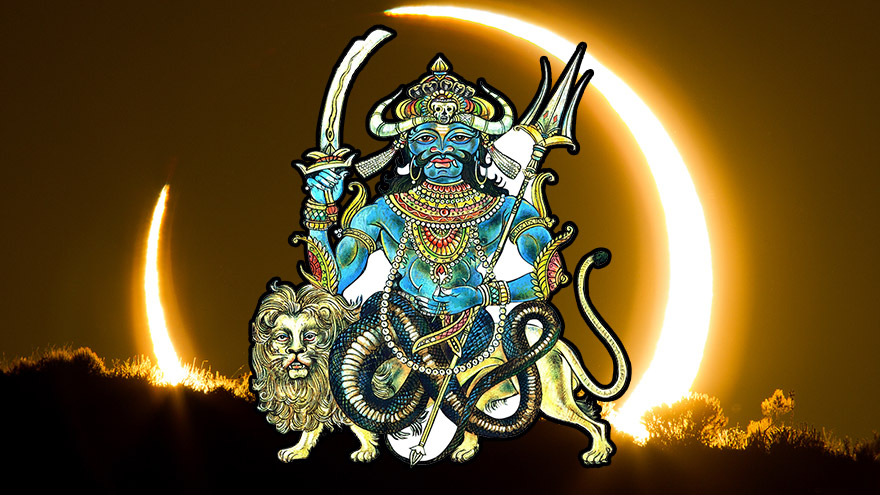
Below are the Charts of 2 eclipses, 224 years apart. The first chart marks the beginning of the Reign of Terror that began during the French Revolution, when idealogue Robespierre assumed power. The second is the chart of the August 8 Eclipse in the United States.
Identical Planetary Placements More Than 200 Years Apart
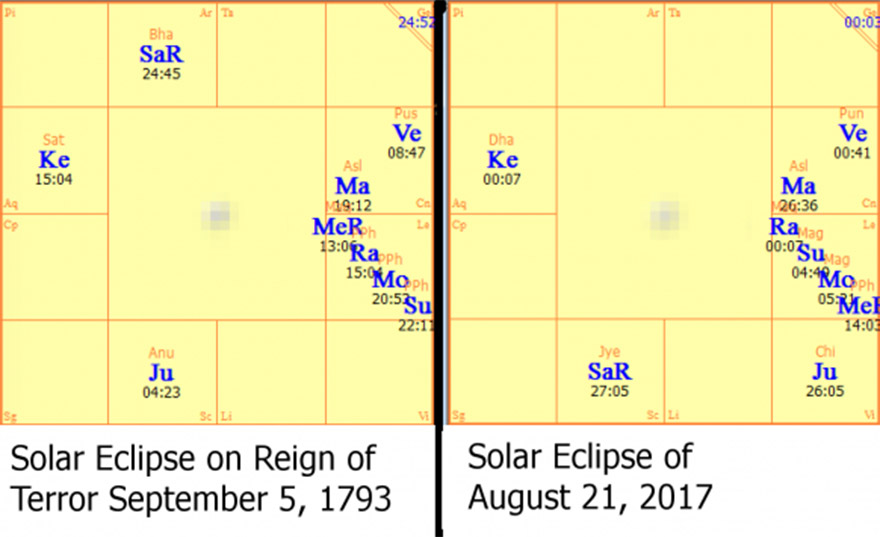
In both dates we see 7 of the nine visible planets in the exact same signs, an occurrence so rare as to boggle the mind. Also, in each example, the shadow of the eclipse path passes within a few hundred miles of each nation’s capitol.
Rahu, sun, moon and retrograde Mercury in Leo. These are both days of the solar eclipse. Eclipse is also very tight, with an orb between four and 7°. This eclipse in Leo shows a counterfeit version of power, which usually trends toward tyranny and domination.
[wp_ad_camp_1]
The common “Mercury retrograde” connection refers to backward thinking, miscommunication, flawed analyses and the lack of discrimination in support of this despotism and violence.
Additionally, we see Mars and Venus, both in cancer. The debilitated Mars shows a lack of discipline and moral integrity (9th house ruler, from Leo). Venus, which shows diplomacy and tolerance is highly compromised by this weakened Mars.
Additionally, prominent/important planets in Scorpio, a sign of paranoia, are ominous – Especially given the aforementioned debilitated Mars. When the ruler is weakened, the lower quality of the sign emerges. Meaning, Scorpio at best is a sign of emotional courage and resolve. When Mars is weakened however, it trends toward paranoia and emotional reaction.
The Eclipse Path of the September 5, 1793 eclipse
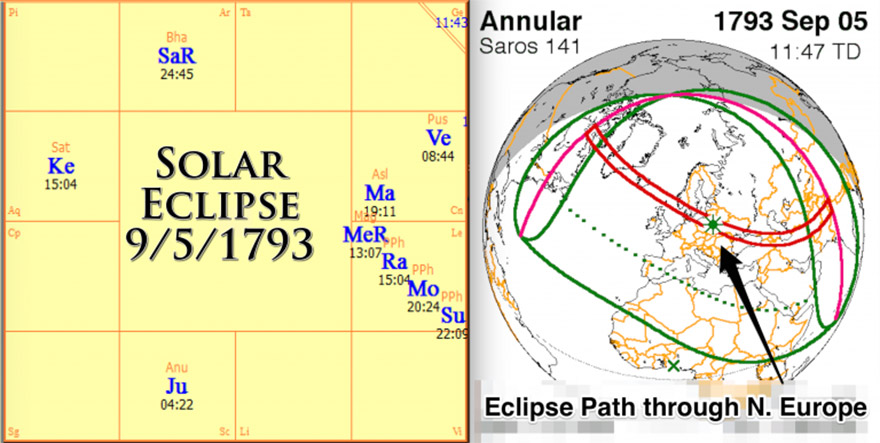
As you can see in this chart, the path of the eclipse passed within a few hundred miles of Paris, the city in question.
The Eclipse Path of the Solar eclipse Path of August 21, 2017
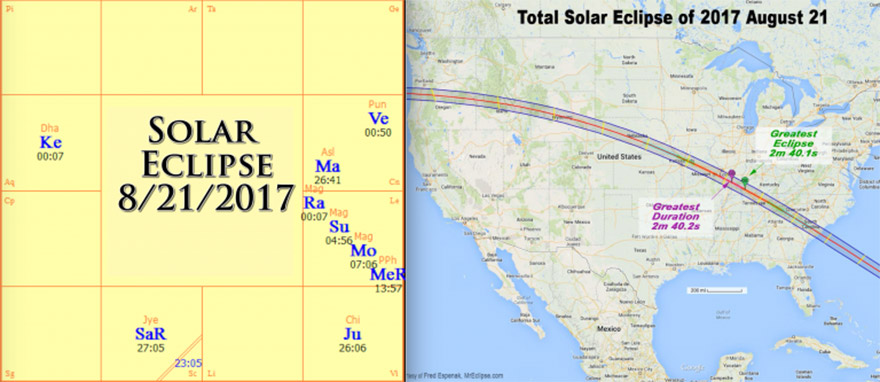
As you can see, the upcoming solar eclipse in August 2017 will pass within a few hundred miles of the US capital, Washington DC.
Chart of the Current President in relation to the August Eclipse Chart
It’s clear to see the connection between the chart of the current president and the 2 eclipse charts. He has a 6° Leo ascendant, with Mars at 3°. The sun will be eclipsed at approximately 5° on August 21, which is right on his ascendant and Mars.

Why the Nodes/Rahu?
Do you remember the story of Rahu and Ketu? Rahu had his head chopped off after being deceived. Rahu is a planet of confusion, deception and trickery. In fact, I discovered the connection to the reign of terror, and the solar eclipse, after a prominent decapitation occurred several years ago on a solar eclipse. This led me to investigate the most notorious rain of decapitations in history, the reign of terror in France. Much to my surprise I learned it both began and ended the days of the solar eclipses.
Why Leo?
Leo Is the sign of the King. The sun being eclipsed by Rahu shows the obsessives and confused expression of power which led to the bloodbath in France more than 200 years ago. This same confused power struggle is looming ominously before us now.
Thoughts / Predictions / Conclusions
We are not 18th Century France, reacting to an entrenched monarchy system. We are a democracy, with many checks and balances in place to hedge against a literal “Reign of Terror”. But we definitely have a potential for harsh, authoritarian power plays and there are provisions in our bylaws that account for things like “Martial Law”, especially if it is to restore “Public Safety”.
We have already seen, not only attempts to silence dissenters (Media, Intel, Justice), but the removal of scientific data and information from official government websites, the installation of Cabinet members hostile to the Agencies they are meant to protect / citizens they are meant to serve, etc. Given the level of mobilized resistance already to these efforts by the current admin, there is no reason to think it will not get worse before it gets better. In the name of “Public Safety” we may see some attempts to over reach – using national guard – for example, or outlawing protests (especially if they get violent which may be coming).
Given the level of mobilized resistance already to these efforts by the current admin, there is no reason to think it will not get worse before it gets better. In the name of “Public Safety” we may see some attempts to over reach – using national guard – for example, or outlawing protests (especially if they get violent which may be coming).
It is my hope that the revolution is against the current regime, that in fact they represent the worn-out aristocracy that began to shift, culturally at least, with Barack Obama. Recognition of mutli-versity and inclusion from the Obama years led to the backlash against it we are seeing – as it was corrupted by the same flawed system of paybacks, elitism and moneyed interests. Those years were seen as a certain Tyrrany by some. Whereas others see this current regime as the real tyrrany.
I am voting for inclusion and openness.
Following the French Revolution (if you set aside Napoleon’s conquest) France settled into a democratic system. There revolution had to be as harsh (in the reverse) as the system / oppression it was replacing in order to find balance.
Source: vedicartandscience.com







I hope you have taken the variation in Julian and Gregorian calendars in this regard.
https://www.timeanddate.com/calendar/julian-gregorian-switch.html
let’s see how predictions come about
Correlation seems to be too weak. If we look at history , the violence and terror – as we know it today- where millions of innocents suffer- started with Battle Of Badr. When Mohd Gori established Islamic empire in India, Hindus started suffering terror. Probably even prior to invasion of Mohd Gori, there were wars and power struggles. But innocents never got killed in a war. Almost 1,200 years, there have been desecration, destruction, looting, demolition of Hindu temples, use of idols as steps in Muslims’ bath rooms (hammams) , change of holy place names to =====BAds, forced conversions, exploitation of human brain to believe that Hindu society segregated and exploited and others didn’t where as segregation and exploitation have been much higher in others. Converted Muslims in India are not admitted to ulema as defined in Quaran. Converted Christians are not treated as equals to white Christians. Dividing and weakening has been going on. LIKEWISE in American continent, almost 600 years ago, there have been massive violence, crimes, usurpation of land, enslavement, deceit, killing using bison poisoning and small pox vaccines and misappropriation of 80% natural resources by 8% Caucasians using slave labour. Nuclear bombing or Mylai massacre or recent precision bombing have all been MORE VIOLENT than French revolution. The latter targeted within a society. Even good royals were guillotined. Very few innocents among common people (other than royals) lost their lives. To me it appears it is just publication of OPINIONs that have no logic or no correlation of data but mere sensational. Suppose Trump triggers third world war with North Korea, the loss of live of innocents would still me minuscule when compared to past 1200 years of ISlamic violencein India. WE CAN’T GLORIFY ISLAMIC VIOLENCE IN INDIA AND CONDEMN MUCH LOWER LEVEL OF OTHER VIOLENCE OUTSIDE INDIA. All we can say is that one UK astronomer threatened local inhabitants of America to surrender vast tracts of land failing which he will cause the SUN disappear knowing teh timing of eclipse and human species was cheated by the members of same species.
Let us see what happens on August 21. Yes, the charts are similar except for Retrograde Saturn
French Democracy is rapidly being compromised by the multicultural elements within parliament. More churches are being used as mosques, and those that no longer have a congregation to support them are being demolished. Should French culture be compromised for the sake of multiculturalism?
Hopefully, your interpretation of the solar eclipse that is projected to happen on August 21, ’17 in the U.S. is nothing more than your subjective narrative based on pseudo-scientific astrological analysis. Correlations can always be inferred after the fact; i.e., French Reign of Terror – U.S. solar eclipse and the current administration. Be careful what you project: it might just manifest if enough people believe in it.
A friend just sent this to me. Good article and I believe your final statement is spot on. That the French revolution, much as our own in America 76, was equal to the oppression. It also appears your assessment is in line with another assessment I recently read, which is actually a warning, from a really fantastic Hebrew scholar. He related the coming August eclipse as being the exact same picture that we see in the story of the prophet Jonah regarding Nineveh. And NOW he just sent everyone a video about how Hawaii is warning people of a military attack and war FORTY DAYS after Aug 21st! 40 days! How can that be a coincidence in all of this? Here is a link to that scholars Nineveh Eclipse article. http://ancienthebrewlearningcenter.blogspot.com/2017/08/aug-21st-great-eclipse-usa-and-nineveh.html
As a general laying out of the stars and their influence your alarming concern is clearly presented. But as regards the internal affairs of the US there has been unlawful behavior from the Executive Branch of government beginning in January 2008. Even prior to this adherence to Constitutional Law was absent many times since 1992. So the stars are not developing their interactions in a vacuum and who represents the “Reign of Terror” may depend upon your political persuasion. Best standard of conduct for human behavior I have found is in Gita Chapters 16 and 17. I suggest using this as a measure when examining the influence of the Solar Eclipse or of any other physical phenomena.
kudo 2 u 4 bringing such a treasure of info, say, knowledge 2 general public at large thru’ this site. excellent, keep it up.
A real eye-opener. Keep an eye on Guam and the Korean crisis. Solstice is just days away. Thank you for your research and insight.